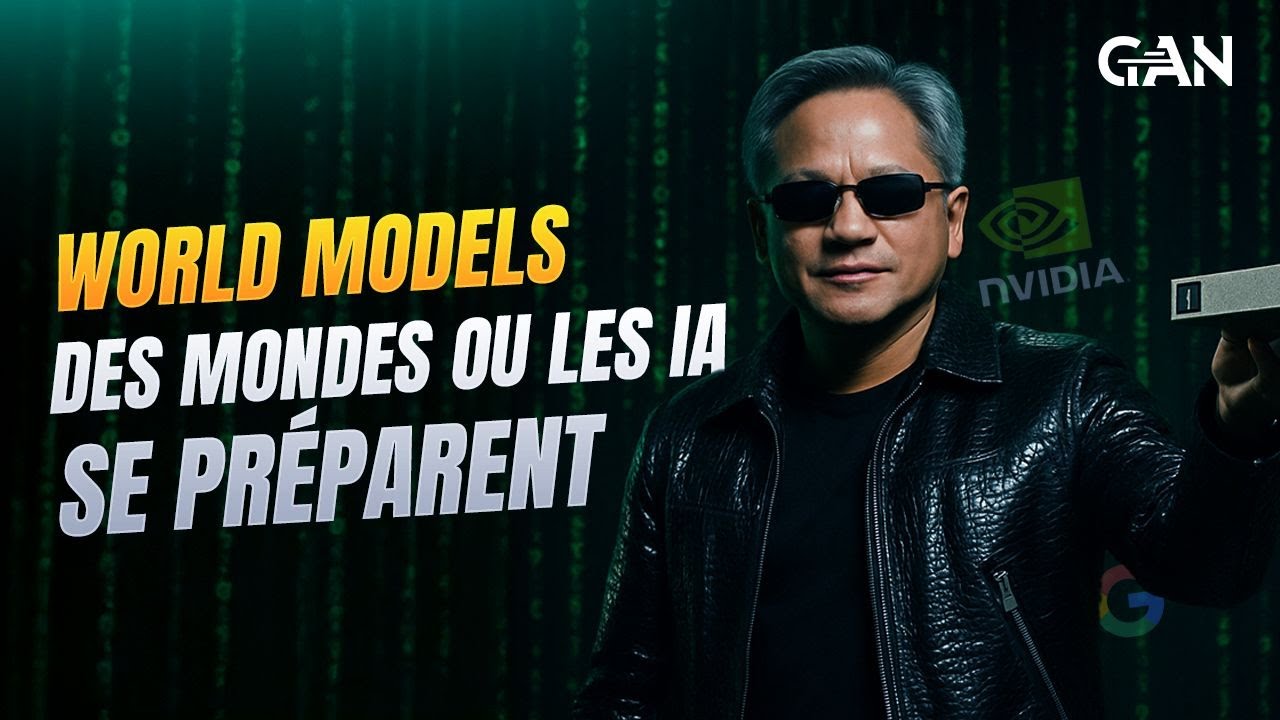
Pourquoi Nvidia mise TOUT sur cette technologie (3 000 milliards $) ? Avec David GURLÉ
Keywords
Summary
183 words
Critical Evaluation
The video provides an insightful expert perspective on the emerging field of World Models and synthetic data, which is highly relevant to current AI developments. David Gurlé brings practical experience from working with synthetic data for defense applications, adding credibility to his claims. The discussion is well-structured, covering key players like Nvidia, Google, and Tesla, and contrasting different approaches. However, the video lacks rigorous scientific depth; it is more of a conversational analysis than a detailed technical review. Specific data points, such as Apple’s $11 million expenditure, are mentioned without sources, which weakens the factual reliability. The argumentation is generally sound, but some claims are speculative, such as the convergence of different approaches. The sources cited are not explicitly mentioned, and the video relies heavily on the expert’s opinion rather than verifiable evidence. The title accurately reflects the content, and the discussion provides valuable insights into the strategic importance of World Models. Overall, the video is informative and thought-provoking, but it would benefit from more concrete data and citations to enhance its scientific rigor.
174 words
Title / Content Match
The title accurately reflects the main topic: Nvidia's bet on world models and synthetic data, with a focus on the $3 trillion valuation context.
Quality & Reliability
6/10
The video features an expert opinion from David Gurlé, who has experience in synthetic data for defense applications. However, the discussion is largely conversational and lacks detailed citations or verifiable data. The claims about Apple's spending and Nvidia's strategy are not backed by specific sources within the video.
Key Moments
Markers derived by PSI from the transcript: the creator did not define chapters.
- Introduction to World Models and their purpose.
- Discussion on the cost of natural data collection, citing Apple's finger detection example.
- Explanation of synthetic data and its necessity for training AI in diverse scenarios.
- Comparison between Nvidia Omniverse and Google Genie 3 approaches.
- Discussion on the Chinese zero-shot learning approach and its implications.
- Analysis of Tesla's advantage in collecting real-world data through its products.
- Exploration of synthetic data for text and human behavior simulation.
- Conclusion on the complementarity of different approaches and future outlook.
Contribution & Novelties
The video offers a unique expert perspective on the strategic importance of World Models and synthetic data, highlighting the economic and practical challenges of natural data collection. It provides a comparative analysis of Nvidia’s Omniverse, Google’s Genie 3, and the Chinese zero-shot approach, and discusses Tesla’s innovative business model of monetizing data collection. The discussion also touches on the potential of synthetic data for simulating human behavior, which is a forward-looking concept.
Pour aller plus loin :
- World Models in AI — Provides a general overview of the concept.
- Nvidia Omniverse — Official page for Nvidia’s simulation platform.
- Google Genie — Blog post about Genie 3.
- Synthetic Data Generation — Overview of synthetic data and its uses.
- Zero-shot learning — Explanation of the zero-shot learning paradigm.
126 words
Radar Profile
The radar profile shows balanced scores across information quantity, quality, technical level, and reliability, indicating a moderately informative and credible discussion, though not deeply technical or heavily sourced.