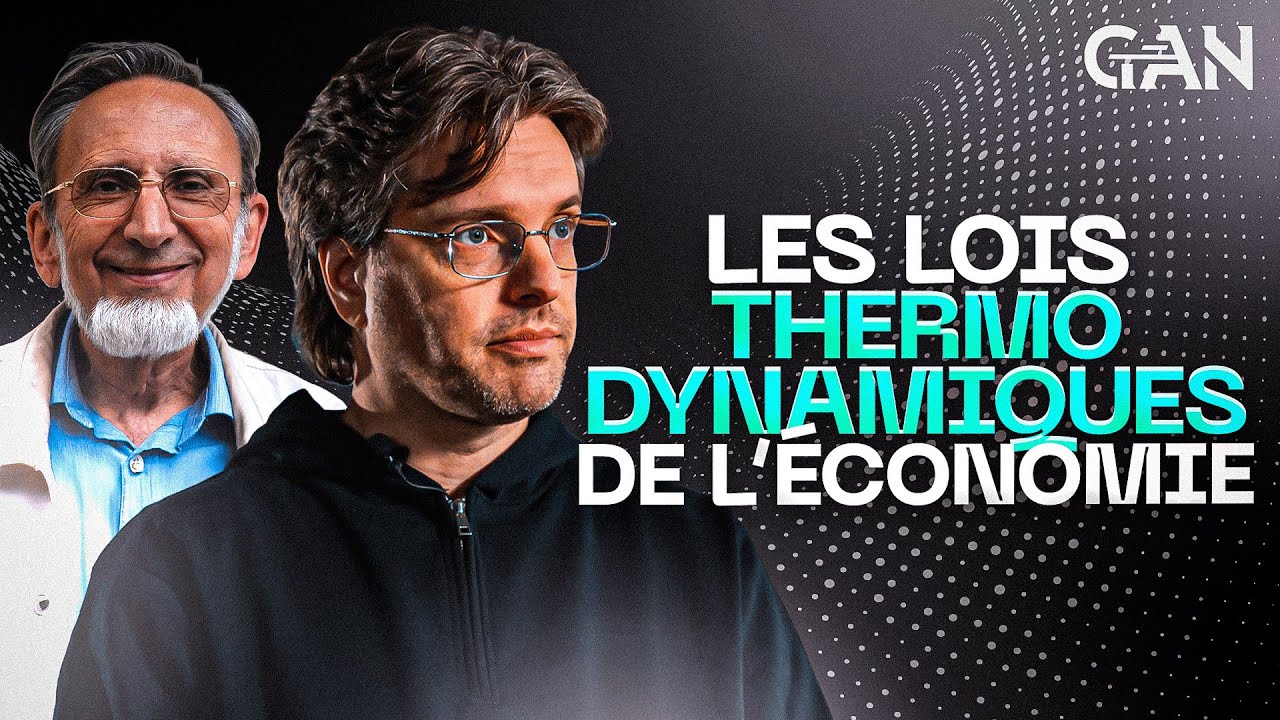
La thermodynamique DEBUNK le mythe de la décroissance heureuse ! Conf expliquée de François RODDIER
Keywords
Summary
123 words
Critical Evaluation
The video provides a valuable and engaging introduction to the application of thermodynamics to economics, a niche but important interdisciplinary field. It correctly explains the fundamental laws of thermodynamics and uses analogies (e.g., boiling water, Bénard cells) to illustrate complex concepts like dissipative structures and criticality. The argument that human societies are dissipative structures that must increase energy dissipation is a compelling framework, supported by the work of Ilya Prigogine and others. However, the video makes several speculative leaps that lack rigorous scientific backing. For instance, it defines intelligence as the capacity to dissipate energy per kilogram, which is a provocative but unproven hypothesis. Similarly, it claims that ‘good’ and ’evil’ can be defined objectively in terms of energy dissipation, which is a philosophical assertion rather than a scientific one. The video also simplifies the economic implications, presenting degrowth as thermodynamically impossible without adequately addressing the nuances of economic systems, such as the distinction between energy consumption and economic value. The sources cited are limited to the original conference and a newsletter signup, with no peer-reviewed references provided. The argumentation is coherent but relies heavily on the authority of François Roddier, whose ideas are not universally accepted. The title accurately reflects the content, and the video does not misrepresent the conference. Overall, the video is intellectually stimulating and provides a good starting point for further exploration, but it should be viewed as a popularized interpretation rather than a rigorous scientific analysis.
241 words
Title / Content Match
The title accurately reflects the content: the video debunks the idea of happy degrowth using thermodynamic arguments, as presented by François Roddier.
Quality & Reliability
7/10
The video presents a clear and accessible explanation of thermodynamic principles applied to economics, based on a conference by François Roddier. It correctly states the laws of thermodynamics and introduces concepts like dissipative structures and information. However, it simplifies complex ideas and makes speculative leaps (e.g., defining intelligence and good/evil in terms of energy dissipation) without rigorous scientific backing. The source is a secondary analysis of a conference, not peer-reviewed research.
Key Moments
Markers derived by PSI from the transcript: the creator did not define chapters.
- Introduction to the video and the conference by François Roddier.
- Definition of economics as the study of the metabolism of human societies.
- Explanation of the three laws of thermodynamics.
- Introduction of dissipative structures and their role in the universe.
- Discussion of criticality and self-organization in dissipative systems.
- Application of thermodynamics to economics and the concept of energy intensity.
- Information as the opposite of entropy and its relation to thermodynamics.
- Money as a representation of free energy in economic systems.
- Why degrowth is thermodynamically impossible according to the video.
- Conclusion: the pursuit of knowledge as the only escape from entropy.
Cited Sources
- Newsletter Grand Angle Invest — Mentioned in the description as a way to subscribe for more content.
- Full conference by François Roddier — The original conference that the video analyzes.
Concurring Sources
- Ilya Prigogine's work on dissipative structures — Prigogine's theories on dissipative structures and self-organization support the video's claims about human societies as dissipative structures.
- The concept of exergy — Exergy is a measure of useful energy, which aligns with the video's discussion of energy dissipation and free energy.
Dissenting Sources
Contribution & Novelties
The video provides a clear and accessible synthesis of François Roddier’s conference, making complex thermodynamic concepts understandable to a broader audience. It highlights the application of thermodynamics to economics, a relatively underexplored field, and introduces the idea that human societies are dissipative structures. The video also offers a provocative definition of intelligence and a quantitative definition of good and evil based on energy dissipation, which, while speculative, stimulate further thought.
Pour aller plus loin :
- Dissipative structures — Wikipedia article on dissipative systems, which are central to the video’s argument.
- Entropy and information — Wikipedia article on information entropy, related to the video’s discussion of information as the opposite of entropy.
- Thermodynamics and economics — Wikipedia article on ecological economics, which explores the relationship between thermodynamics and economic systems.
129 words
Radar Profile
The radar profile shows high scores in quantity of information and technical level, indicating a dense and informative video. The quality of information and reliability are moderate, reflecting the speculative nature of some claims. Overall, the video is intellectually stimulating but should be viewed critically.
💬 Très positif. Sur les 30 commentaires analysés, la grande majorité exprime un enthousiasme marqué pour la vidéo, saluant sa qualité, sa densité et la vulgarisation réussie de concepts complexes. Plusieurs commentaires mentionnent la nécessité de revoir la vidéo pour bien comprendre, ce qui témoigne de sa profondeur.