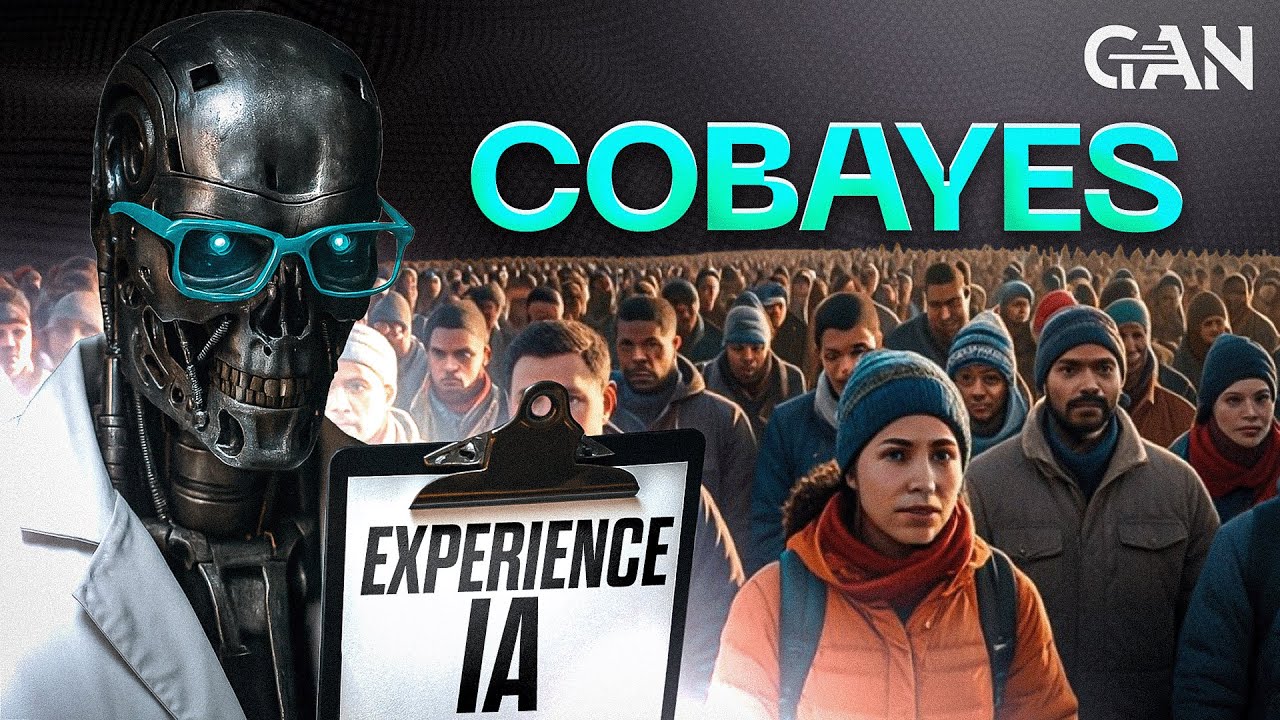
288 humains sont les cobayes d'une IA.
Keywords
Summary
156 words
Critical Evaluation
The video provides a compelling overview of a significant advancement in AI-driven scientific research. It accurately describes the multi-agent architecture and the experimental process, based on the actual paper. The presenter effectively communicates the novelty of the system: its autonomy in hypothesis generation, experimental design, and execution, which challenges traditional research methods. The discussion of the cost and potential for self-sustaining AI research is thought-provoking, though speculative. The video’s strength lies in its clear explanation of complex concepts, making them accessible to a general audience. However, it lacks critical analysis of the paper’s limitations, such as the potential for biases in the AI’s literature review or the generalizability of the findings. The presenter’s enthusiasm sometimes leads to overstatements, like comparing the system to Skynet, which may mislead viewers about the current state of AI. The sources cited are minimal, with only a newsletter link, and the video does not provide direct references to the paper or related studies. The title accurately reflects the content, and the video does not contain any obvious misinformation, but it could benefit from a more balanced perspective on the ethical implications and the robustness of the AI’s conclusions. Overall, it is a valuable introduction to the topic, but viewers should seek the original paper for a rigorous scientific assessment.
214 words
Title / Content Match
The title is catchy and accurately reflects the main topic: an AI conducting experiments on 288 humans.
Quality & Reliability
7/10
The video presents a real scientific paper (arXiv preprint) and explains its methodology and results accurately, but includes speculative extrapolations and pop-culture analogies that reduce its scientific rigor.
Key Moments
Markers derived by PSI from the transcript: the creator did not define chapters.
- Introduction: AI conducting experiments on 288 humans.
- Presentation of the arXiv paper and the multi-agent system.
- Explanation of the six types of AI agents.
- Discussion of why multi-agent systems are more effective.
- Comparison with Terminator Zero and the concept of agentic AI.
- Details of the experiment: recruitment, data filtering, and results.
- Implications for autonomous science and potential self-sustaining AI.
- Discussion of future AI developments like AZR and ASI.
- Conclusion and call to action.
Cited Sources
- Newsletter Grand Angle Invest — The only link provided in the description, likely for viewers to subscribe to the channel's newsletter.
Concurring Sources
- arXiv preprint — The paper discussed in the video, though the exact URL is not provided in the description. It is assumed to be on arXiv given the mention of 'Arxive'.
Dissenting Sources
- No discordant sources found — The video does not mention any sources that contradict its claims.
Contribution & Novelties
The video highlights a pioneering example of AI conducting autonomous scientific research, challenging established theories. It emphasizes the shift from monolithic AI to multi-agent systems, which could lead to more efficient and scalable research. The presenter also connects this to broader trends in AI development, such as self-improving models.
Pour aller plus loin :
- Multi-agent systems — Overview of multi-agent systems and their applications.
- Cognitive psychology — Background on the field where the experiment was conducted.
- Prolific — Platform used for recruiting participants, relevant to the experimental method.
88 words
Radar Profile
The radar profile shows high scores in quantity of information and reliability, with moderate technical depth. This indicates a well-informed video that provides substantial content, but with some speculative elements that reduce its scientific rigor.