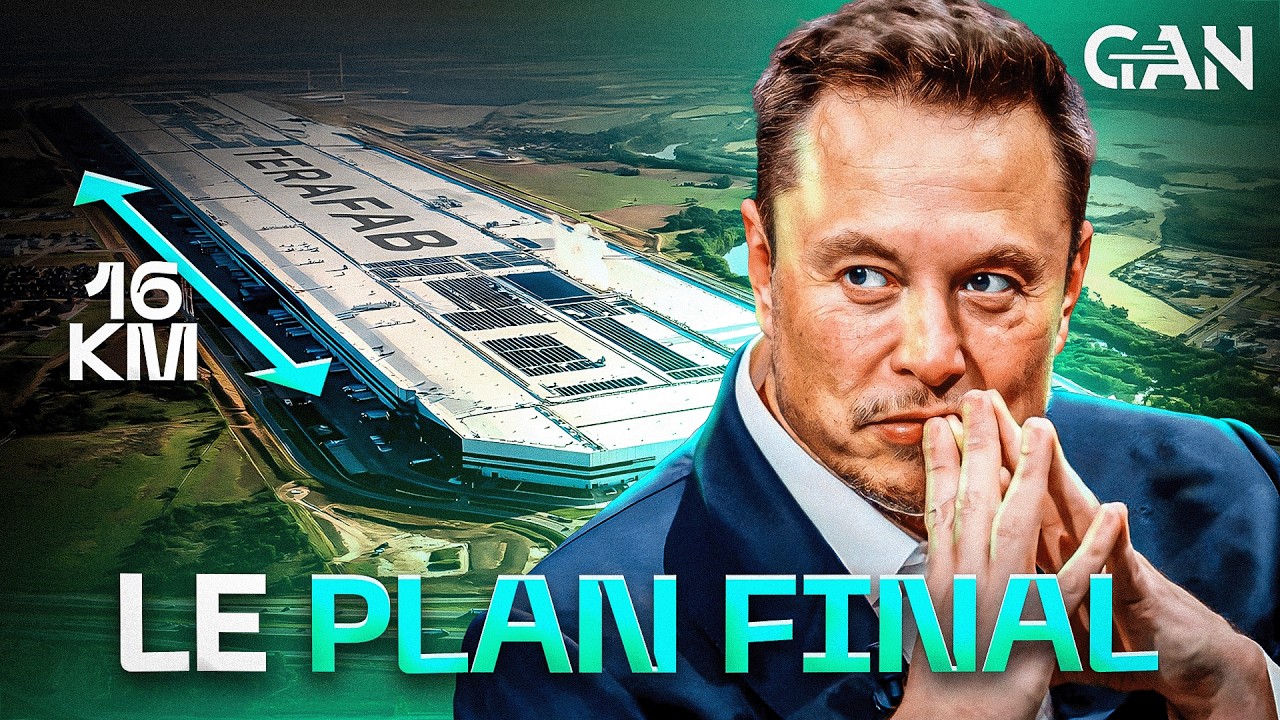
Personne ne réalise ce qu'Elon Musk vient de créer
Keywords
Summary
114 words
Critical Evaluation
The video offers a comprehensive and engaging analysis of Elon Musk’s TeraFAB project, placing it within a broader industrial and philosophical context. The presenter demonstrates a good understanding of the semiconductor industry, AI infrastructure, and space logistics, weaving together various threads to present a coherent vision. The argumentation is structured logically, starting with the problem of chip demand and energy constraints, then moving to the proposed solution of space-based data centers, and finally connecting it to Musk’s other ventures. The use of concrete numbers (e.g., 16 km factory, 10 GW, 80/20 split) adds a sense of concreteness, though some figures may be speculative or based on Musk’s own claims. The video also touches on the strategic synergy between Tesla, SpaceX, and xAI, drawing parallels to the successful SpaceX-Starlink model. However, there are several weaknesses. The claim that ’the laws of physics change in space’ is misleading; while the environment differs, the fundamental laws remain the same. This could mislead viewers. The video also tends to accept Musk’s projections at face value, without critically examining the technical and economic feasibility of such massive projects. For instance, the cost of launching materials into space, even with Starship’s projected low cost, remains significant, and the logistics of building and maintaining orbital data centers are not addressed. The video also lacks discussion of potential risks, such as space debris, regulatory hurdles, and the environmental impact of such large-scale manufacturing. The sources cited are minimal, primarily the newsletter link, and the video relies heavily on the presenter’s interpretation of Musk’s announcements. The title is somewhat sensationalist, but the content is generally substantive. Overall, the video provides a thought-provoking overview, but viewers should be aware that it is an opinion piece rather than a rigorous scientific analysis.
291 words
Title / Content Match
The title is catchy and matches the content, which explores the implications of Musk's TeraFAB announcement.
Quality & Reliability
6/10
The video presents a speculative analysis of Elon Musk's TeraFAB project, mixing factual elements (announcements, orders of magnitude) with personal interpretations and projections. The channel is a popular science/tech commentary channel, not a primary source. The content is based on public statements and industry knowledge, but lacks rigorous verification and contains some inaccuracies (e.g., physics in space). The analysis is coherent but should be treated as opinion rather than established fact.
Key Moments
Markers derived by PSI from the transcript: the creator did not define chapters.
- Introduction: Musk's TeraFAB announcement and its scale.
- The chip shortage and dependence on TSMC.
- The problem of heat and the rationale for space-based computing.
- The 80/20 split: terrestrial vs. orbital computing.
- TeraFAB as part of an integrated industrial system with Tesla, SpaceX, and xAI.
- The role of Starship and Starlink in enabling space-based infrastructure.
- The vision of lunar industrialization and mass drivers.
- Philosophical reflections on abundance, work, and humanity's future.
Cited Sources
- Grand Angle Nova Newsletter — Referenced as a way to subscribe for more content.
Concurring Sources
- SpaceX official website — Official information on Starship and Starlink.
- Tesla official website — Information on Tesla's AI and robotics efforts.
Dissenting Sources
- Physics laws in space — The video claims that laws of physics change in space, which is incorrect; only environmental conditions differ.
Contribution & Novelties
The video provides a synthesized analysis of Musk’s TeraFAB project, connecting it to a broader industrial strategy and philosophical implications. It offers a clear explanation of the technical challenges (heat, energy) and the proposed space-based solution, which is not widely covered in mainstream media. The video also highlights the synergy between Musk’s companies, presenting a unique perspective on his long-term vision.
Pour aller plus loin :
- Kardashev scale — Relevant to the video’s discussion of civilization types.
- Space-based solar power — Directly related to the idea of orbital energy generation.
- Semiconductor fabrication plant — Provides background on chip manufacturing.
- Starship — The launch vehicle mentioned for reducing space access cost.
110 words
Radar Profile
The radar profile shows high scores in quantity of information and technical level, but lower scores in quality and reliability, reflecting the speculative nature of the content and the lack of rigorous sourcing.
💬 The comments are generally positive and engaged, with viewers expressing fascination and some critical corrections. On the 30 comments analyzed, the tone is balanced, with a mix of enthusiasm and constructive criticism.