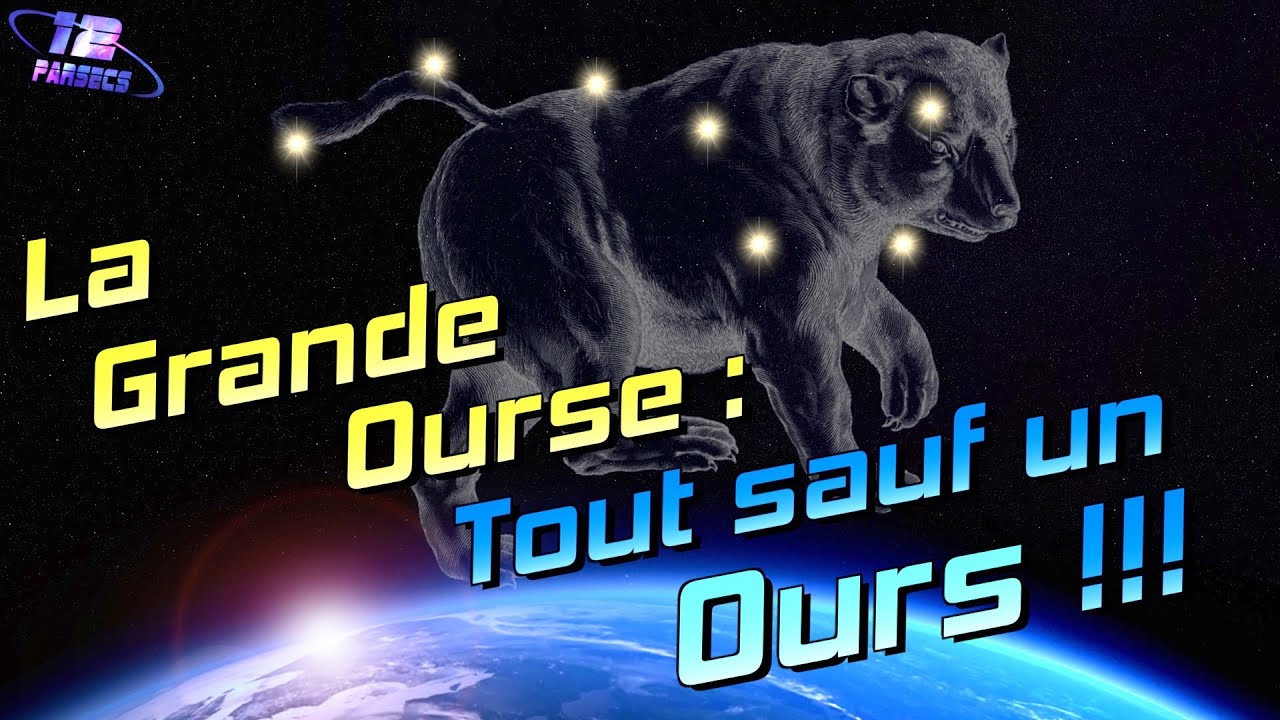
La Grande Ourse : C'est tout sauf un ours !
Keywords
Summary
205 words
Critical Evaluation
Value of the Information & Strength of the Argument
The video provides valuable information about Ursa Major, going beyond the basic recognition of the Big Dipper. It explains the constellation’s official boundaries, the names and characteristics of its main stars, and interesting facts like the Mizar multiple star system and the Ursa Major moving group. The argumentation is solid, with the host clearly explaining concepts such as binary stars, optical doubles, and the distinction between a constellation and an asterism. The use of humor and mnemonic devices helps make the information memorable. However, some claims are presented without explicit sources, and the host occasionally uses approximations for comedic effect, which could be misleading if taken literally.
Scientific Rigor, Source Quality, Title Accuracy
The video demonstrates a good level of scientific rigor for a popular science context. The host accurately describes the nature of Mizar as a multiple star system and mentions the Ursa Major moving group, which are well-established astronomical facts. The description includes links to sources such as Futura-Sciences and Cosmovisions for mythology, and Stelvision for M81/M82, which adds credibility. However, the video does not cite sources for all claims, and the humorous tone sometimes blurs the line between fact and joke. The title is appropriate and catchy, accurately reflecting the content’s focus on debunking the ‘bear’ image of the constellation.
222 words
Title / Content Match
The title is catchy and accurate, as the video explains why the constellation is not actually a bear, while also covering its main features.
Quality & Reliability
7/10
The video provides accurate basic astronomical information about the constellation Ursa Major, including star names, the nature of Mizar as a multiple star system, and the Ursa Major moving group. The content is presented with humor and some approximations, but the core facts are correct. The creator cites a few sources in the description, but the video itself lacks explicit citations for many claims.
Key Moments
Markers derived by PSI from the transcript: the creator did not define chapters.
- Introduction and disclaimer about the video being more serious than usual.
- Explanation that the Big Dipper is not the whole constellation, but a part of it.
- Start of the section on the names of the seven main stars, with mnemonic devices.
- Detailed discussion of Mizar, its double nature, and the discovery of its multiple components.
- Explanation of the Ursa Major moving group and its significance.
- Mention of deep-sky objects in Ursa Major, including M81 and M82.
- How to use the Big Dipper to find Polaris and the North Star.
- Greek myth of Callisto and Arcas, explaining the constellation's origin.
Cited Sources
- Signification de la Grande Ourse pour les Grecques — Referenced for the Greek mythology of the constellation.
- Grande Ourse (Constellation) — Referenced for general information about the constellation.
- M81 et M82 : duo galactique — Referenced for the galaxies M81 and M82.
- André Peyron — Referenced as a source for astrophotography inspiration.
Concurring Sources
- Ursa Major (Wikipedia) — Confirms the constellation's boundaries and the names of its stars.
- Mizar and Alcor (Wikipedia) — Confirms the multiple star nature of Mizar and its optical companion Alcor.
- Ursa Major moving group (Wikipedia) — Confirms the existence of the stellar association.
Contribution & Novelties
The video offers an engaging and humorous introduction to Ursa Major, making astronomical facts accessible to a broad audience. Its original contribution lies in its mnemonic devices for remembering star names and its clear explanation of the Mizar multiple star system. The video also highlights the unusual nature of the Ursa Major moving group, which is a more advanced topic not often covered in popular science.
Pour aller plus loin :
- Ursa Major — Wikipedia article providing comprehensive information about the constellation.
- Mizar and Alcor — Wikipedia article detailing the multiple star system.
- Ursa Major moving group — Wikipedia article on the stellar association.
- Messier 81 — Wikipedia article on the galaxy M81.
- Messier 82 — Wikipedia article on the Cigar Galaxy.
122 words
Radar Profile
The radar profile shows a balanced performance with high scores in information quantity and quality, but a lower score in technical level, reflecting the video's accessible approach. The reliability score is moderate, indicating that while the content is generally accurate, it lacks explicit citations for all claims.
💬 Très positif. Sur les 30 commentaires analysés, l'enthousiasme est unanime : les spectateurs saluent l'humour, la pédagogie et la qualité des informations, avec de nombreux éloges sur le style unique du créateur.