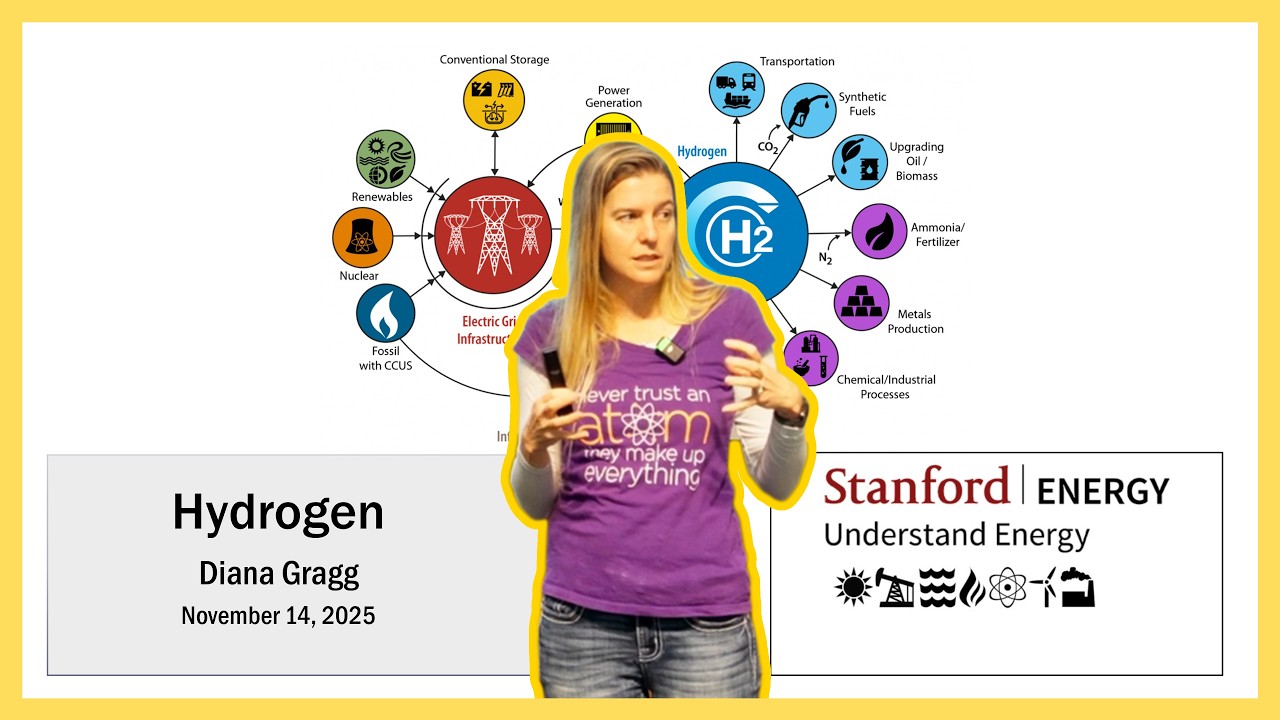
Hydrogen Lecture | Diana Gragg | Stanford Understand Energy
Keywords
Summary
212 words
Critical Evaluation
The lecture provides a solid, well-structured introduction to hydrogen as an energy carrier, suitable for an academic audience. Diana Gragg demonstrates deep familiarity with the subject, drawing on her experience in the chemical industry, which adds practical credibility. The content is accurate and aligns with current scientific consensus on hydrogen production and use. The explanation of hydrogen colors is particularly clear, helping to demystify a common point of confusion. The lecture effectively highlights the efficiency losses in the power-to-hydrogen-to-power pathway, which is a critical consideration for evaluating hydrogen’s role in decarbonization. However, the lecture lacks specific citations or references to recent studies, which would strengthen its academic rigor. The discussion of costs is based on a single unnamed study, and the lecture does not delve into the latest policy developments or market trends. The speaker also briefly mentions geologic hydrogen without providing details, which is an emerging area of interest. The lecture’s strength lies in its clarity and balance, but it could benefit from more quantitative data and references. The title accurately reflects the content, and the lecture fulfills its educational purpose. Overall, it is a valuable resource for understanding hydrogen’s potential and limitations, but it is not a comprehensive review of the latest research.
205 words
Title / Content Match
The title accurately reflects the content: a lecture on hydrogen, covering its properties, production, uses, and future prospects.
Quality & Reliability
8/10
Lecture by a Stanford lecturer with expertise in energy and environmental engineering. Provides a balanced overview of hydrogen as an energy carrier, covering production methods, uses, and challenges. Includes references to DOE diagrams and personal industry experience. No citations of specific studies, but the content is consistent with established knowledge in the field.
Chapters
Cited Sources
- Diana Gragg's Stanford profile — Speaker's academic profile, providing credentials and background.
- Understand Energy: Hydrogen — Course page with additional resources on hydrogen.
- Understand Energy Newsletter — Sign-up for monthly energy updates.
- Diana Gragg's introductory video — A video introducing Diana Gragg, possibly with more context on her work.
Concurring Sources
- IEA: The Future of Hydrogen — International Energy Agency report on hydrogen's role in clean energy transitions, aligning with the lecture's overview.
Dissenting Sources
- Some studies question the efficiency of green hydrogen for certain applications — The lecture acknowledges efficiency losses but does not cite specific studies; some research suggests that direct electrification may be more efficient for many applications, which is a point of debate.
Contribution & Novelties
The lecture provides a clear and accessible overview of hydrogen as an energy carrier, emphasizing the importance of production methods in determining its environmental impact. It offers a practical perspective from the speaker’s industry experience, which is not commonly found in academic lectures. The explanation of hydrogen colors is particularly useful for understanding the nuances of hydrogen production. The lecture also highlights the efficiency losses in hydrogen pathways, which is a critical consideration for its role in decarbonization.
Pour aller plus loin :
- Hydrogen production - Wikipedia — Provides a comprehensive overview of hydrogen production methods, including steam reforming and electrolysis.
- Fuel cell - Wikipedia — Explains the technology for converting hydrogen to electricity, which is relevant to the lecture’s discussion of fuel cells.
- Carbon capture and storage - Wikipedia — Relevant to blue hydrogen production, as discussed in the lecture.
141 words
Radar Profile
The radar profile shows high scores in quality and reliability, reflecting the speaker's expertise and balanced presentation. The quantity of information is moderate, and the technical level is accessible to a general audience. The overall profile indicates a reliable educational resource.