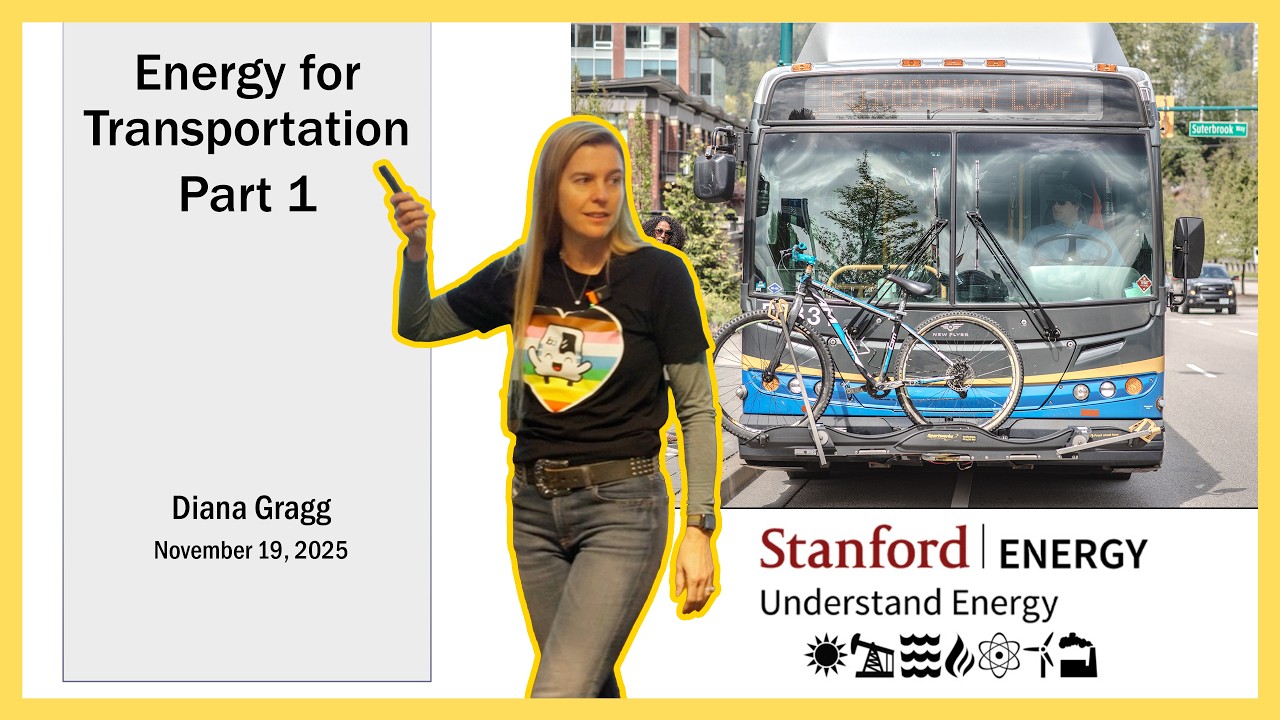
Transportation Lecture Part 1 | Diana Gragg | Stanford Understand Energy
Keywords
Summary
190 words
Critical Evaluation
The lecture provides a comprehensive and well-structured introduction to the transportation energy sector, suitable for an educational audience. Diana Gragg, a core lecturer at Stanford, demonstrates deep knowledge of the subject, presenting data and historical context clearly. The content is scientifically sound, relying on established facts and policies, though it is not original research. The argumentation is logical, moving from the significance of transportation to specific issues like air pollution and biofuels. The lecture effectively highlights the complexity of decarbonizing transportation, acknowledging trade-offs and uncertainties, such as the sustainability of biofuels. The use of visual aids and examples enhances understanding. However, the lecture is introductory and does not delve into advanced technical details, which may be a limitation for experts. The sources cited are primarily institutional (Stanford) and the lecture itself, with no external references provided in the description. The adequacy between title and content is high. Overall, the lecture is a valuable educational resource, though it could benefit from more critical analysis of certain claims, such as the net benefits of biofuels. The public comments, if any, were not provided, so no analysis of audience reception is included.
189 words
Title / Content Match
The title accurately reflects the content: a lecture on transportation energy, covering history, modes, externalities, and policies.
Quality & Reliability
8/10
Lecture by a Stanford lecturer with expertise in energy and environmental engineering, based on established data and policies. Content is well-structured and references historical and current facts, though it is an educational overview rather than original research.
Chapters
Cited Sources
- Diana Gragg - Stanford Profile — Instructor's profile page, providing credentials and background.
- Understand Energy - Transportation — Learning Hub page with additional resources on transportation energy.
- Understand Energy Newsletter — Sign-up for monthly newsletter on energy topics.
- Diana Gragg - Interview — Additional video featuring Diana Gragg, possibly an interview or lecture.
Concurring Sources
- IEA - Transport — International Energy Agency data on transport energy use, aligning with the lecture's statistics.
- EIA - Use of Energy for Transportation — US Energy Information Administration overview of transportation energy consumption, consistent with the lecture's figures.
Contribution & Novelties
The lecture provides a structured overview of the transportation energy sector, emphasizing the role of oil, the challenges of decarbonization, and the importance of policy. It offers a balanced perspective on biofuels, acknowledging their potential but also their limitations. The presentation is part of a broader educational initiative by Stanford to improve energy literacy.
Pour aller plus loin :
- Renewable Fuel Standard (RFS) — Official EPA page explaining the RFS, a key policy discussed in the lecture.
- Corporate Average Fuel Economy (CAFE) Standards — NHTSA page detailing CAFE standards, which are central to fuel economy policies.
- Clean Air Act — EPA overview of the Clean Air Act, relevant to air pollution regulation in transportation.
- Biofuels and Sustainability — IEA page on bioenergy, providing data and analysis on biofuels’ role in energy systems.
132 words
Radar Profile
The radar profile shows high scores in quantity and quality of information, with a moderate technical level. This indicates a well-balanced educational lecture that is informative and reliable, though not highly technical. The overall reliability is strong, reflecting the credibility of the instructor and the institutional backing.