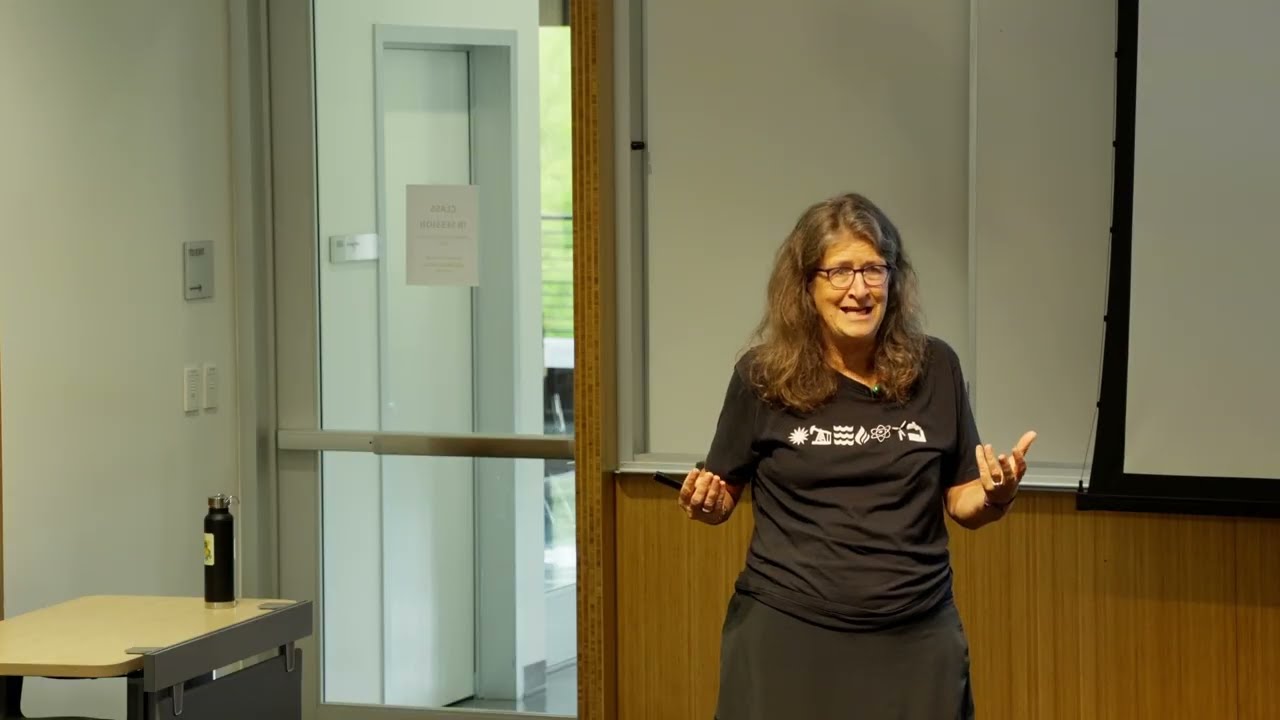
Prospecting for Oil and Natural Gas Lecture | Jane Woodward | Stanford Understand Energy
Keywords
Summary
152 words
Critical Evaluation
The lecture provides a solid, comprehensive introduction to oil and gas prospecting, suitable for a general audience with some scientific background. Jane Woodward’s expertise is evident, and she effectively uses analogies (e.g., salad dressing, medical imaging) to explain complex geological concepts. The content is well-structured, following a logical progression from geology to methods to land rights. The scientific rigor is generally high, with accurate descriptions of reservoir properties and trap types. However, the lecture is not a formal scientific presentation; it lacks citations to specific studies or data, and some statements (e.g., about methane hydrates) are presented without supporting evidence. The discussion of land rights is particularly valuable, as it highlights the unique US context. The title accurately reflects the content, and the lecture meets its educational objectives. The main weakness is the absence of references to peer-reviewed literature, which limits its use as a standalone scientific source. Nevertheless, as an educational lecture, it is effective and engaging.
158 words
Title / Content Match
The title accurately reflects the content, which is a lecture on prospecting for oil and natural gas.
Quality & Reliability
8/10
Lecture by an experienced industry professional and Stanford professor, providing a comprehensive overview of oil and gas prospecting. Content is well-structured, based on established geological principles, and includes practical insights. However, it is a single lecture without peer review, and some claims (e.g., methane hydrates) are presented without detailed evidence.
Chapters
Cited Sources
- Prospecting for Oil and Natural Gas - Understand Energy Learning Hub — Official course page with additional resources and fast facts.
- Jane Woodward - Stanford Profile — Instructor's Stanford profile.
- Jane Woodward - Introduction Video — Video introducing Jane Woodward.
- Understand Energy Newsletter — Newsletter sign-up for energy education content.
Concurring Sources
- Understand Energy Learning Hub — Official course page with additional resources and fast facts.
Contribution & Novelties
The lecture offers a practical, industry-informed perspective on oil and gas prospecting, bridging geological theory with real-world exploration practices. It emphasizes the importance of porosity and permeability, and explains the distinction between conventional and unconventional resources. The discussion of land rights and the social license to operate adds a unique socio-economic dimension.
Pour aller plus loin :
- Petroleum geology - Wikipedia — Provides foundational concepts of petroleum geology.
- Seismic reflection - Wikipedia — Explains the seismic method used in exploration.
- Hydraulic fracturing - Wikipedia — Details the stimulation technique for unconventional resources.
92 words
Radar Profile
The radar profile shows high scores in quantity and quality of information, with a moderate technical level, indicating a well-balanced lecture that is informative yet accessible. The reliability is also high, reflecting the instructor's expertise.