Hydropower 10-Minute Take | Diana Gragg | Stanford Understand Energy
Keywords
Summary
185 words
Critical Evaluation
The video provides a solid, well-structured introduction to hydropower, covering its mechanics, grid value, environmental trade-offs, and future prospects. Diana Gragg, a Stanford lecturer, delivers the content with authority and clarity, making complex concepts accessible without oversimplifying. The explanation of how hydropower works, from the water cycle to turbine operation, is accurate and effectively uses visual aids. The emphasis on grid services, particularly black start and flexibility, highlights a often-underappreciated aspect of hydropower, adding depth to the discussion. The balanced treatment of environmental impacts, including methane emissions and habitat disruption, demonstrates scientific rigor. However, the video lacks specific citations or references to studies, which would enhance its credibility for a more technical audience. The discussion of pumped storage and its comparison to batteries is timely and relevant, though it could have delved deeper into the economic and geographical constraints. The future outlook is realistic, acknowledging the slower growth of hydropower compared to other renewables. Overall, the video is an excellent educational resource, though it could benefit from more detailed data and sources to support its claims. The title accurately reflects the content, and the presentation is engaging and informative.
189 words
Title / Content Match
The title accurately reflects the content: a concise 10-minute overview of hydropower.
Quality & Reliability
8/10
The video is presented by Diana Gragg, a Stanford lecturer and energy expert, providing a balanced overview of hydropower. It covers technical aspects, grid services, environmental impacts, and future trends. The content is well-structured and based on established knowledge, though it lacks detailed citations within the video itself.
Key Moments
Markers derived by PSI from the transcript: the creator did not define chapters.
- Introduction to hydropower and orientation to a conventional plant diagram.
- Hydropower's global significance: 14% of world electricity, regional importance.
- Explanation of the water cycle and potential energy difference.
- Historical context and evolution of hydropower technology.
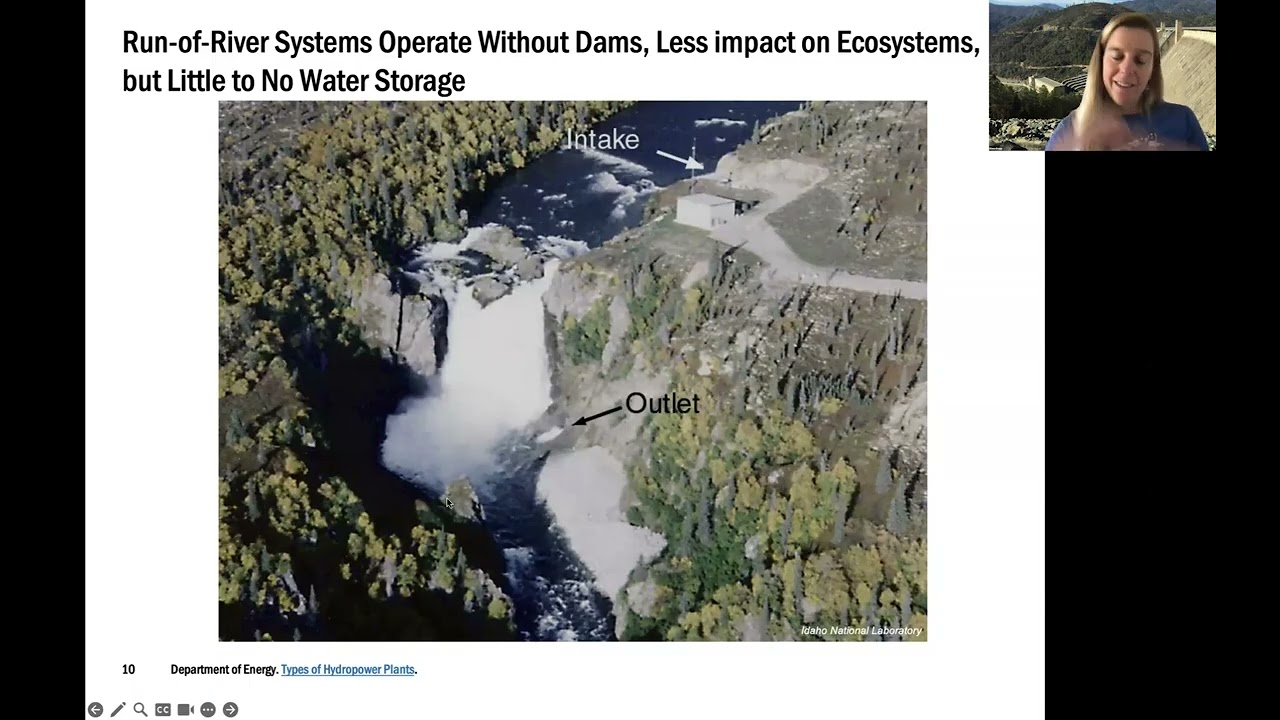
- Detailed operation of conventional and run-of-river systems.
- Grid services: black start, flexibility, and integration of renewables.
- Pumped hydro storage as a battery and comparison with batteries.
- Environmental impacts: methane emissions, habitat fragmentation, fish mortality.
- Future outlook: growth in Africa and China, overall downward trend.
Cited Sources
- Diana Gragg - Stanford Profile — Speaker's profile page for credentials.
- Hydropower - Understand Energy Learning Hub — Companion resource for further learning on hydropower.
- Energy Spotlight Newsletter — Newsletter sign-up for ongoing energy education.
- Diana Gragg - Interview — Additional video featuring Diana Gragg.
Concurring Sources
- International Hydropower Association — Industry association providing data and reports on hydropower.
- U.S. Energy Information Administration - Hydropower explained — Government source with statistics and explanations.
Dissenting Sources
Contribution & Novelties
This video provides a concise, expert-led overview of hydropower, emphasizing its role in grid services and storage, which is often overlooked. It balances technical details with environmental considerations, making it a valuable educational resource.
Pour aller plus loin :
- Hydropower - Wikipedia — General overview and history.
- Pumped-storage hydroelectricity - Wikipedia — Detailed explanation of pumped storage technology.
- Environmental impact of reservoirs - Wikipedia — Discusses methane emissions and other impacts.
- Grid energy storage - Wikipedia — Context on storage technologies including batteries.
83 words
Radar Profile
The radar profile shows high scores in information quantity, quality, and reliability, with a slightly lower technical level, indicating a well-balanced and accessible educational content.