Biofuels10-Minute Take | Diana Gragg | Stanford Understand Energy
Keywords
Summary
156 words
Critical Evaluation
The video offers a solid, accessible introduction to biofuels, suitable for a general audience seeking to understand the basics. The presenter, Diana Gragg, is a Stanford lecturer with relevant expertise, lending credibility to the content. The information is accurate and well-structured, covering the main types of biofuels, their production processes, environmental impacts, and policy context. The discussion of carbon neutrality is nuanced, acknowledging that full life-cycle emissions often negate the theoretical benefits. The comparison between corn and sugarcane ethanol is informative, highlighting land and energy intensity differences. The video also addresses important controversies, such as food competition and environmental degradation, providing a balanced view. However, the video lacks specific citations or references to scientific studies, which limits its depth for those seeking rigorous evidence. The presentation is clear and engaging, with good use of visuals and examples. The title accurately reflects the content, and the 10-minute format is appropriate for an overview. Overall, the video is a valuable educational resource, though it could benefit from more detailed sourcing and exploration of advanced topics.
173 words
Title / Content Match
The title accurately reflects the content: a concise 10-minute overview of biofuels, covering key types, production, impacts, and future trends.
Quality & Reliability
8/10
The video is presented by a Stanford lecturer with expertise in energy and environmental engineering, and it provides a balanced overview of biofuels, including their production, environmental impacts, and policy context. The information is consistent with established scientific knowledge, though it lacks detailed citations within the video itself.
Key Moments
Markers derived by PSI from the transcript: the creator did not define chapters.
- Introduction to biofuels and their role in the energy system.
- Explanation of carbon neutrality potential and challenges.
- Overview of ethanol and biodiesel, including blending limits.
- Discussion of renewable diesel as a drop-in fuel.
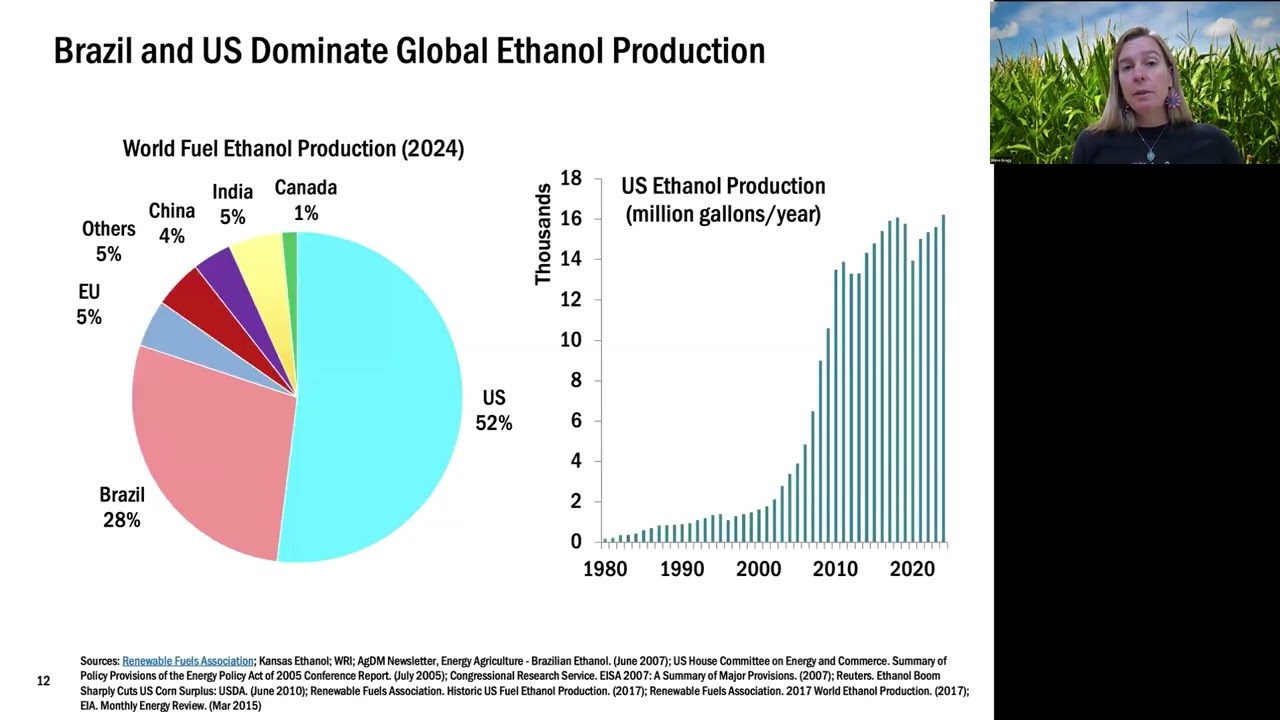
- Global production and policy drivers, including the Renewable Fuel Standard.
- Comparison of corn and sugarcane ethanol, and cellulosic ethanol challenges.
- Environmental concerns: land use, water, and food competition.
- Impact of corn ethanol on dead zones and palm oil on habitats.
- Future of biofuels, focusing on sustainable aviation fuels.
- Current status of sustainable aviation fuels and conclusion.
Cited Sources
- Diana Gragg's Stanford Profile — Presenter's academic profile, providing credibility.
- Biofuels Page on Understand Energy Learning Hub — Additional resources and detailed content on biofuels.
- Energy Spotlight Newsletter Sign-up — Newsletter for further energy education.
- Diana Gragg's Introductory Video — Another video by the presenter, possibly providing more context.
Concurring Sources
- Renewable Fuel Standard (EPA) — Confirms the existence and goals of the US policy mentioned in the video.
- Low Carbon Fuel Standard (California) — Confirms the California policy driving renewable diesel adoption.
Contribution & Novelties
The video provides a concise, up-to-date overview of biofuels, emphasizing the distinction between conventional biofuels (ethanol, biodiesel) and advanced options like renewable diesel and sustainable aviation fuels. It highlights the role of policy in driving biofuel adoption and the environmental trade-offs, such as land use and food competition. The presentation is accessible and well-structured, making it a useful educational resource.
Pour aller plus loin :
- Renewable Fuel Standard (EPA) — Official information on the US policy driving ethanol and biodiesel use.
- Low Carbon Fuel Standard (California) — Details on California’s policy promoting renewable diesel and other low-carbon fuels.
- Sustainable Aviation Fuel (IATA) — Industry perspective on the potential and challenges of SAFs.
- Life Cycle Assessment of Biofuels — Research on the environmental impacts of biofuel production.
- Cellulosic Ethanol — Overview of the technology and its current status.
137 words
Radar Profile
The radar profile shows high scores in quantity and quality of information, with moderate technical level and high reliability. This indicates a well-balanced educational video that provides substantial content without being overly technical, suitable for a broad audience.