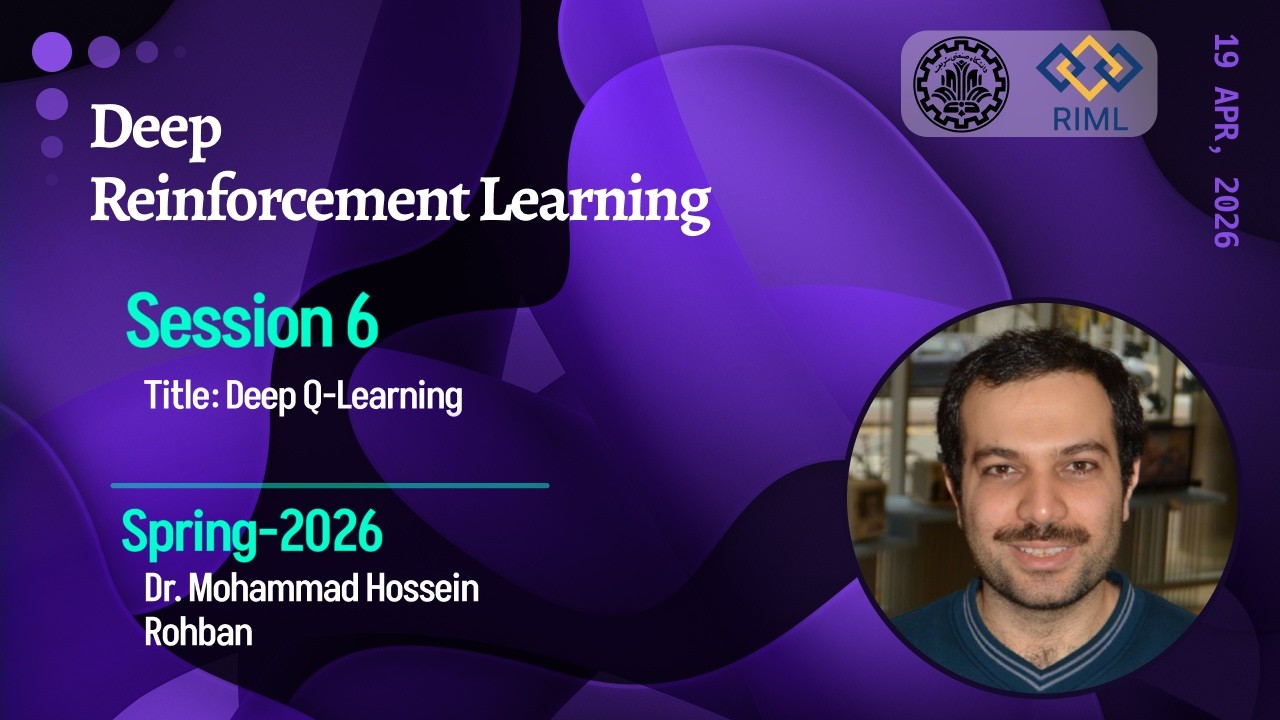
Reinforcement Learning 2026 - Session 6
Keywords
Summary
126 words
Critical Evaluation
Value of the Information & Strength of the Argument
The lecture provides a solid theoretical foundation for function approximation in reinforcement learning. The instructor clearly explains the limitations of tabular methods and the motivation for using neural networks. He systematically addresses the challenges of non-IID data and non-stationary targets, offering practical solutions such as experience replay and target networks. The argumentation is logical and well-structured, with a focus on understanding the underlying principles rather than just presenting algorithms. The instructor encourages critical thinking by asking students to consider the implications of the state distribution and the potential pitfalls of the approach.
Scientific Rigor, Source Quality, Title Accuracy
The lecture is scientifically rigorous, with a clear and accurate presentation of the concepts. However, no external sources are cited, and the content is based on the instructor’s knowledge and standard reinforcement learning literature. The title accurately reflects the content, and the lecture is well-organized. The instructor’s responses to student questions demonstrate a deep understanding of the material and add to the credibility of the presentation.
173 words
Title / Content Match
The title accurately reflects the content: a session on reinforcement learning focusing on function approximation.
Quality & Reliability
8/10
The lecture provides a rigorous introduction to function approximation in reinforcement learning, covering key concepts such as value function approximation, stochastic gradient descent, and the challenges of non-IID data and non-stationary targets. The instructor encourages critical thinking and addresses student questions, demonstrating a solid understanding of the material. However, the video is a lecture without cited sources or references, and the content is not peer-reviewed.
Key Moments
Markers derived by PSI from the transcript: the creator did not define chapters.
- Introduction and recap of previous session on tabular Q-learning and SARSA
- Motivation for function approximation using Pac-Man example
- Challenges of non-IID data and non-stationary targets
- Defining loss function for value function approximation
- Stochastic gradient descent and Monte Carlo targets
- Bootstrapping and bias-variance tradeoff
- Q-learning with function approximation and network architectures
Contribution & Novelties
This lecture provides a clear and accessible introduction to function approximation in reinforcement learning, bridging the gap between tabular methods and deep RL. It emphasizes the practical challenges of non-IID data and non-stationary targets, which are often overlooked in introductory treatments. The discussion of bias-variance tradeoff in the context of target selection is particularly valuable.
Pour aller plus loin :
- Deep Q-Networks (DQN) — The seminal paper introducing deep Q-learning with experience replay and target networks.
- Reinforcement Learning: An Introduction — The standard textbook by Sutton and Barto, covering function approximation in detail.
- Experience Replay — A technique to address non-IID data in RL.
- Target Networks — A method to stabilize training by using a separate network for targets.
119 words
Radar Profile
The radar profile shows high scores in quantity and quality of information, as well as technical level, indicating a dense and informative lecture. The reliability score is slightly lower due to the lack of external sources, but the content is consistent with established RL theory.