Generative modeling - ordinary differential equation and stochastic differential equations
Keywords
Summary
126 words
Critical Evaluation
Value of the Information & Strength of the Argument
The lecture provides a solid conceptual foundation for generative modeling, clearly explaining why ODEs and SDEs are useful. The argumentation is logical and builds step by step, from basic probability to stochastic processes. The value lies in its pedagogical clarity and the emphasis on the mathematical underpinnings, which is often missing in more applied treatments. The speaker effectively motivates the need for stochastic processes and joint distributions, and then shows how ODEs/SDEs offer a practical characterization. The discussion is well-structured and supports the main thesis that these tools are central to modern generative models.
Scientific Rigor, Source Quality, Title Accuracy
The lecture is based on an MIT course and a preprint, indicating a solid academic foundation. The mathematical definitions and derivations are presented with care, and the speaker acknowledges the need for rigor in defining measurable functions and probability spaces. The title accurately reflects the content, which is a focused introduction to ODEs and SDEs in generative modeling. No external sources are cited in the video itself, but the description may contain links (not provided here). The lecture is self-contained and does not rely on unverified claims.
196 words
Title / Content Match
The title accurately reflects the content, which focuses on generative modeling using ODEs and SDEs.
Quality & Reliability
8/10
The lecture is based on a well-structured MIT course and a preprint, providing a rigorous mathematical foundation. The presentation is clear and pedagogical, with careful definitions and derivations. However, it is a single lecture without external verification or peer review in the video itself.
Key Moments
Markers derived by PSI from the transcript: the creator did not define chapters.
- Introduction and overview of the lecture plan.
- Motivation for generative modeling and the problem of sampling from complex distributions.
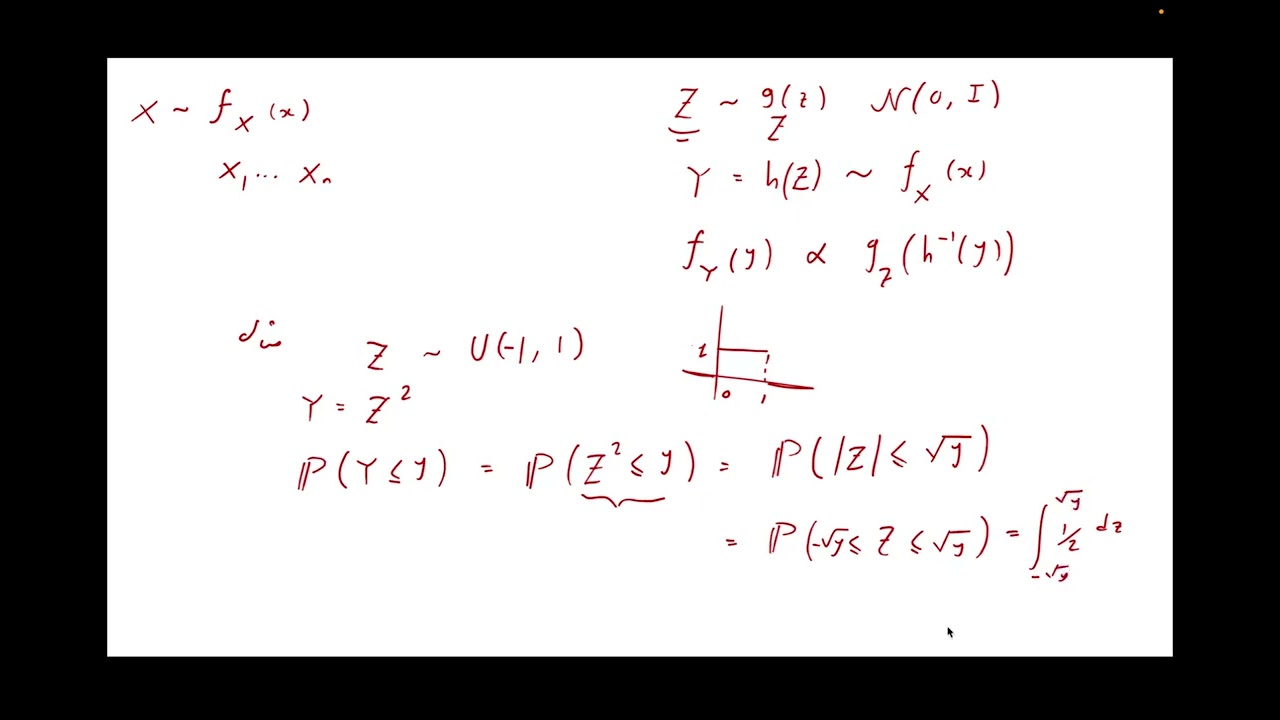
- Simple transformation approach: applying a function to a simple random variable.
- Example with uniform distribution and square transformation, deriving the density.
- Introduction to stochastic processes and why they are needed for more complex transformations.
- Review of probability spaces, sigma-algebras, and random variables.
- Definition of stochastic processes and the need for joint distributions.
- Introduction to ODEs and SDEs as characterizations of stochastic processes.
- Discussion on sampling from stochastic processes and the role of ODEs/SDEs.
- Conclusion and transition to next topics.
Contribution & Novelties
The lecture provides a clear and rigorous introduction to the mathematical foundations of generative modeling using ODEs and SDEs, which is valuable for understanding modern flow-based and diffusion models. It emphasizes the importance of stochastic processes and joint distributions, and explains how ODEs/SDEs offer a practical way to define and sample from these processes.
Pour aller plus loin :
- Flow Matching for Generative Modeling — The paper that introduced flow matching, directly related to the lecture’s topic.
- Score-Based Generative Modeling through Stochastic Differential Equations — A key paper linking SDEs to diffusion models.
- Stochastic Differential Equations: An Introduction with Applications — Wikipedia overview of SDEs, providing background on the mathematical formalism.
111 words
Radar Profile
The radar profile shows high scores in technical level and information quality, indicating a mathematically rigorous and informative lecture. The lower score in information quantity reflects the focused scope, while the high fiabilite_globale suggests the content is reliable and well-presented.