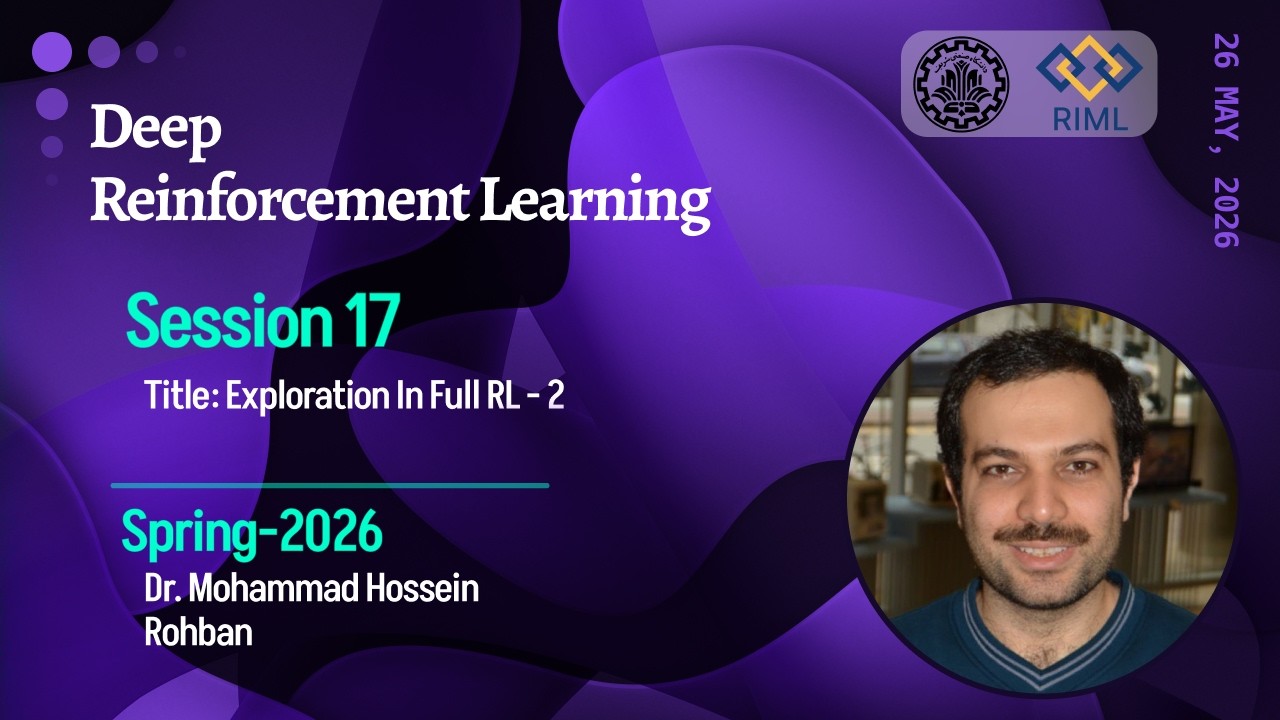
Reinforcement Learning 2026 - Session 17
Keywords
Summary
167 words
Critical Evaluation
Value of the Information & Strength of the Argument
The lecture provides substantial value by bridging bandit exploration methods to full RL, offering a clear derivation of pseudo-counts and demonstrating their effectiveness. The argumentation is solid, building from the exploration challenge to the solution, with mathematical derivations and empirical results. The instructor’s explanations are thorough, and he addresses potential pitfalls, such as the issue of exact state counting in continuous spaces. The use of Montezuma’s Revenge as a running example helps ground the concepts. However, the lecture is a single perspective and does not critically compare with alternative approaches in depth.
Scientific Rigor, Source Quality, Title Accuracy
The lecture is scientifically rigorous, with a clear logical structure and mathematical derivations. The instructor references key works, such as Bellemare et al. on pseudo-counts, and mentions the ‘Go-Explore’ paper from OpenAI. However, no formal citations are provided on screen, and the lecture relies on the instructor’s expertise. The title accurately reflects the content, and the lecture is well-organized. The instructor’s teaching style is interactive, addressing student questions, which enhances understanding.
178 words
Title / Content Match
The title accurately reflects the content: a session on reinforcement learning, specifically focusing on exploration methods.
Quality & Reliability
8/10
The lecture is a detailed technical exposition of exploration techniques in reinforcement learning, grounded in established research (e.g., Bellemare et al. on pseudo-counts, UCB, Thompson sampling). The instructor demonstrates deep knowledge and provides mathematical derivations. However, the video is a lecture with no formal citations or peer-reviewed sources shown, and the content is not independently verified.
Key Moments
Markers derived by PSI from the transcript: the creator did not define chapters.
- Introduction and recap of exploration challenge
- Discussion of optimistic exploration and bonus functions
- Introduction to pseudo-counts and density models
- Derivation of pseudo-count update equations
- Autoregressive models for density estimation
- Results on Montezuma's Revenge with pseudo-count bonus
- Discussion of other pseudo-count methods and practical considerations
Cited Sources
- Bellemare et al., 'Unifying Count-Based Exploration and Intrinsic Motivation' — Referenced as the basis for pseudo-count exploration.
- Go-Explore: a New Approach for Hard-Exploration Problems — Mentioned in relation to separating exploration for reaching states vs. optimizing within states.
Concurring Sources
- Bellemare et al., 'Unifying Count-Based Exploration and Intrinsic Motivation' — The pseudo-count method is directly based on this work.
Contribution & Novelties
The lecture provides a clear and detailed explanation of pseudo-counts for exploration in RL, bridging the gap between bandit methods and full RL. It offers a step-by-step derivation of how to estimate pseudo-counts using density models, which is a key contribution. The discussion of autoregressive models and practical considerations adds depth.
Pour aller plus loin :
- Unifying Count-Based Exploration and Intrinsic Motivation — The foundational paper on pseudo-counts.
- Go-Explore: a New Approach for Hard-Exploration Problems — Discusses separating exploration phases.
- Thompson Sampling — A key method for posterior sampling in bandits and RL.
93 words
Radar Profile
The radar profile shows high scores in technical level and information quality, indicating a dense, expert-level lecture. The slightly lower score in information quantity suggests the lecture is focused but not overly broad. Overall, the lecture is highly technical and reliable.