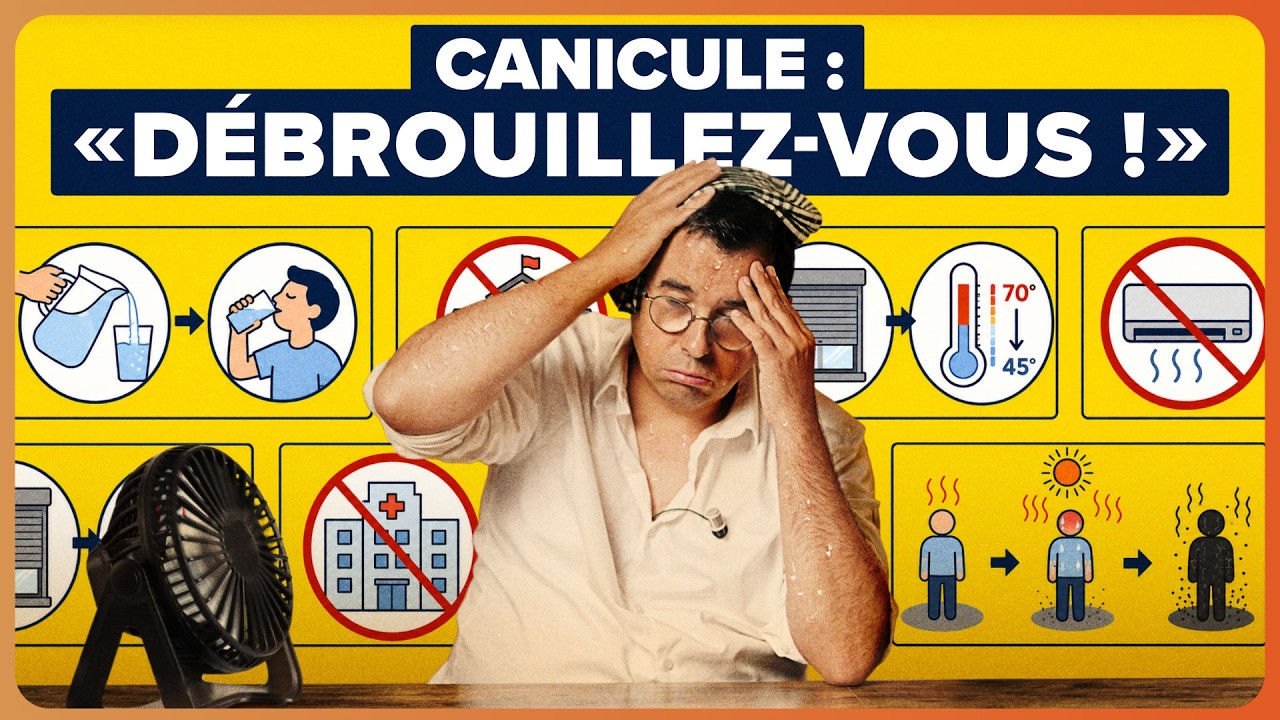
3 500 MORTS DE CHAUD, BREVET DES COLLÈGES BRADÉ : bienvenue en nullocratie !
3,500 HEAT-RELATED DEATHS, MIDDLE SCHOOL DIPLOMA DEVALUED: welcome to nullocracy!
Keywords
Summary
172 words
Critical Evaluation
Value of the Information & Strength of the Argument
The video provides a substantial amount of information, including specific data points (e.g., 3,500 deaths, 12% of new buildings with AC, 60 billion euros spent on the ‘Pentecost Monday’ scheme) and references to official reports (Haut Conseil pour le Climat, rapport Rivaton). The argumentation is coherent and persuasive, using a logical structure to contrast the government’s rhetoric with its actions. The host’s use of irony and direct comparisons (e.g., the cost of cleaning the Seine vs. air conditioning for EHPADs) strengthens the critique. However, the argumentation is one-sided and does not present counterarguments, which limits its scientific rigor. The video is more of an opinion piece than an objective analysis, but it is well-supported by cited sources.
Scientific Rigor, Source Quality, Title Accuracy
The video references several credible sources, including the Haut Conseil pour le Climat, the rapport Rivaton, Météo France data, and articles from Jean-Baptiste Fressoz. The description provides links to the show’s website (elucid.media) where sources are listed, as well as interviews with Fressoz. However, the video does not always clearly attribute specific claims to their sources, and some statements are presented as fact without direct citation. The title accurately reflects the content, which is a critical review of government actions. The video is well-structured with clear chapters, and the host’s expertise in data analysis is evident. Overall, the sources are credible, but the presentation is biased towards a critical viewpoint.
242 words
Title / Content Match
The title accurately reflects the content, which covers the heatwave deaths, the criticized middle school diploma, and broader political failures.
Quality & Reliability
7/10
The video is a well-documented editorial commentary, citing official reports (Haut Conseil pour le Climat, rapport Rivaton), scientific data (Météo France, GIEC), and news articles. However, it is explicitly opinionated and does not provide a balanced view, and some claims are presented without direct sources in the video.
Chapters
Cited Sources
- Sources de la vidéo et articles cités — Page listing all sources and articles referenced in the video.
- Interview de Jean-Baptiste Fressoz (1) — Interview with historian Jean-Baptiste Fressoz, likely discussing climate change and adaptation.
- Interview de Jean-Baptiste Fressoz (2) — Second interview with Jean-Baptiste Fressoz, further exploring climate topics.
- Épisode précédent du syndrome de la page 27 — Link to the previous episode of the series.
Concurring Sources
- Haut Conseil pour le Climat — The video cites a recent report from this body indicating France is not prepared for climate change.
- Rapport Rivaton — Official report on the RE2020 regulation, which the video uses to show the difficulty of installing AC in new buildings.
Dissenting Sources
External References
Contribution & Novelties
The video offers a critical perspective on the French government’s climate adaptation policies, highlighting the contradiction between stated beliefs and actual actions. It provides specific examples, such as the RE2020 regulation hindering air conditioning installation, and the underfunding of EHPADs. The ‘Pour aller plus loin’ section suggests further exploration of these topics.
Pour aller plus loin :
- Rapport Rivaton sur la RE2020 — Official report on the RE2020 regulation, cited in the video.
- Haut Conseil pour le Climat — Independent body assessing French climate policy, referenced in the video.
- Jean-Baptiste Fressoz — Historian interviewed in the video, known for his work on climate and energy history.
- Canicule de 2003 en Europe — Historical context for heatwaves in France.
- RE2020 — French environmental regulation for new buildings.
126 words
Radar Profile
The radar profile shows high scores in quantity of information and technical level, reflecting the video's data-driven approach. However, the quality of information and global reliability are slightly lower due to the one-sided, opinionated nature of the content.
💬 Très positif. Sur les 30 commentaires analysés, la grande majorité exprime un soutien enthousiaste à la chaîne, saluant l'humour et la qualité du travail, avec quelques critiques acerbes envers le gouvernement.