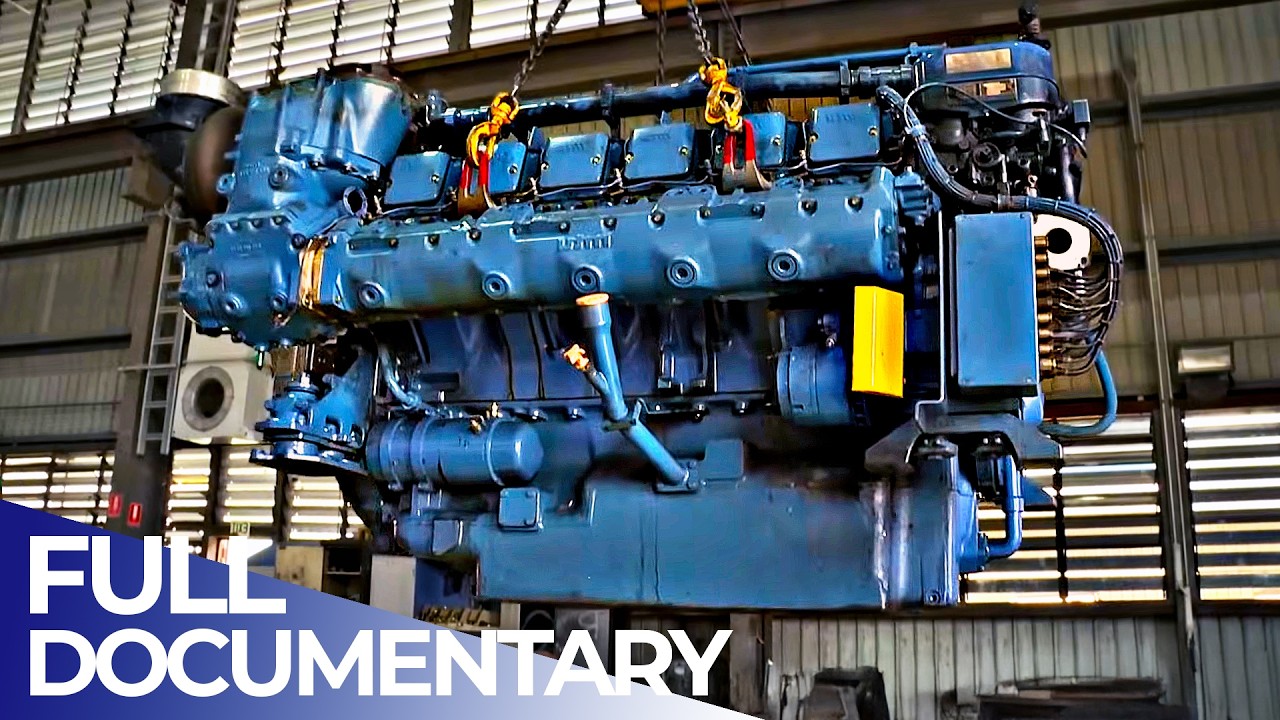
Massive V-12 Locomotive Engine | Mega Maintenance | FD Engineering
Keywords
Summary
163 words
Critical Evaluation
The documentary offers a compelling behind-the-scenes look at heavy machinery maintenance, showcasing real-world engineering challenges and solutions. The information is presented through direct observation and expert commentary, providing a practical understanding of the procedures. The strength of the content lies in its authenticity: viewers witness actual maintenance operations, including the delicate extraction of a six-ton engine and the in-situ seal replacement in a hydroelectric plant. The technical details, such as engine specifications (47.5 L, twin-turbo V12, 1,800 PS) and the scale of the scraper (16 m, 75 tons), are informative and well-integrated into the narrative. However, the documentary lacks critical analysis or independent verification of the claims made. It relies heavily on the statements of the maintenance personnel, which, while credible, are not cross-checked with external sources. The absence of references or citations limits its scientific rigor. The argumentation is primarily descriptive rather than analytical, focusing on the ‘how’ rather than the ‘why’ or the broader implications. The adéquation between the title and content is good, as the locomotive engine overhaul is a central focus, but the inclusion of other projects might dilute the specificity. Overall, the documentary is valuable for its educational content and realistic portrayal of engineering maintenance, but it would benefit from additional context and expert validation to enhance its reliability.
214 words
Title / Content Match
The title accurately reflects the content, focusing on the overhaul of a massive V-12 locomotive engine, with additional maintenance segments.
Quality & Reliability
7/10
The documentary provides detailed, real-world maintenance procedures with expert commentary, but lacks citations to external sources and does not offer independent verification of the technical claims.
Key Moments
Markers derived by PSI from the transcript: the creator did not define chapters.
- Introduction to the locomotive engine removal in Bowen Hills.
- Details on the engine specifications and the need for overhaul.
- Extraction of the engine using the gantry crane.
- Transition to Tumut-1 hydroelectric power station and the MIV seal replacement.
- Explanation of the in-situ seal replacement and its challenges.
- Introduction to the scraper overhaul in Archerfield.
- Separation of the tractor and scraper sections.
- Reinstallation of the tandem valve at Tumut-1.
- Overcoming the stuck hitch pin on the scraper.
- Final stages of the locomotive engine removal and wrap-up.
Cited Sources
- Next episode: Massive V-12 Locomotive Engine | Mega Maintenance — Referenced in the description as the next episode in the series.
Concurring Sources
- Free Documentary - Engineering Channel — The channel is dedicated to engineering documentaries, providing similar content.
Contribution & Novelties
The documentary provides an insider view of large-scale maintenance operations, highlighting the precision and teamwork required. It showcases innovative in-situ repair techniques, such as the seal replacement at Tumut-1, which reduces downtime significantly. The content is valuable for engineering students and professionals interested in heavy machinery maintenance.
Pour aller plus loin :
- Locomotive engine maintenance — Overview of locomotive types and maintenance practices.
- Hydroelectric power station — Background on hydroelectric generation and maintenance.
- Caterpillar 657G scraper — Information on the scraper model and its specifications.
85 words
Radar Profile
The radar profile shows high scores in quantity of information and technical level, indicating a detailed and specialized content. The quality and reliability are moderate, reflecting the lack of external validation. The overall balance suggests a solid documentary with room for improvement in sourcing.