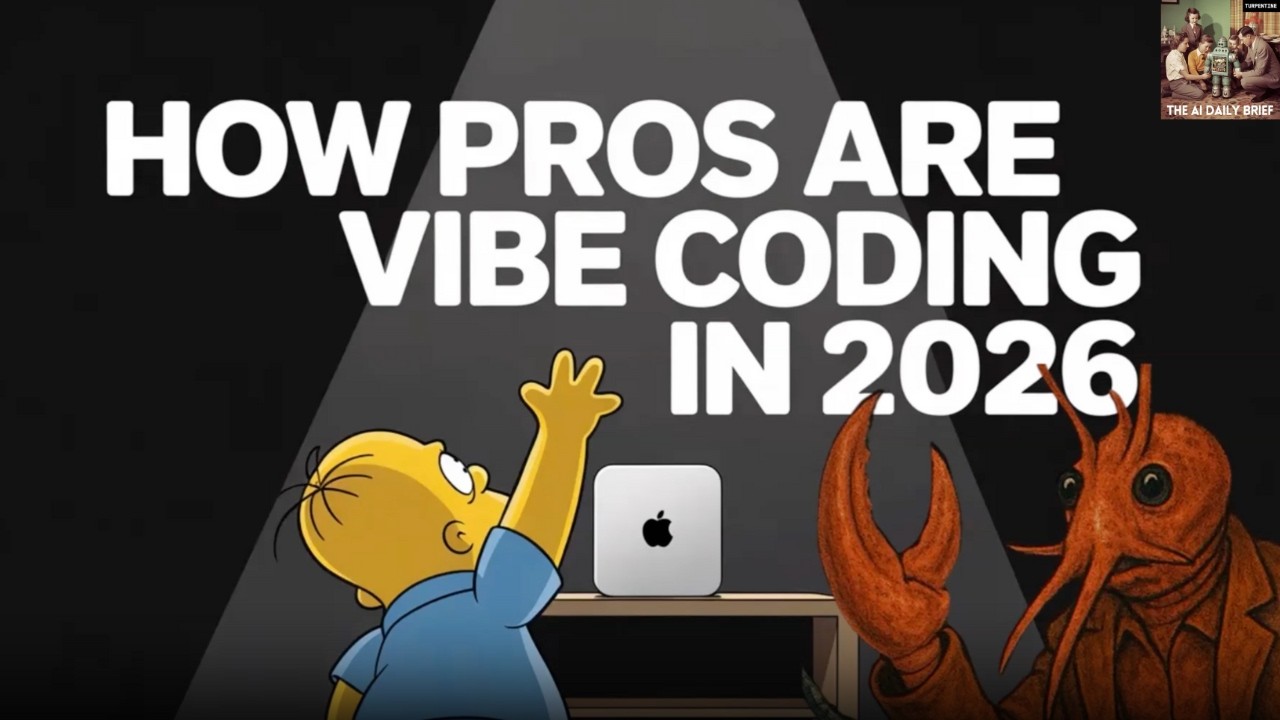
Ralph Wiggum, Clawdbot and Mac Minis: How Pros are Vibe Coding in 2026
Keywords
Summary
136 words
Critical Evaluation
Value of the Information & Strength of the Argument
The video provides valuable insights into the current state of AI coding, offering concrete examples and explanations of new tools and methodologies. The argumentation is solid, supported by references to blog posts, tweets, and real-world experiments. However, it relies heavily on anecdotal evidence and social media buzz, which may not represent the broader developer community. The host does a good job of explaining technical concepts in an accessible manner, but some claims could benefit from more rigorous validation.
Scientific Rigor, Source Quality, Title Accuracy
The video demonstrates a reasonable level of scientific rigor, citing specific sources such as Cursor’s blog post and Ryan Carson’s explanations. However, many sources are social media posts or blog posts, which are not peer-reviewed. The title accurately reflects the content, and the video stays on topic. The description includes links to the podcast and a sponsor, but no direct links to the cited sources are provided in the description, which could be improved for transparency.
169 words
Title / Content Match
The title accurately reflects the content, focusing on the mentioned tools and the trend of vibe coding.
Quality & Reliability
7/10
The video provides a well-structured overview of recent developments in AI coding, citing specific examples and sources. However, it relies heavily on anecdotal evidence and social media posts, lacking in-depth technical verification or peer-reviewed sources.
Key Moments
Markers derived by PSI from the transcript: the creator did not define chapters.
- Introduction to the episode and the topic of vibe coding terms.
- Explanation of the shift in perception towards agentic coding.
- Discussion of Cursor's experiment building a browser with GPT-5.2.
- Explanation of the Ralph Wiggum loop and its origin.
- Introduction to Clawdbot and its capabilities.
- Discussion of using Mac Minis to run Clawdbot and the viral trend.
- Controversy over CLI vs GUI interfaces and the rise of Conductor.
- Conclusion summarizing the trend towards autonomous agents.
Cited Sources
- Podcast link — Link to the podcast version of The AI Daily Brief.
- Vanta - Simplify compliance — Sponsor link mentioned in the description.
Concurring Sources
- Cursor blog post on scaling long-running autonomous coding — Referenced in the video as the source for Cursor's browser experiment.
Dissenting Sources
- Claude Code Psychosis by Jasmine Sun — Mentioned in the video as a counterweight to the hype, highlighting accessibility issues.
Contribution & Novelties
The video provides a timely overview of emerging trends in AI coding, particularly the shift towards autonomous agents. It introduces and explains new terms like Ralph Wiggum and Clawdbot, which are not widely known. The discussion of Cursor’s browser experiment offers a concrete example of the potential of agentic coding. The video also highlights the debate between CLI and GUI interfaces, which is relevant for developers.
Pour aller plus loin :
- Claude Code — Official documentation for Claude Code, a key tool mentioned in the video.
- Agentic AI — Wikipedia article on agentic AI, providing background on the concept.
- Bash (Unix shell) — Wikipedia article on Bash, relevant to understanding the Ralph Wiggum loop.
114 words
Radar Profile
The radar profile shows high scores in quantity and quality of information, with moderate technical depth and reliability. This indicates a well-informed overview that is accessible to a broad audience, but may lack in-depth technical analysis.