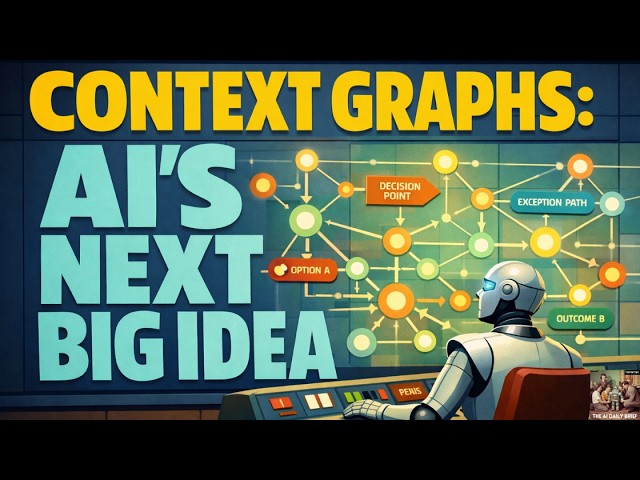
Context Graphs: AI's Next Big Idea
Keywords
Summary
151 words
Critical Evaluation
Value of the Information & Strength of the Argument
The video provides valuable insights by synthesizing multiple perspectives on a emerging concept. It clearly explains the problem of missing decision lineage and how context graphs could address it. The argumentation is logical, building from the systems of record debate to the specific proposal of context graphs, and includes concrete examples. However, it relies heavily on the essays it summarizes without critical evaluation, and the claims are not backed by empirical evidence.
Scientific Rigor, Source Quality, Title Accuracy
The video references several essays by name (Jamine Ball, Foundation Capital, Cogent Enterprise, Aaron Levie) but does not provide direct URLs or citations within the video. The description includes only a podcast link, not the referenced essays. The title accurately reflects the content. The video is a news review, not a primary research piece, so the lack of direct citations is somewhat expected, but for a rigorous analysis, more transparency on sources would be beneficial.
162 words
Title / Content Match
The title accurately reflects the content, which focuses on explaining the concept of context graphs and their potential significance.
Quality & Reliability
7/10
The video synthesizes ideas from multiple essays by investors and analysts, providing a coherent overview. It lacks direct citations to primary sources within the video, but references are made to named essays. The content is analytical and forward-looking, with no experimental data.
Key Moments
Markers derived by PSI from the transcript: the creator did not define chapters.
- Introduction to the topic of context graphs and why they are being discussed.
- Discussion of Jamine Ball's essay on systems of record and the problem of canonical data.
- Introduction of the context graph concept from Foundation Capital's essay.
- Examples of decision traces and how context graphs would capture them.
- Discussion on design considerations, including not predefining context graphs.
- Human role in managing agents and the importance of context engineering.
Cited Sources
- Podcast link — Link to the podcast version of The AI Daily Brief, mentioned in the description.
Concurring Sources
- Long Live Systems of Record — Essay by Jamine Ball referenced in the video, discussing systems of record and canonical data.
- AI's Trillion Dollar Opportunity: Context Graphs — Essay by Foundation Capital referenced in the video, introducing the context graph concept.
Contribution & Novelties
The video provides a clear and accessible explanation of the concept of context graphs, synthesizing recent essays and discussions. It highlights the importance of decision traces and the ‘what versus why’ gap in enterprise data. The discussion on not predefining context graphs and letting agents discover organizational schema is a novel perspective. The video also connects the concept to broader trends like context engineering and the changing role of humans in AI-driven workflows.
Pour aller plus loin :
- Knowledge graph — Background on knowledge graphs, which context graphs extend.
- Decision intelligence — Related field focusing on decision processes.
- Agent-based model — Relevant to understanding agent behavior and traces.
108 words
Radar Profile
The radar profile shows high scores in quantity of information and technical level, indicating a content-rich and somewhat technical video. Quality and reliability are moderate, reflecting the synthesis of secondary sources without primary data. The overall balance suggests a well-informed but not deeply rigorous analysis.