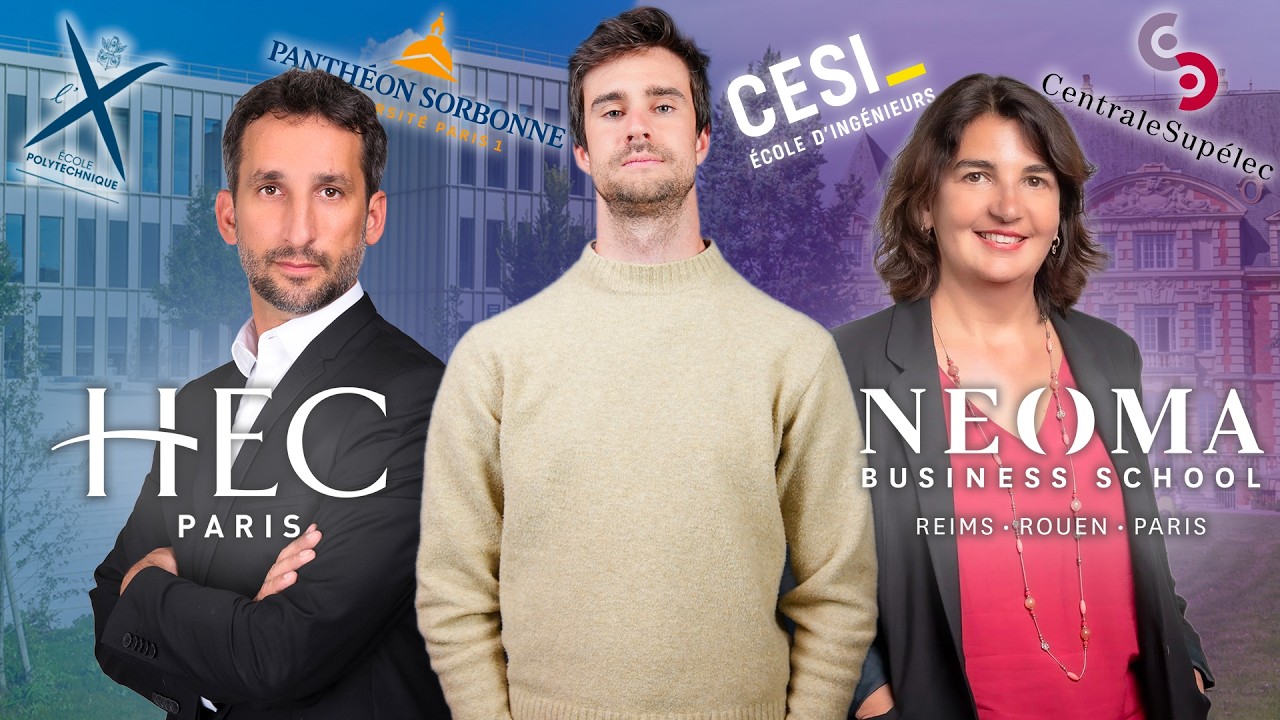
L'importance des doubles compétences en école de commerce (avec HEC et NEOMA)
Keywords
Summary
207 words
Critical Evaluation
Value of the Information & Strength of the Argument
The video provides valuable insights into the strategic thinking of two leading French business schools regarding dual competencies. The argumentation is solid, as both speakers present coherent rationales for their approaches, supported by examples of specific programs (e.g., HEC’s partnership with École Polytechnique, NEOMA’s dual degree with CentraleSupélec). They effectively argue that dual competencies are essential for addressing contemporary challenges like AI, geopolitics, and climate change. However, the discussion is largely qualitative and lacks empirical data or comparative analysis, which limits its scientific rigor. The speakers’ authority adds weight to their opinions, but the lack of concrete statistics or case studies weakens the overall argumentation.
Scientific Rigor, Source Quality, Title Accuracy
The video demonstrates a high level of scientific rigor in the sense that the speakers are credible experts with deep institutional knowledge. However, they do not cite external sources or provide references to support their claims, relying instead on anecdotal evidence and personal experience. The title accurately reflects the content, which is a focused discussion on dual competencies in business schools. The description provides links to Major Prépa’s resources, but these are promotional and not directly related to the video’s content. Overall, the video is informative but not rigorously sourced.
210 words
Title / Content Match
The title accurately reflects the content, which focuses on the importance of dual competencies in business schools, with specific insights from HEC and NEOMA.
Quality & Reliability
7/10
The video features two high-level academic leaders (Delphine Manceau, Director General of NEOMA, and Éloïc Peyrache, Director General of HEC Paris) discussing strategic trends in business education. Their expertise lends credibility, but the discussion is largely opinion-based and lacks empirical data or citations. The information is reliable for understanding institutional perspectives but not as a rigorous scientific source.
Chapters
- Introduction
- L'arrivée des doubles diplômes
- Une accélération du phénomène ?
- Un modèle lisible à l'international ?
- Est-ce que les étudiants sont plus demandeurs de doubles diplômes qu'avant ?
- La triple compétence, un must-have dans les années à venir ?
- Comment vont évoluer les offres de doubles diplômes de NEOMA et HEC ?
- Conclusion
Cited Sources
- Major Prépa - La Méta — Mentioned in the description as a program for high school students.
- Major Prépa - Planning de travail — Linked in the description as a resource for study planning.
- Major Prépa - Discord — Linked in the description as a community platform.
- Major Prépa - LinkedIn — Linked in the description as a professional network.
Contribution & Novelties
The video offers a unique perspective by bringing together two leaders from competing business schools to discuss the strategic importance of dual competencies. It highlights the French model’s agility in forming partnerships and the distinction between internalizing competencies and offering dual degrees. The discussion provides practical insights into how these schools are adapting to global trends.
Pour aller plus loin :
- Dual degree — Provides a general overview of dual degree programs internationally.
- Grandes écoles — Explains the French higher education system, relevant to the context.
- Interdisciplinarity — Discusses the concept of combining disciplines, central to the video’s theme.
99 words
Radar Profile
The radar profile shows balanced scores across all dimensions, with slightly higher scores in information quantity and quality, reflecting the substantive discussion. The technical level is moderate, suitable for a general audience interested in business education.