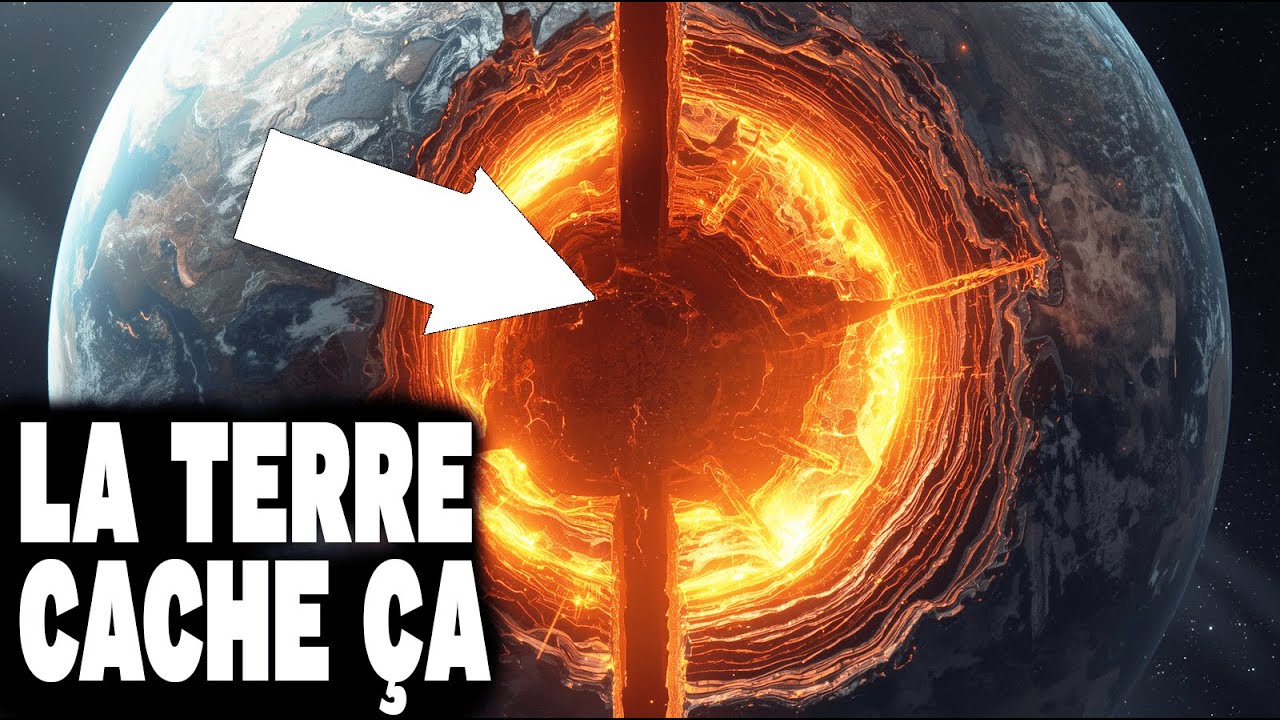
VOYAGE AU CENTRE DE LA TERRE : Ce que les scientifiques ont découvert à des kilomètres sous nos pieds
Keywords
Summary
150 words
Critical Evaluation
Value of the Information & Strength of the Argument
The video provides substantial value by synthesizing a large body of geological knowledge into a coherent narrative. It effectively explains complex concepts such as mantle convection, phase transitions, and the role of water in the deep Earth. The argumentation is logical and well-structured, building from the surface to the core. However, it lacks critical analysis of competing hypotheses and does not address uncertainties in the field. The presentation is one-sided, presenting established theories without discussing ongoing debates, which limits its scientific depth.
Scientific Rigor, Source Quality, Title Accuracy
The scientific rigor is moderate. The video relies on well-established geological principles and does not present fringe ideas. However, it does not cite specific studies or researchers, making it difficult to verify claims. The title accurately reflects the content, which is a comprehensive overview of Earth’s interior. The absence of citations is a notable weakness for a scientific documentary. The video does not include any sponsored content or advertising.
166 words
Title / Content Match
The title accurately reflects the content, which is a detailed exploration of Earth's interior layers and recent scientific discoveries.
Quality & Reliability
7/10
The video provides a comprehensive and accurate overview of Earth's internal structure, based on established scientific knowledge. It correctly explains key concepts such as the Mohorovičić discontinuity, mantle convection, and phase transitions. However, it lacks citations to specific studies or sources, and some simplifications may omit nuances. The content is generally reliable but not at the level of a peer-reviewed source.
Key Moments
Markers derived by PSI from the transcript: the creator did not define chapters.
- Introduction to the Earth's crust, distinguishing oceanic and continental types.
- Explanation of the lithosphere and asthenosphere, and plate tectonics.
- Discussion of the Mohorovičić discontinuity and the upper mantle.
- Description of the transition zone at 410 and 660 km depths, including mineral phase changes.
- Exploration of the lower mantle, including subducted plates and ancient reservoirs.
- Discussion of the core, its composition, and the generation of Earth's magnetic field.
Contribution & Novelties
The video offers a comprehensive and accessible synthesis of current knowledge about Earth’s interior, making it valuable for educational purposes. It highlights recent discoveries such as deep water reservoirs and the dynamics of the core. However, it does not present original research or novel insights. For further exploration, consider the following resources:
- Seismic Tomography — Provides an overview of the technique used to image Earth’s interior.
- Earth’s Internal Structure — Detailed article on the layers of the Earth.
- Mantle Convection — Explains the process driving plate tectonics.
- Ringwoodite — A mineral that may store water in the transition zone.
99 words
Radar Profile
The radar profile shows high scores in quantity of information and technical level, indicating a content-rich and moderately technical presentation. The quality and reliability scores are slightly lower, reflecting the lack of citations and some simplifications. Overall, the video is informative but not deeply rigorous.