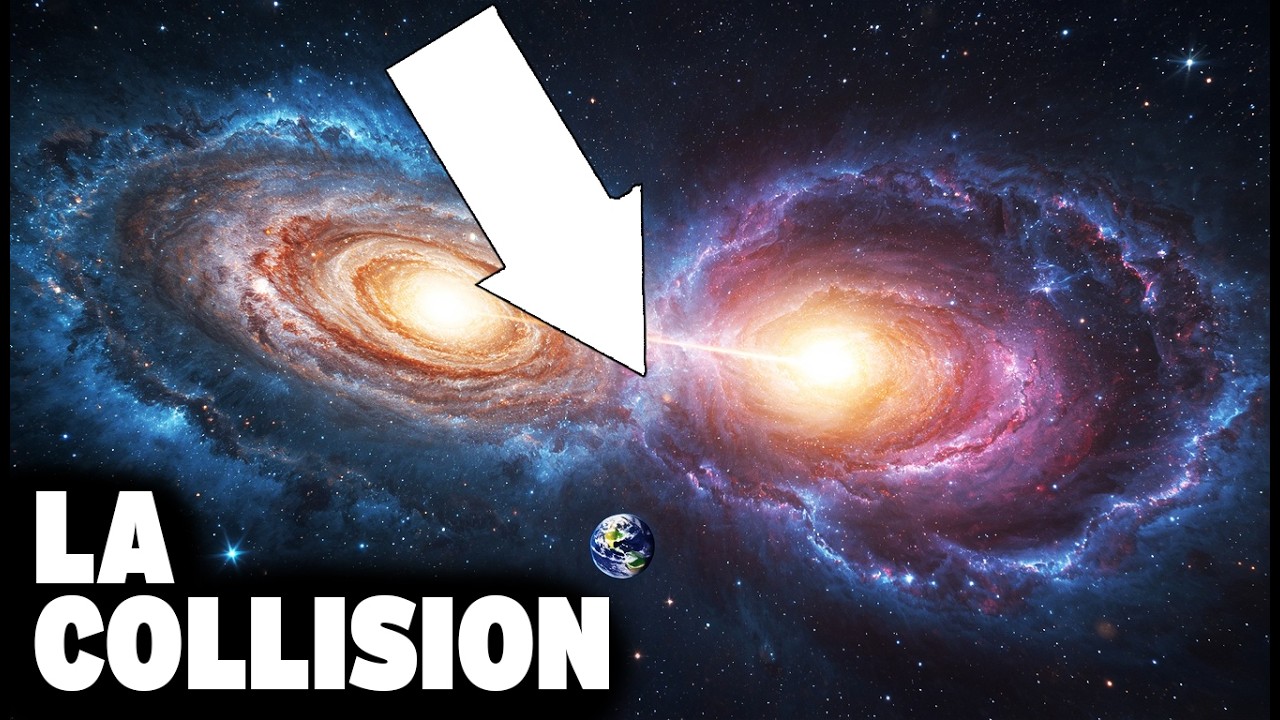
Voici ce qui arrivera à la Terre quand Andromède nous percutera - DOCUMENTAIRE ESPACE
Keywords
Summary
151 words
Critical Evaluation
Value of the Information & Strength of the Argument
The documentary provides valuable scientific information, accurately explaining the physics of galaxy collisions and the likely fate of Earth. It argues convincingly that the collision will not directly destroy Earth, but that the Sun’s evolution will. The argumentation is solid, supported by references to specific studies and simulations. The use of analogies (e.g., the orange and Paris-Moscow distance) helps convey the vast emptiness of space. The documentary also places the event in a broader cosmic context, discussing the Local Group and the eventual isolation of Milkomeda due to dark energy.
Scientific Rigor, Source Quality, Title Accuracy
The documentary demonstrates scientific rigor by citing specific research, such as the 2012 study by van der Marel using Hubble data, and mentioning simulations by Cox and Loeb. It also references the Gaia mission’s findings on past mergers. The sources are credible and relevant. The title accurately reflects the content, focusing on the Andromeda collision and its implications for Earth. The documentary maintains a high level of accuracy, though it simplifies some details for a general audience. No comments were provided for analysis.
188 words
Title / Content Match
The title accurately reflects the content, which focuses on the future collision with Andromeda and its consequences for Earth.
Quality & Reliability
8/10
The documentary presents scientifically accurate information about the Andromeda collision, citing specific studies (e.g., van der Marel 2012) and using current astronomical data. It distinguishes between direct stellar collisions and gravitational effects, and correctly emphasizes the Sun's evolution as the primary threat to Earth. Minor simplifications and lack of detailed citations in the narration slightly reduce the score.
Key Moments
Markers derived by PSI from the transcript: the creator did not define chapters.
- Introduction to Andromeda: distance, size, and approach speed.
- Explanation of the 2012 Hubble study confirming head-on collision.
- Timeline of the collision: first passage, main collision, and merger.
- Why stellar collisions are unlikely: vast distances between stars.
- Gravitational effects: tidal tails, starbursts, and galaxy distortion.
- Fate of supermassive black holes and gravitational wave emission.
- Earth's survival: unlikely to be hit, but Sun's evolution is the real threat.
- Comparison of timescales: human history vs. cosmic timescales.
- Possible scenarios for the Sun's fate: ejection or relocation in Milkomeda.
- Historical observations of Andromeda and its classification.
Cited Sources
- The Astrophysical Journal - van der Marel et al. 2012 — Study measuring Andromeda's proper motion with Hubble, confirming head-on collision.
- The Astrophysical Journal - Cox & Loeb 2008 — Simulations of the Milky Way-Andromeda merger, including possible solar system ejection.
Concurring Sources
- NASA - Andromeda Galaxy — NASA's page on Andromeda, providing basic facts and images.
- ESA - Gaia — ESA's Gaia mission page, relevant to past mergers in the Milky Way.
Contribution & Novelties
The documentary synthesizes current scientific knowledge about the Andromeda collision, providing a clear and engaging narrative. It emphasizes the counterintuitive fact that the collision will not destroy Earth, but the Sun’s evolution will. It also highlights the eventual merger of supermassive black holes and the emission of gravitational waves. The documentary adds value by contextualizing the event within the broader cosmic history and future.
Pour aller plus loin :
- Milkomeda (Wikipedia) — Overview of the predicted merger.
- Gaia mission (ESA) — Mission that mapped stellar motions, revealing past mergers.
- LISA mission (ESA) — Future space-based gravitational wave detector that could observe such mergers.
103 words
Radar Profile
The radar profile shows high scores in quantity and quality of information, with a moderate technical level. This indicates a well-researched documentary that is accessible to a general audience while maintaining scientific accuracy.