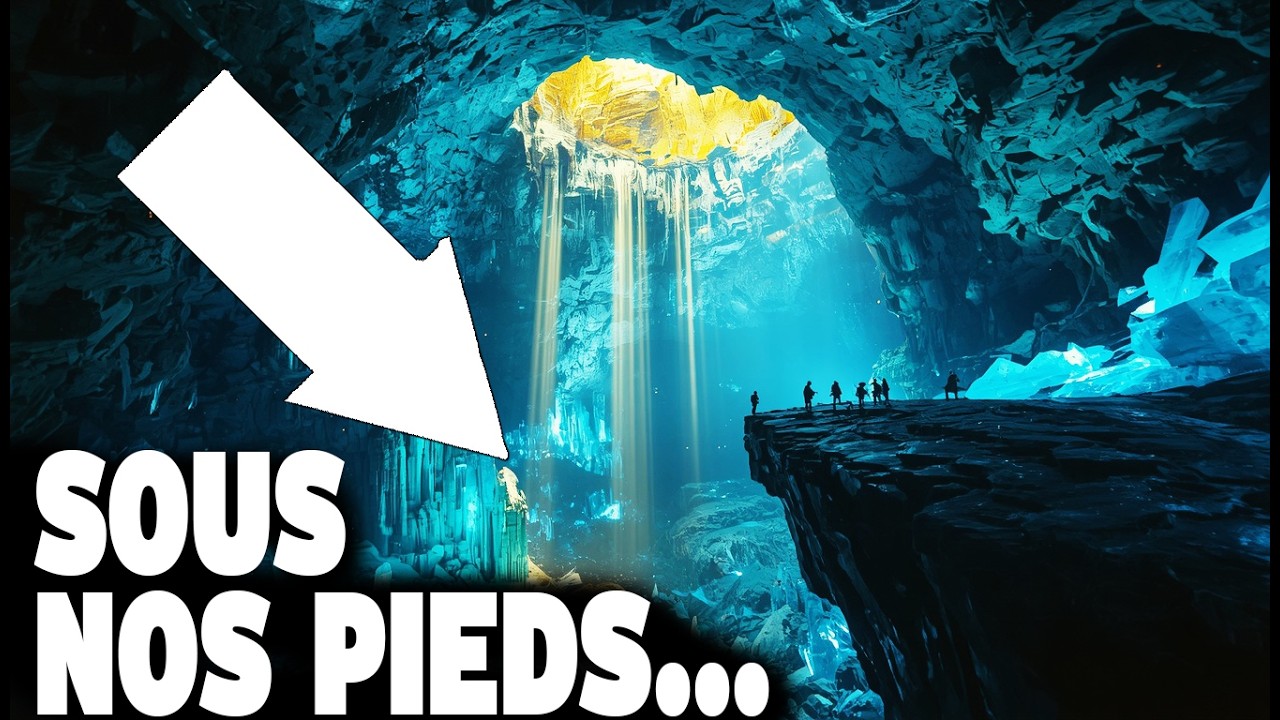
Sous nos pieds, un monde que nous ne connaissons pas encore - Documentaire Histoire de la Terre
Keywords
Summary
159 words
Critical Evaluation
Value of the Information & Strength of the Argument
The documentary provides substantial value by synthesizing recent scientific findings and presenting them in an engaging narrative. It effectively argues that Earth’s interior is a frontier of discovery, using concrete examples like the Kola borehole and the 2014 ringwoodite study to illustrate both the limits of direct exploration and the power of indirect methods. The argumentation is solid, as it distinguishes between established facts and hypotheses, such as the Theia origin of LLSVPs, and acknowledges uncertainties. The film’s strength lies in its ability to convey complex geophysical concepts to a broad audience without oversimplifying the science.
Scientific Rigor, Source Quality, Title Accuracy
The documentary demonstrates scientific rigor by referencing specific studies and data, such as the Kola borehole depth, the 2014 Nature paper on ringwoodite, and the Deep Carbon Observatory’s biomass estimates. It also mentions recent research on inner core rotation (2023 and 2024 studies) and LLSVP hypotheses. However, it does not provide direct citations within the video, and some claims are presented without explicit sources. The title accurately reflects the content, and the documentary maintains a high level of accuracy, though it occasionally simplifies complex topics for accessibility.
198 words
Title / Content Match
The title accurately reflects the content, which explores the largely unknown deep Earth and its recent discoveries.
Quality & Reliability
8/10
The documentary presents a comprehensive overview of Earth's deep interior, citing specific studies and data (e.g., Kola borehole depth, ringwoodite water content, deep biosphere biomass estimates). It distinguishes between established knowledge and ongoing research, and avoids sensationalism. However, some claims lack precise citations within the video, and the presentation is aimed at a general audience, which may simplify complex topics.
Key Moments
Markers derived by PSI from the transcript: the creator did not define chapters.
- Introduction: comparing space exploration with our limited knowledge of Earth's interior.
- Kola Superdeep Borehole: depth, challenges, and what it revealed.
- Seismology as the primary tool for probing Earth's interior.
- Discovery of water in ringwoodite and implications for Earth's water cycle.
- Deep biosphere: microorganisms living kilometers below the surface.
- Inner core rotation changes and their significance.
- LLSVPs: mysterious structures at the core-mantle boundary.
- Implications for astrobiology and habitability of other worlds.
- Conclusion: Earth's interior as a frontier of knowledge.
Cited Sources
- Deep Carbon Observatory — Mentioned as a major international research program on deep life.
- Nature Geoscience study on inner core rotation (2023) — Referenced for the 70-year oscillation cycle of the inner core.
- Nature study on inner core rotation (2024) — Referenced for the confirmation of super-rotation and sub-rotation phases.
- Science study on water in deep diamonds (2018) — Referenced for evidence of water in the lower mantle.
- Nature study on ringwoodite water (2014) — Referenced for the discovery of water in ringwoodite from the transition zone.
Concurring Sources
- Deep Carbon Observatory — Supports the existence and scale of the deep biosphere.
- Nature Geoscience study on inner core rotation (2023) — Confirms the oscillation of the inner core's rotation.
- Nature study on inner core rotation (2024) — Confirms the super-rotation and sub-rotation phases.
Dissenting Sources
- Hypothesis on LLSVP origin from Theia — The Theia origin hypothesis is not universally accepted; alternative explanations exist.
Contribution & Novelties
The documentary synthesizes recent discoveries about Earth’s deep interior, presenting them in an accessible format. It highlights the paradox of knowing more about space than our own planet’s depths and emphasizes the importance of indirect methods like seismology and geoneutrinos. The film’s original contribution is its narrative that connects deep Earth processes to broader questions of habitability and planetary evolution.
Pour aller plus loin :
- Deep Carbon Observatory — Official site of the Deep Carbon Observatory, providing extensive resources on deep carbon and life.
- Ringwoodite — Wikipedia article on ringwoodite, the mineral that revealed water in the transition zone.
- Kola Superdeep Borehole — Wikipedia article detailing the history and findings of the deepest borehole.
- Large low-shear-velocity provinces — Wikipedia article on LLSVPs, discussing their characteristics and possible origins.
- Deep biosphere — Wikipedia article on the deep biosphere, covering the microorganisms living in the subsurface.
144 words
Radar Profile
The radar profile shows high scores in information quantity, quality, and reliability, with a slightly lower technical level, reflecting the documentary's balance between depth and accessibility. The overall shape indicates a well-researched and informative content that is suitable for a general audience interested in Earth sciences.
💬 Sur les 0 commentaires analysés, aucune tendance n'est disponible.