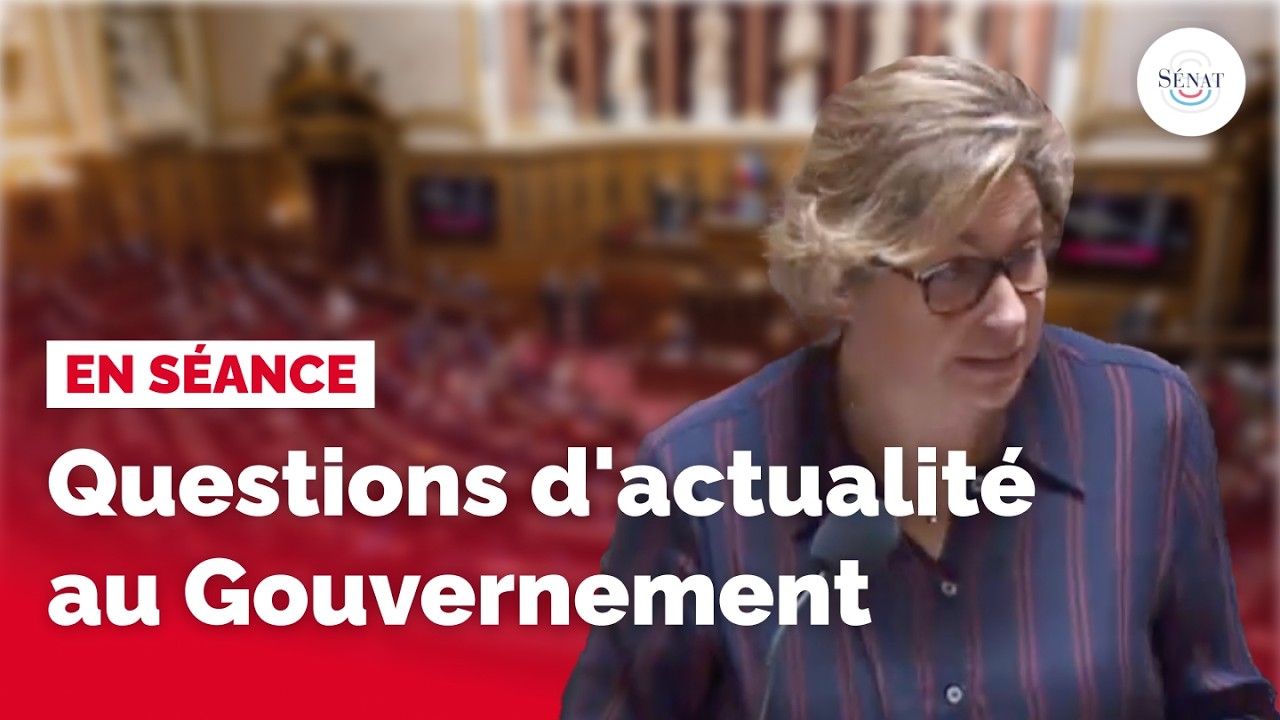
Questions d'actualité au Gouvernement
Keywords
Summary
234 words
Critical Evaluation
Value of the Information & Strength of the Argument
The video provides direct access to French parliamentary debates, offering primary source material on current political issues. The arguments are presented by elected officials and ministers, reflecting their political positions. The value lies in the transparency of the democratic process and the articulation of government policy. However, the argumentation is highly partisan, with each speaker advocating for their party’s stance, and there is no neutral analysis. The discussions on political violence, flood management, and Cuba are framed within ideological perspectives, which may limit the objectivity of the information.
Scientific Rigor, Source Quality, Title Accuracy
The source is the official Senate channel, which ensures institutional reliability. The content is a verbatim record of parliamentary proceedings, so the information is accurate as spoken, but it is not fact-checked or peer-reviewed. The title accurately describes the content. No external sources are cited within the video, and the description provides no additional references. The adequacy between title and content is perfect, as it is a direct recording of the session.
175 words
Title / Content Match
The title accurately reflects the content: a session of questions to the government in the Senate.
Quality & Reliability
7/10
Official parliamentary session, high institutional reliability, but political statements are inherently biased and not peer-reviewed.
Key Moments
Markers derived by PSI from the transcript: the creator did not define chapters.
- Opening of the session, moment of silence for Quentin de Ranque and firefighters.
- First question by Martin Lévrier on dissolution of militant groups.
- Gérald Darmanin's response, condemning ultra-left and Mélenchon.
- Second question by Claude Malhuret on political violence and LFI.
- Darmanin's second response, discussing dissolution laws.
- Third question by Nathalie Delattre on floods and GEMAPI.
- Mathieu Lefèvre's response on flood management and funding.
- Fourth question by Laurence Harribey criticizing flood response.
- Lefèvre's second response on resilience and cooperation.
- Fifth question by Marianne Margaté on Cuba and US embargo.
- Jean-Noël Barrot's response on French aid to Cuba.
Contribution & Novelties
The video provides an unfiltered view of French parliamentary dynamics and current political debates. It offers primary source material for understanding government positions on issues like political violence, flood management, and foreign policy. The novelty is the direct access to the legislative process, which is valuable for researchers and citizens.
Pour aller plus loin :
- French Senate official website — Official source for parliamentary documents and sessions.
- Loi séparatisme (law on separatism) — Overview of the law mentioned in the debate.
- GEMAPI (Gestion des milieux aquatiques et prévention des inondations) — Explanation of the flood management competence discussed.
98 words
Radar Profile
The radar profile shows moderate scores across all dimensions, with a slightly higher score for quantity of information and reliability, reflecting the institutional source. The low technical level indicates that the content is not specialized, but rather a general political debate.