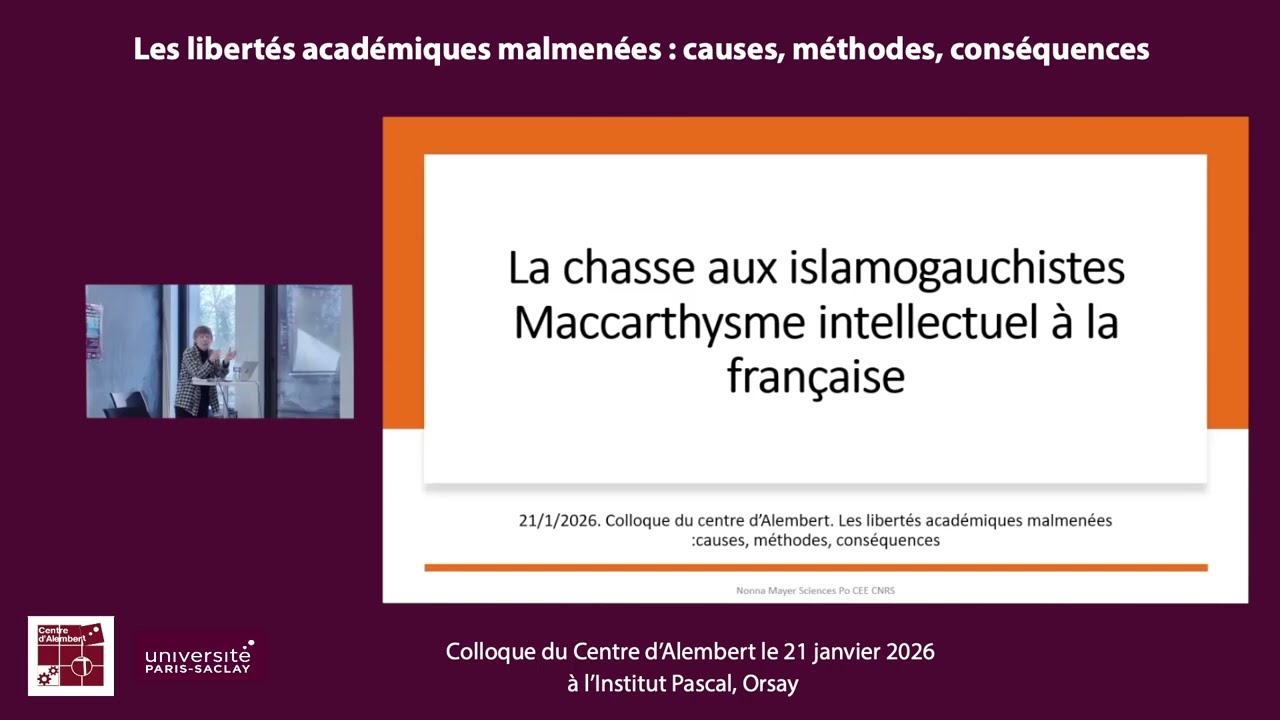
La chasse aux islamogauchistes : un maccarthysme intellectuel à la française
Keywords
Summary
151 words
Critical Evaluation
Value of the Information & Strength of the Argument
The talk provides valuable insights into the political and media dynamics behind the term ‘islamogauchisme’ and its impact on academic freedom in France. Mayer’s argument is well-structured, tracing the term’s history and demonstrating how it was used to discredit researchers. She effectively uses the analogy of McCarthyism to highlight the dangers of such stigmatization. The argumentation is solid, supported by references to specific events, publications, and data, such as the work of Benjamin Teinturier. However, the talk is primarily an opinion piece based on her personal experience and perspective, and it does not provide a systematic analysis of the broader phenomenon.
Scientific Rigor, Source Quality, Title Accuracy
Mayer demonstrates scientific rigor by referencing her own research and that of colleagues, including specific studies and publications. She mentions the book ‘Les mots qui fâchent’ and the work of Benjamin Teinturier, and she cites the CNCDH annual survey. However, the talk is not a formal academic presentation with full citations, and some claims are made without direct evidence. The title accurately reflects the content, focusing on the ‘chasse aux islamogauchistes’ and its comparison to McCarthyism. The talk is part of a conference session on academic freedoms, and Mayer’s expertise lends credibility to her arguments.
211 words
Title / Content Match
The title accurately reflects the content, which focuses on the instrumentalization of the term 'islamogauchisme' and its comparison to McCarthyism.
Quality & Reliability
8/10
The speaker is a highly qualified researcher (CNRS emeritus director, Sciences Po) with extensive expertise in political science and racism studies. The talk is based on her own research and that of colleagues, and references specific works and data. However, it is an opinion/expert talk rather than a peer-reviewed presentation, and some claims are not fully sourced in the video.
Key Moments
Markers derived by PSI from the transcript: the creator did not define chapters.
- Introduction: Mayer introduces herself and her role at CNRS and CNCDH.
- Tracing the origins of the term 'islamogauchisme' with Taguieff and Trigano.
- The role of media and political entrepreneurs in amplifying the term.
- Comparison with McCarthyism and the concept of moral panic.
- Consequences for researchers and strategies for response.
Cited Sources
- Les mots qui fâchent — Book co-edited by Mayer, Policar, and Corcuff (2022) that addresses the stigmatization of social sciences.
- French Democracy In Distress — Recent publication co-edited by Mayer (2025) on French politics.
- Jews and Muslims in the 19th district of Paris — Article by Mayer et al. (2025) in European Journal of Cultural Studies.
Concurring Sources
- Les mots qui fâchent — Book co-edited by Mayer that aligns with her arguments.
- CNCDH annual report on racism and antisemitism — Mayer coordinates this survey, which provides data on discrimination.
Dissenting Sources
- Observatoire du décolonialisme — This group attacked Mayer and her colleagues, representing a contrasting viewpoint.
Contribution & Novelties
The talk offers a unique perspective on the French academic debate by linking the ‘islamogauchisme’ controversy to historical McCarthyism and moral panic theory. It provides a detailed case study of how a term can be weaponized to attack researchers, and it emphasizes the importance of collective action and public engagement in defending academic freedom. The speaker’s personal experience adds authenticity to the analysis.
Pour aller plus loin :
- Moral panic — Concept used by Mayer to analyze the phenomenon.
- McCarthyism — Historical parallel drawn by Mayer.
- Academic freedom — Central theme of the talk.
94 words
Radar Profile
The radar profile shows high scores in information quantity, quality, and reliability, reflecting the speaker's expertise and the depth of content. The technical level is moderate, as the talk is accessible to a general audience but still engages with academic concepts.
💬 No comments were provided for analysis.