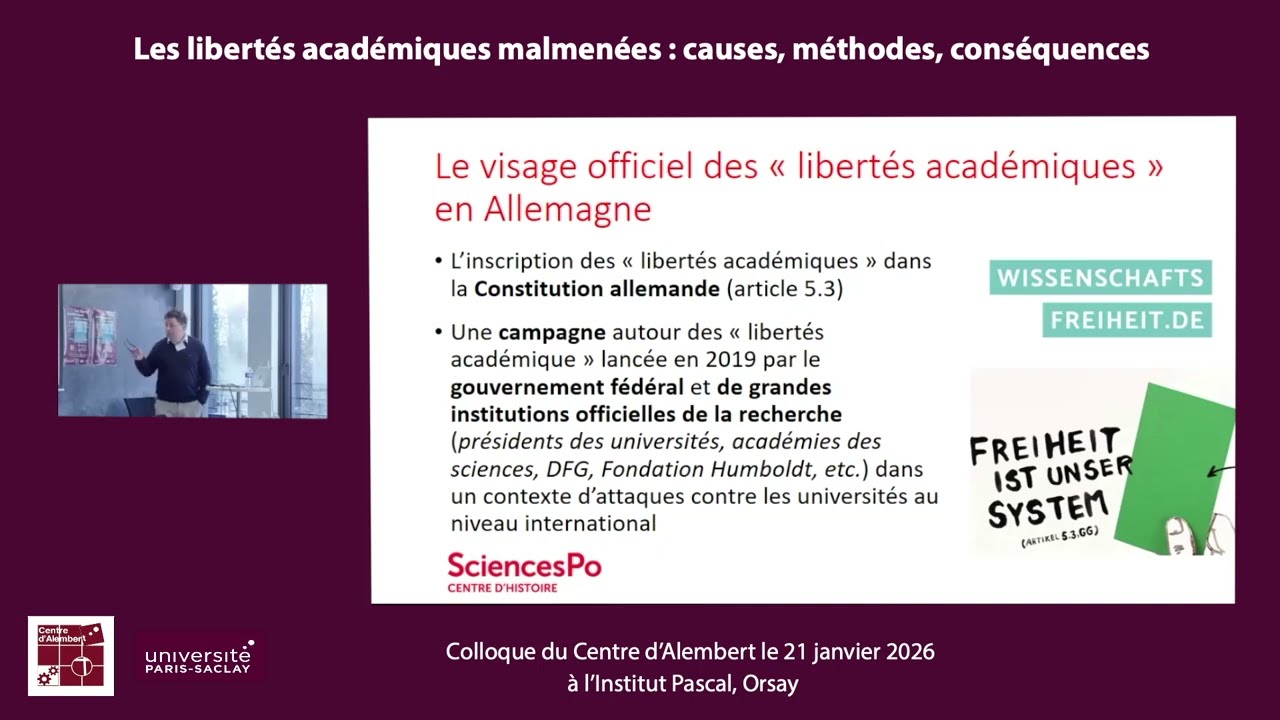
Jakob Vogel, professeur de l'Histoire de l'Europe (19e et 20e siècle) Sciences Po Paris.
Keywords
Summary
181 words
Critical Evaluation
Value of the Information & Strength of the Argument
The talk provides valuable insights into the current state of academic freedom in Germany, drawing on recent surveys, indices, and specific incidents. Vogel’s argumentation is solid, as he systematically contrasts the official self-image with the actual challenges, using data and examples. He effectively contextualizes the debate historically, showing that concerns about academic freedom are not new but have evolved. The discussion of the AfD’s appropriation of the discourse adds a contemporary political dimension. However, the talk is primarily an expert opinion, and some claims could benefit from more detailed evidence, such as the specific surveys and their methodologies.
Scientific Rigor, Source Quality, Title Accuracy
Vogel demonstrates scientific rigor by referencing specific studies, such as the Academic Freedom Index and surveys from the Free University of Berlin and Wissenschaft im Dialog. He also mentions concrete incidents, like the cancellation of a workshop at the University of Munich. The sources are credible, though not all are explicitly cited with URLs. The title accurately reflects the content, focusing on the historical and contemporary debates on academic freedom in Germany. The talk is well-structured and maintains a high level of expertise throughout.
197 words
Title / Content Match
The title accurately reflects the content, which focuses on the historical and contemporary debates on academic freedom in Germany, presented by a professor of European history.
Quality & Reliability
8/10
The speaker is a recognized historian and former director of the Marc Bloch Center, providing an expert analysis based on institutional knowledge and recent events. The talk is well-structured, referencing specific studies and indices, though it is an opinion piece rather than a systematic review.
Key Moments
Markers derived by PSI from the transcript: the creator did not define chapters.
- Introduction: speaker's background and focus on recent developments in academic freedom in Germany.
- Discussion of the constitutional basis of academic freedom in Germany and the 2019 campaign.
- Presentation of survey data showing positive views among academics but more negative public perception.
- Impact of Gaza conflict on German universities, including protests and political pressure.
- Analysis of the network Wissenschaftsfreiheit and its role in the debate.
- Historical comparison with the Union for Academic Freedom in the 1970s.
- Role of the AfD and its anti-university rhetoric, inspired by Trump.
- Conclusion: academic freedom remains a constitutional principle, but concerns for the future are raised.
Cited Sources
- Academic Freedom Index — Referenced to show Germany's positive ranking in academic freedom.
- Wissenschaft im Dialog — Survey on public perception of academic freedom in Germany.
- Free University of Berlin study — Survey among academics on their perception of academic freedom.
- Wissenschaftsfreiheit network — Network claiming to defend academic freedom, discussed in the talk.
Concurring Sources
- Academic Freedom Index — Supports the claim that Germany ranks relatively high in academic freedom.
Dissenting Sources
- Wissenschaftsfreiheit network — The network presents a more alarmist view of academic freedom in Germany, which contrasts with the speaker's more moderate assessment.
Contribution & Novelties
This talk offers a nuanced perspective on academic freedom in Germany, highlighting the gap between self-perception and public opinion, and the influence of political debates such as the Gaza conflict. It also traces the historical evolution of such debates, comparing current networks to earlier movements.
Pour aller plus loin :
- Academic Freedom Index — Provides global rankings and data on academic freedom.
- Wissenschaftsfreiheit network — A German network discussing academic freedom, with articles and statements.
- Marc Bloch Center — Research center on Franco-German relations, relevant to the speaker’s background.
- Central European University — Example of academic freedom challenges in Hungary, mentioned in the talk.
104 words
Radar Profile
The radar profile shows high scores in information quantity, quality, technical level, and reliability, indicating a well-informed and credible presentation. The balance across dimensions suggests a comprehensive analysis, with slightly lower technical level due to the non-technical nature of the topic.
💬 No comments were provided for analysis.