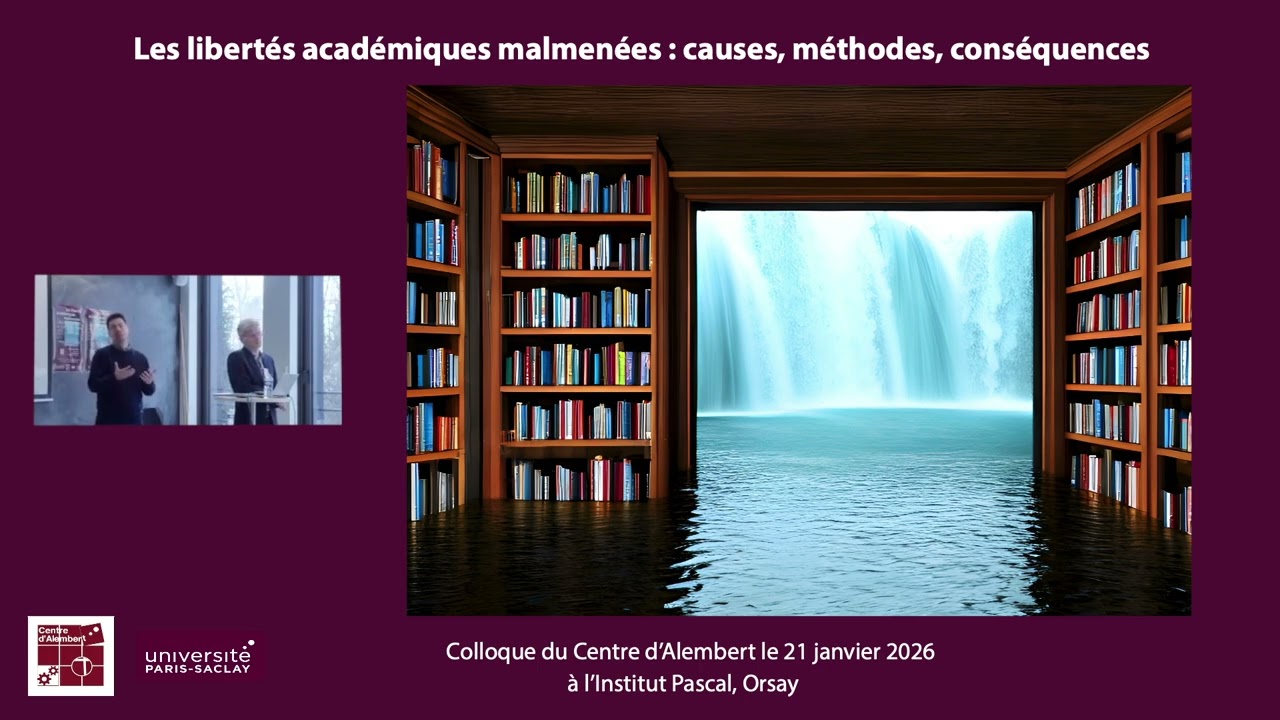
Session 1 : Questions du public à Quentin Landenne et Jérôme Heurtaux
Keywords
Summary
202 words
Critical Evaluation
Value of the Information & Strength of the Argument
The value of the information lies in the nuanced, expert perspectives on a complex topic. The speakers provide a sophisticated analysis of the conceptual distinctions between academic freedom and freedom of expression, drawing on legal, philosophical, and historical contexts. They also offer practical examples from their own experiences, which adds concreteness. The argumentation is solid, as they build on each other’s points and address potential counterarguments. However, the discussion is exploratory and does not present a systematic thesis or empirical evidence, which limits its conclusiveness. The speakers acknowledge the complexity and lack of consensus, which is intellectually honest.
Scientific Rigor, Source Quality, Title Accuracy
The scientific rigor is moderate: the speakers are experts in political science and philosophy, and they reference legal frameworks and historical precedents, but they do not cite specific academic sources or provide a literature review. The quality of sources is therefore based on their expertise rather than explicit citations. The title accurately reflects the content, as it is a Q&A session. The discussion is well-structured and stays on topic, though it is conversational and not a formal lecture.
191 words
Title / Content Match
The title accurately reflects the content: a Q&A session with the two speakers, focusing on academic freedom and freedom of expression.
Quality & Reliability
7/10
The discussion is a nuanced academic debate between two scholars, with references to legal and philosophical frameworks. However, it is a live Q&A session without formal citations or peer-reviewed sources, and the arguments are based on personal expertise and examples.
Key Moments
Markers derived by PSI from the transcript: the creator did not define chapters.
- Introduction and first question on the articulation between academic freedom and freedom of expression.
- Landenne argues that academic freedom is not reducible to freedom of expression, emphasizing epistemic standards.
- Heurtaux discusses the historical precedence of academic freedom and the role of the state.
- Examples of academics speaking on the Israeli-Palestinian conflict and the challenges of defending them.
- Discussion on the limits of academic freedom and the role of funding and institutional structures.
- Heurtaux critiques the trend of restricting academic speech through charters, arguing for broader public engagement.
- Landenne reflects on the relativity of academic freedom and the need to address structural issues.
- Concluding remarks on the importance of collegiality and democratic legitimacy in academic freedom.
Contribution & Novelties
The video provides a nuanced, expert discussion on the conceptual and practical distinctions between academic freedom and freedom of expression, highlighting the epistemic and institutional dimensions often overlooked in public debates. It offers concrete examples and critiques of current trends, such as the proliferation of charters restricting academic speech.
Pour aller plus loin :
- Academic Freedom — Provides a general overview of the concept and its historical development.
- Freedom of Speech — Contextualizes the broader legal and philosophical framework.
- Humboldtian model of higher education — Relevant to the discussion of the link between research and teaching.
96 words
Radar Profile
The radar profile shows a balanced performance across all dimensions, with slightly higher scores in quality of information and fiabilité, reflecting the expert nature of the discussion. The lower score in technical level indicates that the content is accessible to a general audience, while still maintaining intellectual depth.