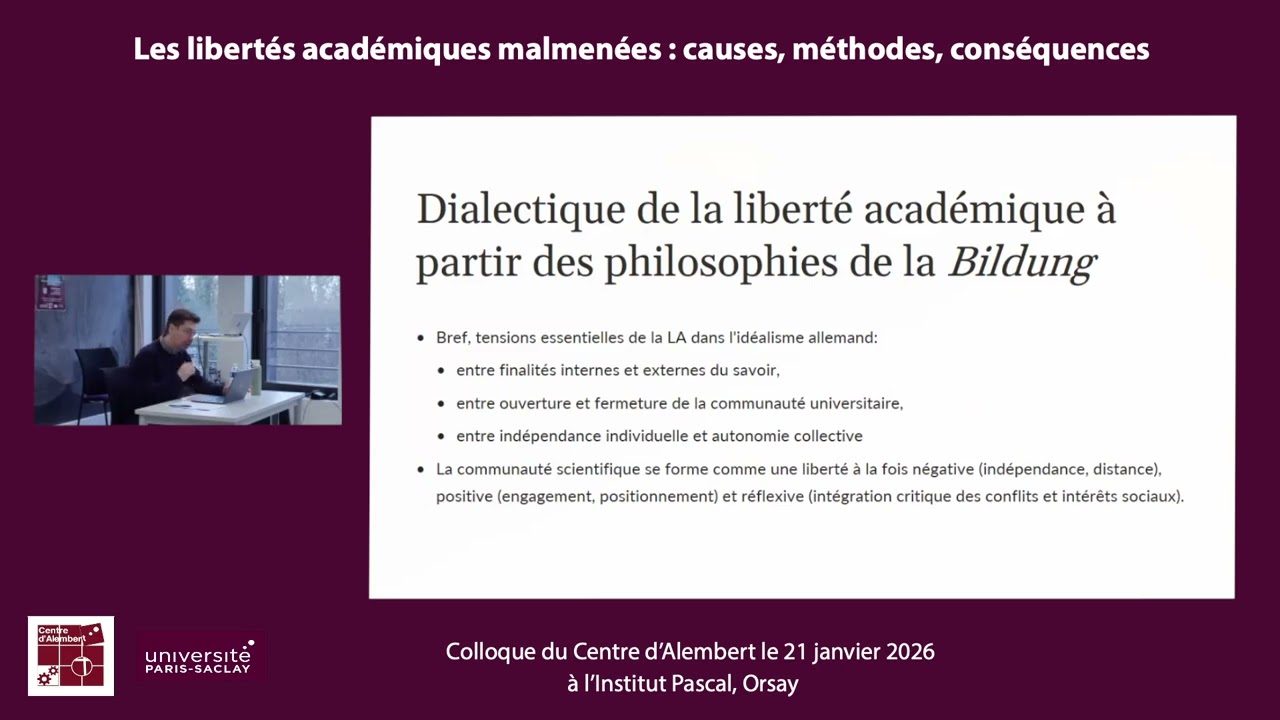
La dialectique de la liberté académique et de ses contraintes. Pour un modèle en spirales
Keywords
Summary
165 words
Critical Evaluation
Value of the Information & Strength of the Argument
The lecture provides a high-value philosophical analysis of academic freedom, synthesizing historical and contemporary sources. The argumentation is rigorous and well-structured, systematically building from historical foundations to a nuanced model. The speaker effectively addresses counterpoints, such as the distinction between academic freedom and freedom of expression, and the tension between democratic equality and epistemic authority. The spiral model is a creative and insightful contribution, offering a framework to reconcile different levels of rights and responsibilities. The reasoning is clear and persuasive, though it remains at a theoretical level without empirical evidence.
Scientific Rigor, Source Quality, Title Accuracy
The speaker demonstrates strong scientific rigor by grounding his argument in primary sources (Kant, Fichte, Humboldt, Mill, Dewey) and contemporary scholars (Post, Engel, Laborde). He accurately references the 1915 AAUP declaration and the EU Charter of Fundamental Rights. The title accurately reflects the content, and the lecture is well-organized. The sources are credible and appropriately cited, though the talk is an expert opinion rather than a systematic literature review.
175 words
Title / Content Match
The title accurately reflects the content: a dialectical analysis of academic freedom and its constraints, culminating in a spiral model.
Quality & Reliability
8/10
The speaker is a qualified researcher (FNRS) and professor, providing a well-structured philosophical argument grounded in historical sources (Kant, Fichte, Humboldt, Mill, Dewey) and contemporary references (Robert Post, Pascal Engel, Cécile Laborde). The talk is rigorous and nuanced, though it remains an opinion/expert analysis rather than an empirical study.
Key Moments
Markers derived by PSI from the transcript: the creator did not define chapters.
- Introduction: focus on philosophical justification of academic freedom.
- Kant's 'Conflict of Faculties' and the tension between internal and external ends of knowledge.
- Fichte's emphasis on self-discipline and the educational mission.
- Humboldt's link between research and teaching, and the community of scholars.
- Democratic justifications: Mill, Dewey, and the 1915 AAUP declaration.
- Distinction between academic freedom and freedom of expression.
- The right to science as a fundamental right, and the spiral model.
- Distribution of rights and responsibilities across different actors.
Cited Sources
- The Conflict of the Faculties — Kant's seminal work on academic freedom, cited as the first major justification.
- AAUP 1915 Declaration of Principles on Academic Freedom and Academic Tenure — Mentioned as a key document combining negative and positive justifications.
- Charter of Fundamental Rights of the European Union, Article 13 — Cited as an explicit expression of academic freedom as a fundamental right.
- Universal Declaration of Human Rights, Article 27 — Quoted to support the right to participate in scientific progress.
Concurring Sources
- Academic Freedom and the Future of the University — General literature supporting the importance of academic freedom.
Dissenting Sources
- Critiques of academic freedom as a privilege — Some scholars argue that academic freedom is a professional privilege rather than a universal right.
Contribution & Novelties
The lecture offers a novel synthesis of historical and contemporary justifications of academic freedom, culminating in a ‘spiral model’ that integrates strict and broad conceptions. It provides a nuanced distinction between academic freedom and freedom of expression, and argues for a fundamental right to science. The model is a valuable contribution to the philosophical debate.
Pour aller plus loin :
- Bildung — Relevant to the German ideal of self-formation.
- Academic freedom — Overview of the concept.
- Robert Post — His work on democratic competence and academic freedom.
87 words
Radar Profile
The radar profile shows high scores in information quality and technical level, indicating a dense and rigorous philosophical analysis. The fiabilite_globale is also high, reflecting the speaker's expertise and use of credible sources. The quantite_information is slightly lower, as the talk is focused on a specific argument rather than broad coverage.
💬 Sur les 0 commentaires analysés, aucune tendance n'est disponible.