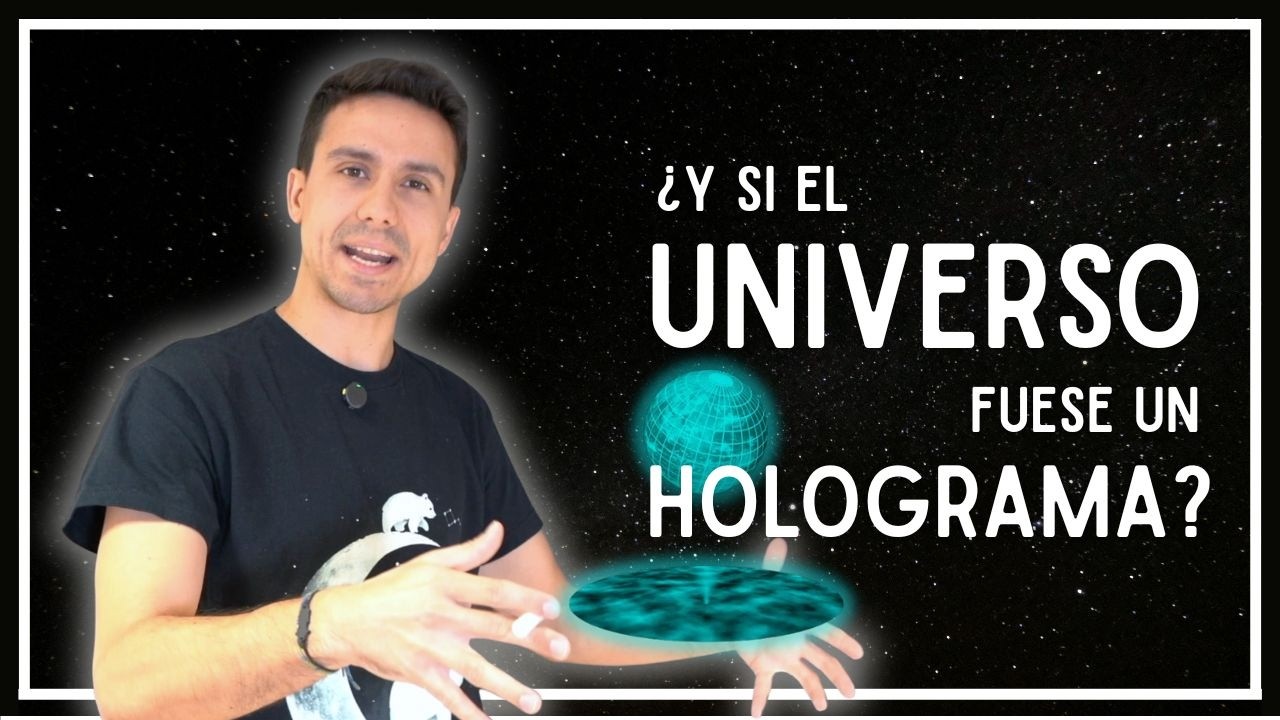
¿Vivimos en un HOLOGRAMA? El principio holográfico
Keywords
Summary
169 words
Critical Evaluation
Value of the Information & Strength of the Argument
The video provides a high-value explanation of a complex topic, breaking it down into logical steps. The argumentation is solid, building from established physics (general relativity, thermodynamics) to the holographic principle. The presenter carefully outlines assumptions and uses a thought experiment to derive the entropy bound, making the reasoning transparent. The connection to AdS/CFT is mentioned as a concrete realization, adding credibility. The video does not oversimplify but manages to convey the core ideas without requiring advanced background.
Scientific Rigor, Source Quality, Title Accuracy
The scientific rigor is high, with accurate explanations and references to key papers (Bekenstein 1973, Strominger & Vafa 1996) provided in the description. The title accurately reflects the content, which is a focused exploration of the holographic principle. The video is produced by a reputable institution (IFT), adding to its reliability. The content is well-structured and avoids sensationalism, presenting the holographic principle as a serious theoretical proposal.
160 words
Title / Content Match
The title accurately reflects the content, which explores the holographic principle and its implications for our understanding of the universe.
Quality & Reliability
9/10
The video is produced by the Instituto de Física Teórica (IFT), a recognized research institution. The content is presented by a physicist and follows a logical, rigorous progression from general relativity to the holographic principle. The explanation is accurate and includes references to key scientific papers (Bekenstein 1973, Strominger & Vafa 1996). The presentation is clear and well-structured, with appropriate visual aids.
Key Moments
Markers derived by PSI from the transcript: the creator did not define chapters.
- Introduction to general relativity and black holes
- Explanation of Hawking radiation and black hole temperature
- Derivation of black hole entropy proportional to area
- Thought experiment leading to the holographic bound
- Contradiction with locality and introduction of holographic principle
- Mention of AdS/CFT correspondence as an example
Cited Sources
- Black holes and entropy — Bekenstein's original paper establishing black hole entropy proportional to area.
- Microscopic origin of the Bekenstein-Hawking entropy — Strominger and Vafa's paper providing a microscopic derivation of black hole entropy in string theory.
- Tensor Networks and Entanglement — Article discussing emergent spacetime and tensor networks, related to the holographic principle.
Concurring Sources
- The holographic principle — Original paper by 't Hooft proposing the holographic principle.
External References
Contribution & Novelties
The video provides a clear and accessible explanation of the holographic principle, tracing its motivation from black hole thermodynamics. It effectively communicates the conceptual leap from area scaling of entropy to the idea that the universe might be a hologram. The presentation is original in its pedagogical approach, using a thought experiment to derive the entropy bound and highlighting the contradiction with locality.
Pour aller plus loin :
- AdS/CFT correspondence — A concrete realization of the holographic principle, relating a gravity theory in anti-de Sitter space to a conformal field theory on the boundary.
- Holographic principle — Overview of the concept and its implications.
- Bekenstein bound — The upper limit on entropy for a region with given energy and size, central to the holographic argument.
125 words
Radar Profile
The radar profile shows high scores in information quantity, quality, and reliability, with a slightly lower but still strong technical level. This indicates a well-balanced, rigorous, and informative video that is accessible to a broad audience while maintaining scientific depth.
💬 Très positif. Sur les 30 commentaires analysés, la grande majorité exprime une forte appréciation, saluant la clarté de l'explication et la qualité de la vulgarisation, avec quelques remarques constructives sur la complexité du sujet.