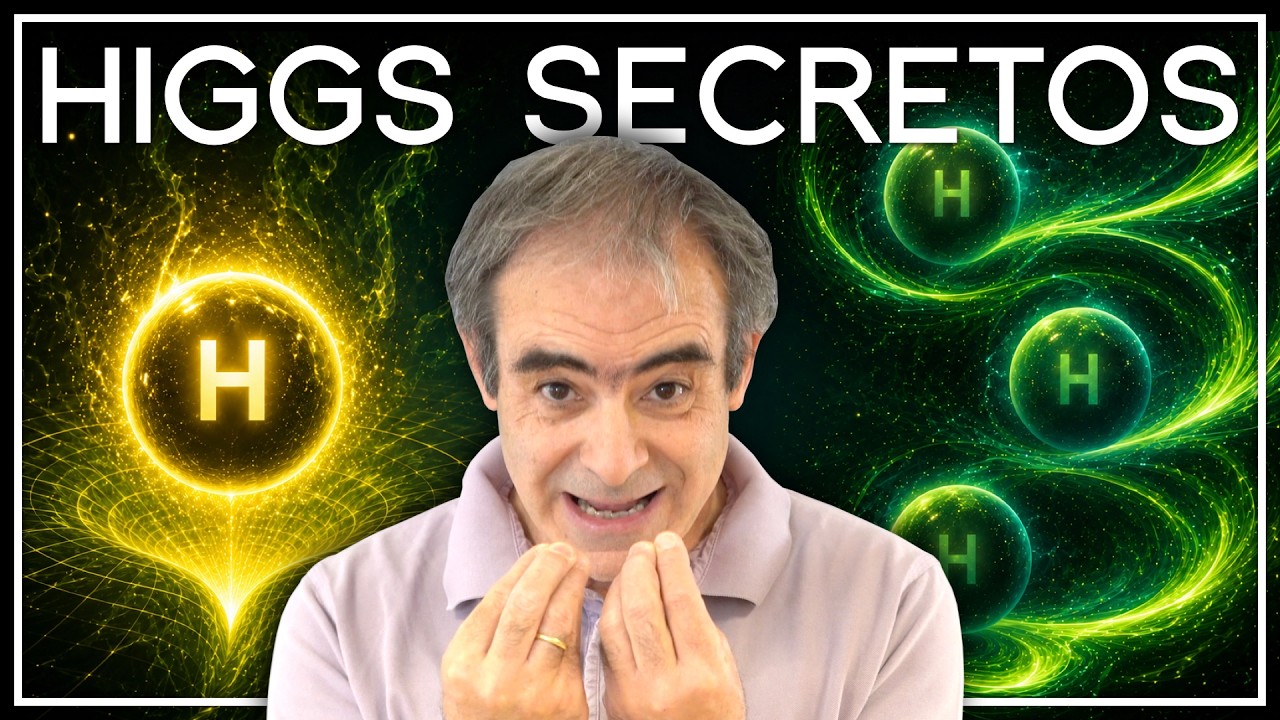
El secreto mejor guardado del Higgs: sus 3 hermanos desaparecidos
Keywords
Summary
135 words
Critical Evaluation
Value of the Information & Strength of the Argument
The video provides a clear and insightful explanation of the Higgs mechanism, emphasizing the role of polarization states and gauge symmetry. The argumentation is logical and builds step by step, making complex concepts accessible. It successfully conveys the deep connection between mass, symmetry breaking, and the existence of the Higgs boson. The use of analogies and visual explanations enhances understanding without oversimplifying the physics.
Scientific Rigor, Source Quality, Title Accuracy
The content is scientifically rigorous, consistent with the Standard Model of particle physics. The presenter is a researcher at a reputable institution, and the video is produced by the IFT. The title accurately reflects the content, focusing on the three ‘hidden’ degrees of freedom. The video does not cite specific sources, but the description includes links to the IFT website and social media, as well as to videos on the cosmic eye and the Higgs discovery, which are relevant. The title-content alignment is excellent.
163 words
Title / Content Match
The title is catchy and accurate, highlighting the three 'hidden' degrees of freedom absorbed by the W and Z bosons, which are indeed the 'missing siblings' of the Higgs boson.
Quality & Reliability
9/10
The video is produced by the Instituto de Física Teórica (IFT), a recognized research center, and presented by a researcher (Ángel Uranga). The content is accurate, well-structured, and aligns with established physics. The explanation of the Higgs mechanism via gauge symmetry and polarization is rigorous and up-to-date.
Chapters
Cited Sources
- IFT website — Official website of the Instituto de Física Teórica, providing information about the institution and its research.
- Cosmic Eye video — Referenced in the description as a credit for visuals, showing scales of the universe.
- Higgs discovery video — Referenced in the description as a credit for the CERN Higgs discovery footage.
Concurring Sources
- Standard Model — The video's content aligns with the Standard Model of particle physics.
Contribution & Novelties
The video offers a fresh perspective on the Higgs mechanism by focusing on the polarization states of gauge bosons, which is often overlooked in popular explanations. It clarifies that the Higgs boson is not alone but is accompanied by three ‘hidden’ fields that give mass to the W and Z bosons. This approach provides a deeper understanding of the mechanism and its connection to symmetry breaking.
Pour aller plus loin :
- Spontaneous symmetry breaking — Key concept underlying the Higgs mechanism.
- Higgs mechanism — Detailed explanation of the mechanism.
- Electroweak interaction — Unification of electromagnetic and weak forces.
98 words
Radar Profile
The radar profile shows high scores in information quantity, quality, and reliability, with a slightly lower but still strong technical level. This indicates a well-balanced, informative, and trustworthy video that is accessible to a broad audience while maintaining scientific depth.