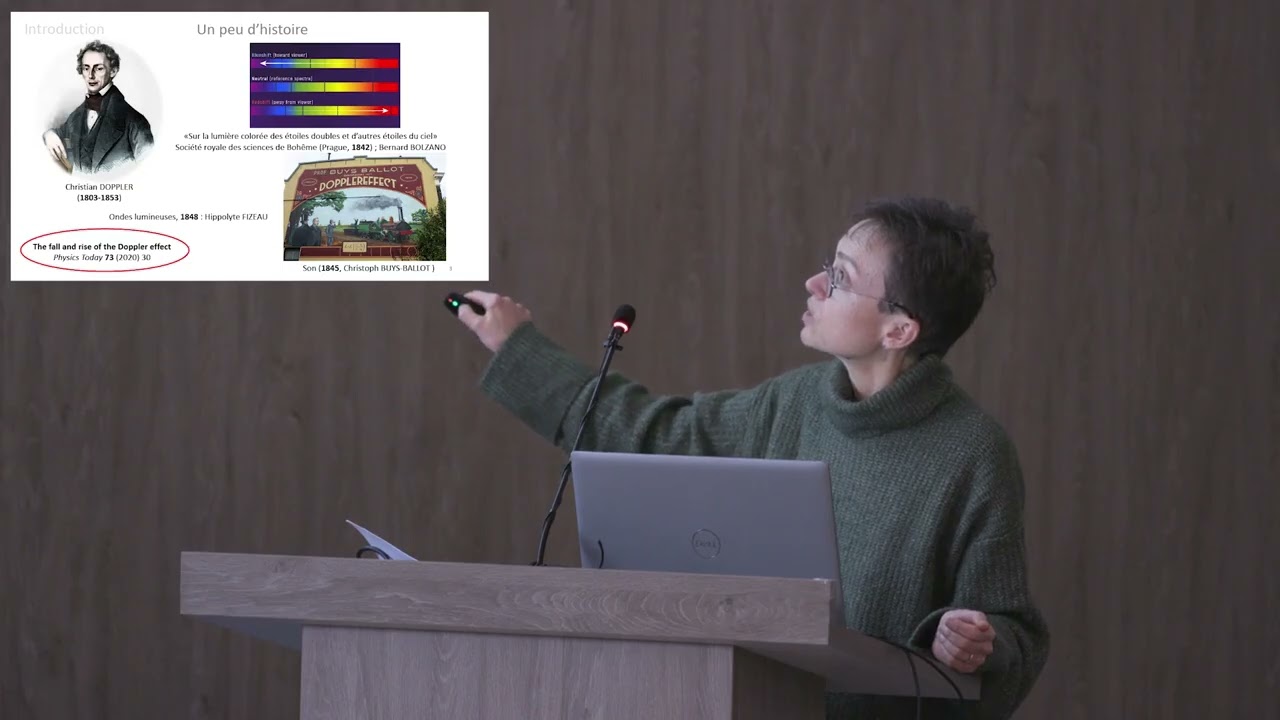
Effet Doppler rotationnel: de la théorie aux applications
Keywords
Summary
139 words
Critical Evaluation
Value of the Information & Strength of the Argument
The talk provides a comprehensive overview of the rotational Doppler effect, from its theoretical foundations to experimental implementations. The speakers effectively argue for the importance of OAM in this context, explaining why spin angular momentum has limited effects. They present experimental evidence, including detection of rotation of a sphere and fluid vortices, which strengthens the validity of the effect. The argumentation is logical and well-supported by references to prior work, such as that of Miles Padgett. The presentation also highlights potential applications, such as remote sensing and metrology, which adds to its value.
Scientific Rigor, Source Quality, Title Accuracy
The scientific rigor is high, with the speakers being experts in the field. They cite relevant literature, including historical papers and recent studies. The sources mentioned are credible, such as the work of Padgett and the company KEOPS. The title accurately reflects the content, and the talk is well-structured. The historical account of Doppler is detailed and adds context. The presentation is a conference talk, so it is not peer-reviewed, but the content aligns with established physics. The adequacy between title and content is excellent.
193 words
Title / Content Match
The title accurately reflects the content, which covers both the theory and applications of the rotational Doppler effect.
Quality & Reliability
8/10
The presentation is given by two professors of physics at the University of Rennes, with a solid background in optics and quantum physics. The content is well-structured, covering the theoretical basis, experimental demonstrations, and applications. The historical account of Doppler is detailed and accurate. The talk is a conference presentation, not peer-reviewed, but the speakers are experts and the content aligns with established physics.
Key Moments
Markers derived by PSI from the transcript: the creator did not define chapters.
- Introduction and presentation of the speakers by the host.
- Janine Emile begins with an overview of the linear Doppler effect and its applications.
- Historical account of Christian Doppler's life and the controversy surrounding his work.
- Introduction to the rotational Doppler effect and the concept of orbital angular momentum (OAM).
- Explanation of OAM beams, including Laguerre-Gaussian beams and their generation.
- Experimental setup and demonstration of detecting rotation using OAM light.
- Detection of rotation of a sphere and fluid vortices.
- Discussion of applications, including remote sensing and metrology.
- Perspectives and future directions for the rotational Doppler effect.
- Conclusion and Q&A session.
Cited Sources
- Article on Christian Doppler's life — Mentioned by Janine Emile as a recent article about Doppler's life.
- KEOPS company — Mentioned as a company that generates OAM beams.
Concurring Sources
- Wikipedia: Orbital angular momentum of light — General reference on OAM.
- Wikipedia: Doppler effect — General reference on Doppler effect.
Contribution & Novelties
The talk provides a clear and accessible introduction to the rotational Doppler effect, which is a relatively recent and less explored phenomenon. It bridges theory and applications, offering insights into how OAM light can be used to detect rotation. The presentation also highlights the historical context and the contributions of key scientists.
Pour aller plus loin :
- Orbital angular momentum of light — Overview of OAM and its applications.
- Laguerre-Gaussian mode — Mathematical description of LG beams.
- Rotational Doppler effect — Brief explanation of the effect.
86 words
Radar Profile
The radar profile shows high scores in quantity and quality of information, with a moderate technical level. The reliability is high, reflecting the expertise of the speakers. The overall profile indicates a well-rounded and informative presentation.
💬 No comments were provided for analysis.