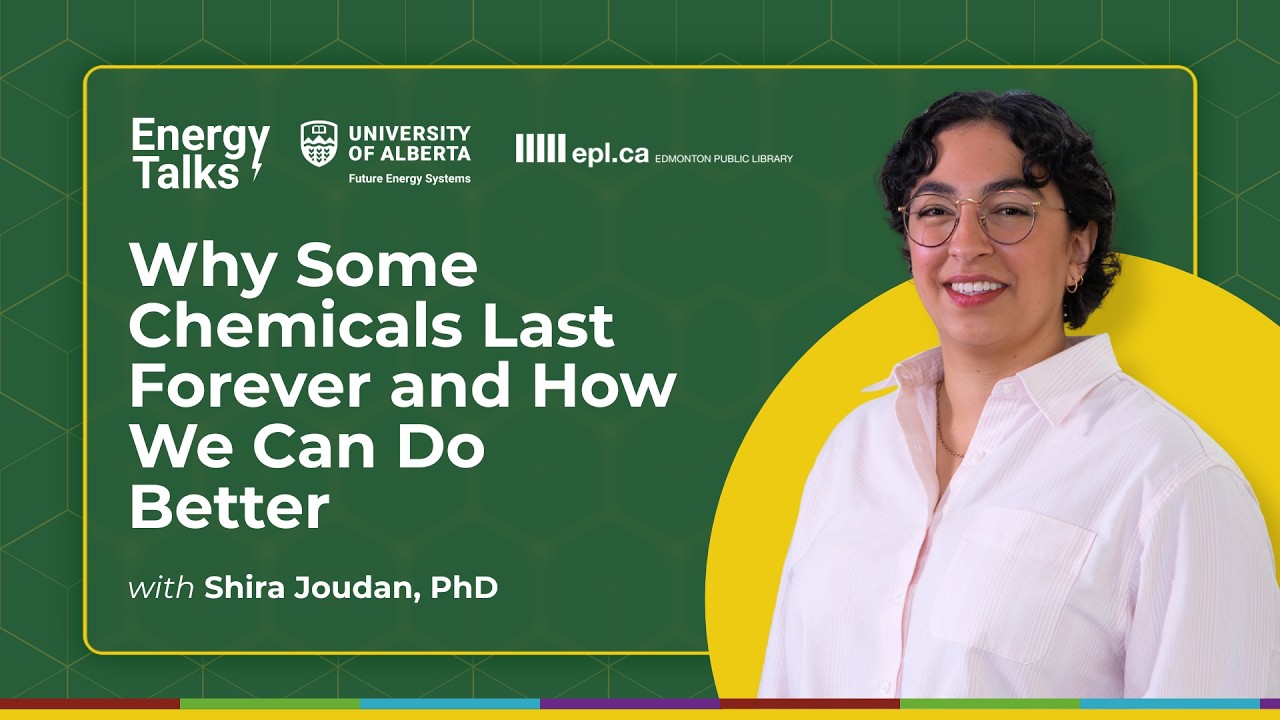
Why Some Chemicals Last Forever and How We Can Do Better | Energy Talks
Keywords
Summary
194 words
Critical Evaluation
Value of the Information & Strength of the Argument
The presentation provides valuable information about the environmental behavior of chemicals, particularly PFAS, and the regulatory framework in Canada. The argumentation is solid, as it builds logically from general principles of chemical persistence to specific examples like DDT and PFAS. The speaker effectively uses her own research experiences to illustrate methods for studying these chemicals, such as field measurements and laboratory simulations. She also raises important considerations, such as the challenges of proving toxicity and the global equity implications of long-range transport. The talk is well-structured and accessible, making complex topics understandable without oversimplifying.
Scientific Rigor, Source Quality, Title Accuracy
The scientific rigor is high, as the speaker is an expert in the field and presents established concepts and regulations. She references the Stockholm Convention and Canadian regulatory thresholds, which are well-documented. However, she does not provide specific citations for many claims, which is typical for a general-audience talk. The title accurately reflects the content, focusing on the persistence of certain chemicals and the potential for improvement. The talk is part of a university research program’s outreach series, which adds credibility. No comments were provided for analysis.
196 words
Title / Content Match
The title accurately reflects the content: the talk explains why certain chemicals (PFAS) persist in the environment and discusses how understanding their properties can inform greener chemical design.
Quality & Reliability
8/10
The talk is given by a chemistry professor with expertise in environmental analytical chemistry, and it is hosted by a university research program. The content is scientifically accurate, well-structured, and based on established concepts and regulations. However, it is a general-audience presentation without detailed citations, and some claims (e.g., specific half-life thresholds) are simplified.
Key Moments
Markers derived by PSI from the transcript: the creator did not define chapters.
- Introduction by Valerie, land acknowledgement, and introduction of speaker Shira Joudan.
- Shira introduces her research group and their focus on environmental analytical chemistry.
- Discussion of the number of chemicals in commerce (350,000) and the challenge of identifying problematic ones.
- Explanation of the five characteristics of 'bad' chemicals: persistence, bioaccumulation, toxicity, long-range transport, and mobility.
- Canadian regulatory thresholds for persistence (half-lives in air, water, soil, sediment).
- Introduction to the Stockholm Convention and example of DDT and its transformation products.
- Definition of PFAS and why they are called 'forever chemicals'.
- Discussion of the large number of PFAS compounds and the need for class-based regulation.
- Explanation of why fluorine is added to chemicals and its effects on properties.
- Discussion of the potential for designing greener chemicals and the importance of considering transformation products.
Cited Sources
- Joudan Lab — Shira Joudan's research group website, mentioned as a resource to learn more about her work.
- Future Energy Systems — The host organization for the talk, providing context on the energy transition research program.
- Future Energy Systems Learning Page — Mentioned as a resource for educational materials related to energy systems.
Concurring Sources
- Stockholm Convention on Persistent Organic Pollutants — The international treaty that lists persistent organic pollutants, including PFAS, and aligns with the talk's discussion of global regulation.
- EPA PFAS Information — The U.S. Environmental Protection Agency's page on PFAS, providing scientific and regulatory information consistent with the talk's content.
Dissenting Sources
- No discordant sources identified — The talk is consistent with established scientific and regulatory information on PFAS and persistent organic pollutants.
External References
Contribution & Novelties
The talk provides a clear and accessible overview of why certain chemicals persist in the environment, focusing on PFAS as a case study. It highlights the importance of persistence as a key driver of environmental problems and discusses the regulatory challenges posed by the large number of PFAS compounds. The speaker also emphasizes the need to consider transformation products and the entire life cycle of chemicals, which is a valuable perspective for designing greener alternatives.
Pour aller plus loin :
- Stockholm Convention on Persistent Organic Pollutants — The international treaty regulating persistent organic pollutants, including PFAS.
- PFAS in the Environment — The U.S. EPA’s page on PFAS, providing information on health effects and regulations.
- Green Chemistry — The American Chemical Society’s resources on green chemistry principles.
- Environmental Chemistry — Overview of the field, including the study of chemical behavior in the environment.
142 words
Radar Profile
The radar profile shows high scores in information quantity, quality, and reliability, with a slightly lower score in technical level, reflecting the talk's accessibility to a general audience. The overall profile indicates a well-balanced and credible presentation.