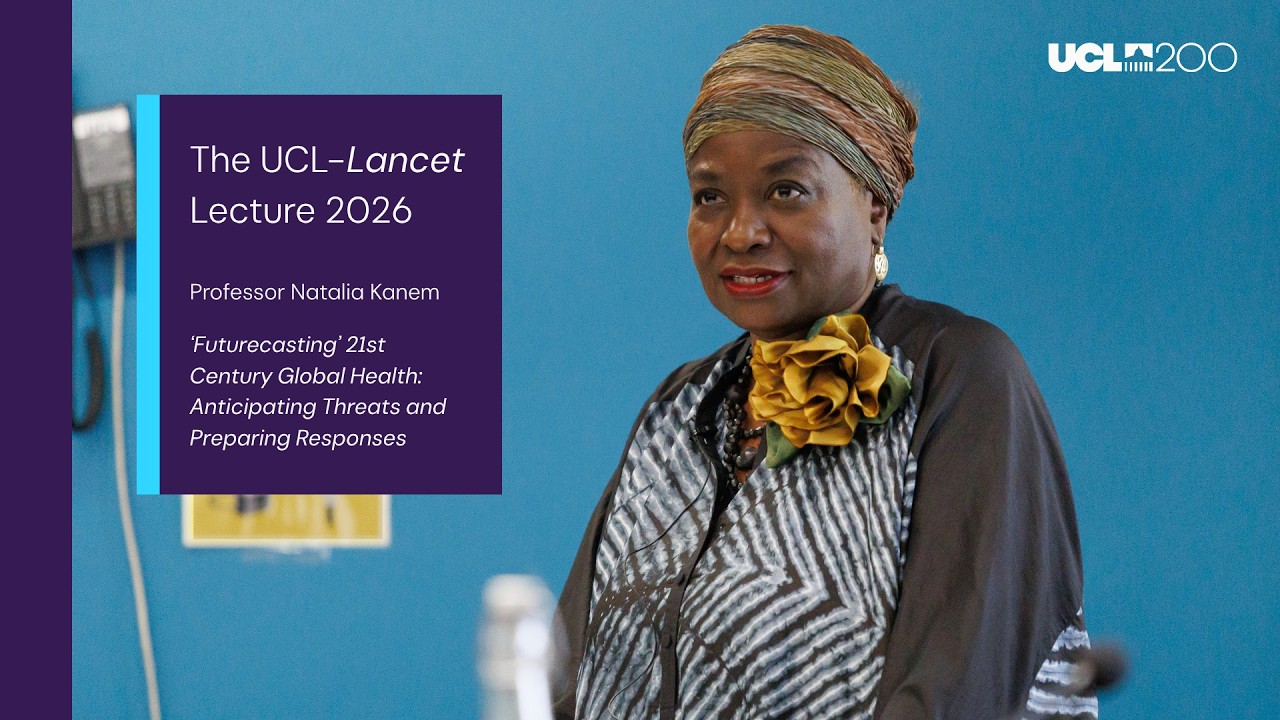
The UCL-Lancet Lecture 2026: Professor Natalia Kanem
Keywords
Summary
140 words
Critical Evaluation
Value of the Information & Strength of the Argument
The lecture provides valuable insights into the future of global health, offering a structured framework for assessing threats using DALYs and scenario analysis. Kanem’s argumentation is solid, drawing on her extensive experience and the work of the Lancet Commission. She effectively balances optimism and realism, acknowledging both the potential for progress and the risks of inaction. The emphasis on the need for political will and interdisciplinary collaboration is well-argued and supported by examples.
Scientific Rigor, Source Quality, Title Accuracy
The lecture demonstrates scientific rigor through its use of established metrics (DALYs) and references to recognized institutions (WHO, IHME). The sources cited are credible, including the Alma-Ata Declaration and the work of The Lancet Commission. The title accurately reflects the content, and the lecture is well-structured. The presentation is grounded in evidence, though some claims are forward-looking and speculative by nature.
149 words
Title / Content Match
The title accurately reflects the content: a lecture on anticipating 21st-century global health threats and preparing responses, given by Professor Natalia Kanem.
Quality & Reliability
8/10
The lecture is delivered by a highly qualified expert (former UNFPA Executive Director, co-chair of The Lancet Commission on 21st Century Global Health Threats) and is hosted by UCL and The Lancet, ensuring academic credibility. The content is forward-looking and based on recognized methodologies (DALYs, scenario analysis), but it is primarily an expert opinion with limited peer-reviewed data presented in the talk.
Key Moments
Markers derived by PSI from the transcript: the creator did not define chapters.
- Introduction and tribute to John Yudkin
- Introduction of Professor Natalia Kanem
- Start of lecture: futurecasting and the importance of foresight
- Discussion of global population trends and health achievements
- Introduction of The Lancet Commission and methodology using DALYs
- Highlighting six major threats: AI, pandemics, AMR, climate change, aging, conflict
- Discussion of current challenges: US withdrawal from WHO, aid cuts, misinformation
- Call to action: need for political will and global cooperation
Cited Sources
- UCL Institute for Global Health — Co-host of the lecture and related to the topic of global health.
Concurring Sources
- World Health Organization — Cited as a source for global health statistics and definitions.
Contribution & Novelties
The lecture provides a comprehensive overview of potential global health threats up to 2100, using a rigorous framework based on DALYs and scenario analysis. It emphasizes the need for proactive, interdisciplinary approaches and highlights the importance of political will in addressing these threats. The lecture is particularly valuable for its long-term perspective and its call to action for global cooperation.
Pour aller plus loin :
- Disability-adjusted life years (DALYs) — A key metric used in the lecture to quantify health burdens.
- The Lancet Commission on 21st Century Global Health Threats — The commission co-chaired by Kanem, which is the basis of the lecture’s content.
- Alma-Ata Declaration — Referenced in the lecture as a foundational definition of health.
117 words
Radar Profile
The radar profile shows high scores in information quantity, quality, and reliability, with a moderate technical level. This indicates a well-informed, credible lecture that is accessible to a broad audience, though it does not delve deeply into technical details.
💬 No comments were provided for analysis.