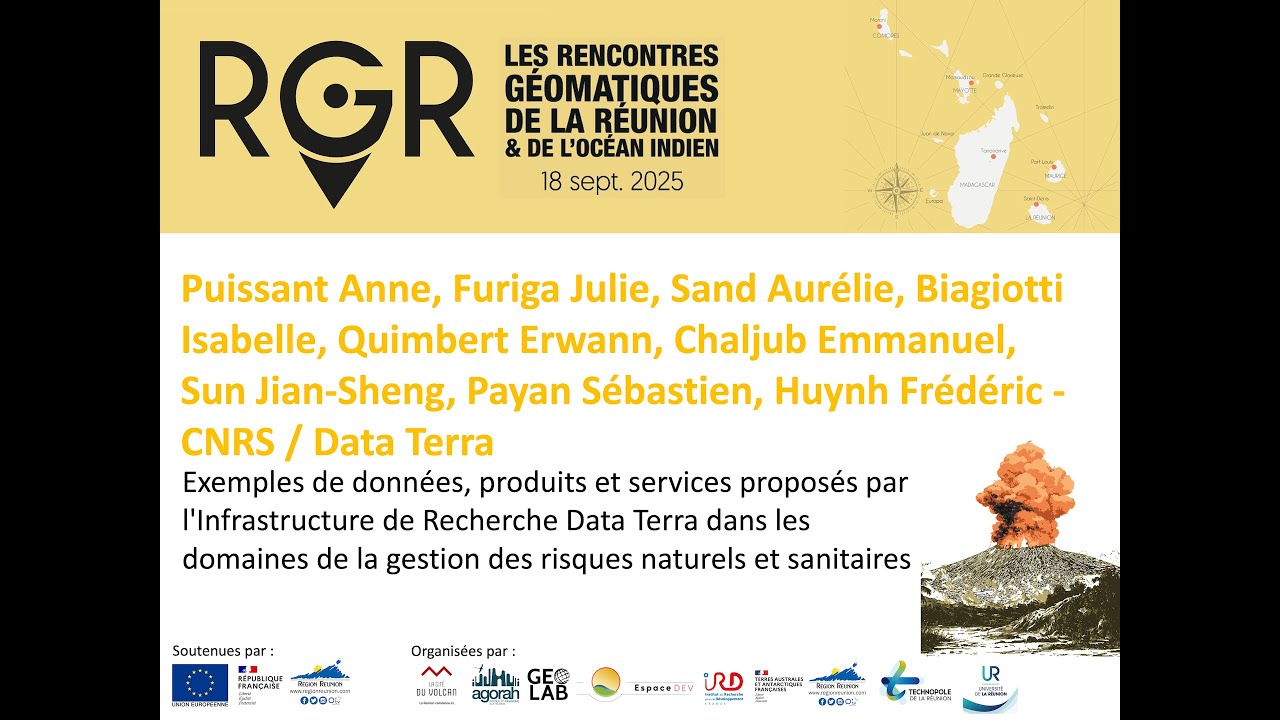
Data Terra Research Infrastructure: Examples of Data, Products and Services for Natural and Health Risk Management
Keywords
Summary
179 words
Critical Evaluation
Value of the Information & Strength of the Argument
The presentation provides a valuable overview of the Data Terra infrastructure, showcasing its role in facilitating access to diverse Earth observation data and processing services. The argumentation is clear and structured, with concrete examples that illustrate the practical applications for risk management. However, the depth is limited; it does not delve into technical details or provide quantitative evidence of the effectiveness of the services. The value lies in its informative nature for a broad audience, but it lacks critical analysis or comparison with alternative approaches.
Scientific Rigor, Source Quality, Title Accuracy
The presentation is scientifically rigorous in that it is delivered by researchers directly involved in the infrastructure, ensuring accurate representation of the services. However, no specific sources are cited within the talk, and the description does not include links to further references. The title accurately reflects the content, and the talk stays on topic throughout. The lack of explicit citations reduces the verifiability of the claims, but the overall reliability is good given the expertise of the speakers.
178 words
Title / Content Match
The title accurately reflects the content, which focuses on Data Terra's data services and examples applied to natural and health risks.
Quality & Reliability
7/10
The presentation is given by researchers involved in the Data Terra infrastructure, providing an authoritative overview of services and examples. However, it is a high-level overview with limited technical depth and no detailed data or citations, so a score of 7 reflects good reliability but not exhaustive scientific rigor.
Key Moments
Markers derived by PSI from the transcript: the creator did not define chapters.
- Introduction to Data Terra research infrastructure and its objectives.
- Explanation of the four categories of services: data access, production, processing, and support.
- Examples of Pleiades image acquisitions for coastal monitoring and post-disaster damage assessment.
- Description of monthly reflectance composites from Sentinel-2 for land cover analysis.
- Introduction to processing services like DSMOT for generating digital surface models from stereo imagery.
- Example of ground displacement mapping using image correlation for landslide monitoring.
- Visualization services for GNSS time series data.
- Use of land cover maps and derived indicators for modeling disease vectors like dengue and fleas.
- Discussion on interoperability with other data systems and the importance of semantic harmonization.
- Q&A session addressing data access conditions and links with other biodiversity data systems.
Contribution & Novelties
The presentation offers a clear and accessible introduction to the Data Terra infrastructure, highlighting its role in democratizing access to Earth observation data and processing services. It emphasizes the practical applications for risk management, which is valuable for stakeholders and researchers. The novelty lies in the concrete examples from the French overseas territories, such as La Réunion, and the integration of various data types (satellite, drone, in-situ) for interdisciplinary research.
Pour aller plus loin :
- Data Terra official website — Official portal for the infrastructure, providing access to data and services.
- Theia data pole — Theia offers satellite image products and services for land surfaces.
- PNDB (Pôle National de Données de Biodiversité) — National biodiversity data hub, part of Data Terra.
- SINP (Système d’Information de l’Inventaire du Patrimoine Naturel) — French system for natural heritage data.
- Copernicus Programme — European Earth observation programme providing Sentinel data.
146 words
Radar Profile
The radar profile shows a balanced performance across all dimensions, with slightly higher scores in information quantity and quality, reflecting the informative nature of the presentation. The technical level is moderate, indicating accessibility to a broad audience, while reliability is good due to the expertise of the speakers.