Colloque Et SI : intervention de Luc Vandromme
Keywords
Summary
196 words
Critical Evaluation
Value of the Information & Strength of the Argument
The talk provides valuable insights into the practical application of educational theories (Bruner’s scaffolding) to autism, and presents original research using eye-tracking to investigate visual attention in children with autism. The argumentation is solid, grounded in the speaker’s own empirical work and references to established literature. He acknowledges the complexity and heterogeneity of autism, and carefully interprets his findings, avoiding overgeneralization. The discussion of joint attention is particularly insightful, linking developmental psychology to real-world interaction.
Scientific Rigor, Source Quality, Title Accuracy
The speaker demonstrates scientific rigor by describing his methodologies in detail, including participant selection, calibration procedures, and statistical analyses. He references key works (e.g., Bruner, Trevarthen, Falck-Ytter) and acknowledges conflicting findings in the literature. The title accurately reflects the content, focusing on intersubjectivity and transformation. The talk is a conference presentation, so it is not peer-reviewed, but the speaker’s expertise and the detailed account of his research lend credibility.
159 words
Title / Content Match
The title accurately reflects the content, which focuses on intersubjectivity and transformation in the context of autism, with a central theme of crossing perspectives.
Quality & Reliability
7/10
The speaker is a psychologist with extensive experience in autism research, presenting findings from his own studies and referencing established theories. The talk is a conference presentation, not a peer-reviewed publication, but it provides detailed methodological descriptions and references to literature.
Key Moments
Markers derived by PSI from the transcript: the creator did not define chapters.
- Introduction: speaker thanks organizers, sets the theme of intersubjectivity and transformation.
- Discussion of Bruner's scaffolding and tutoring situations.
- Description of early inclusive school and tutoring experiments with children with autism.
- Findings from tutoring: older tutors adapt better, younger ones struggle with visual attention.
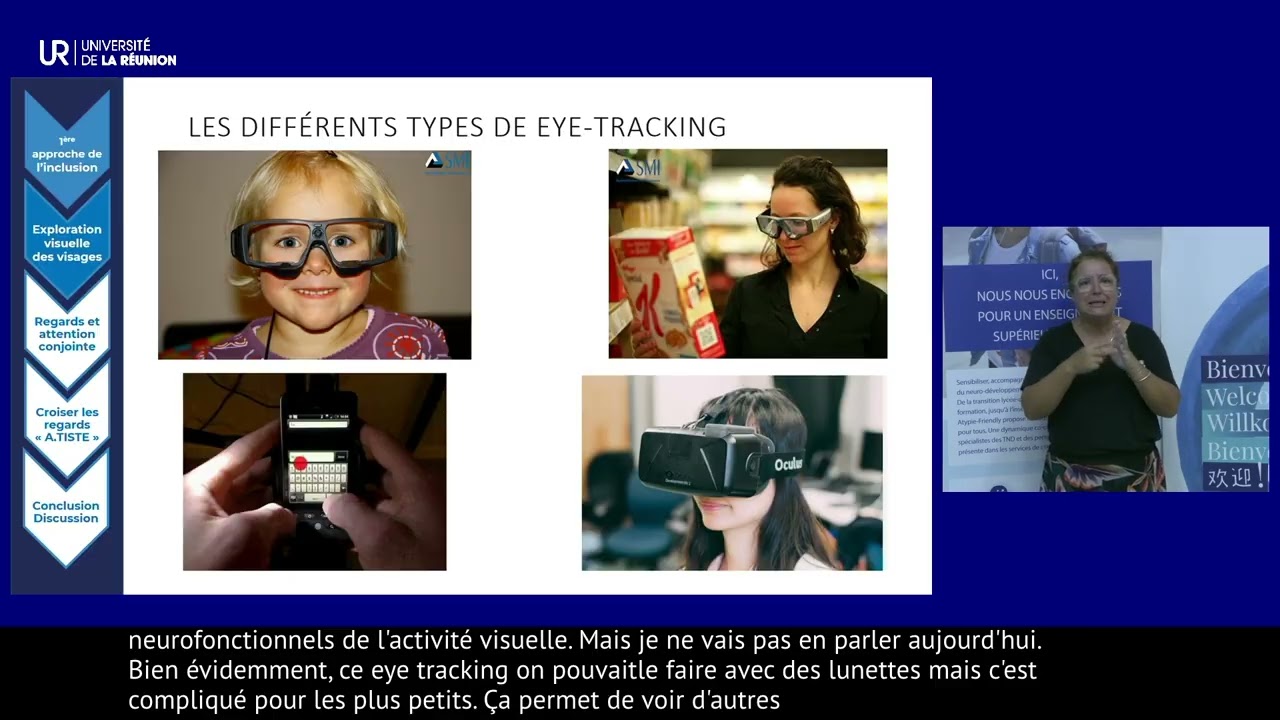
- Introduction to eye-tracking methodology and its applications.
- Review of literature on visual exploration of faces in autism, highlighting inconsistencies.
- Presentation of own eye-tracking study: children with autism look more at background, less at internal features.
- Discussion of joint attention and its development around 9 months.
- Second experiment on joint attention using film stimuli: children with autism often look at pointing hand rather than referent.
- Conclusion: implications for inclusion and education, emphasis on understanding differences.
Cited Sources
- Bruner, J. (1983). Child's Talk: Learning to Use Language — Mentioned as the origin of the concept of scaffolding and tutoring.
- Falck-Ytter et al. (2013). Eye tracking in autism spectrum disorder: A meta-analysis — Referenced as a review of eye-tracking studies in autism.
- Trevarthen, C. (1979). Communication and cooperation in early infancy: A description of primary intersubjectivity — Mentioned in relation to the concept of intersubjectivity and joint attention.
Concurring Sources
- Falck-Ytter et al. (2013). Eye tracking in autism spectrum disorder: A meta-analysis — Supports the finding of atypical visual attention in autism.
Dissenting Sources
- Rutherford et al. (2012) — Found similar visual attention patterns in some conditions, suggesting complexity.
Contribution & Novelties
The talk provides a personal account of decades of research on autism, highlighting the importance of considering both cognitive and social factors. It offers original findings from eye-tracking studies that suggest children with autism have a different visual attention pattern, including increased attention to background and reduced attention to internal facial features, but not a complete avoidance of eyes. The discussion of joint attention experiments reveals specific differences in how children with autism respond to pointing and gaze cues. This contributes to a nuanced understanding of autism and has practical implications for educational interventions.
Pour aller plus loin :
- Joint attention — Overview of the concept and its development.
- Eye tracking — Explanation of the technology used in the studies.
- Autism spectrum — General information on autism spectrum disorder.
129 words
Radar Profile
The radar profile shows a balanced performance across all dimensions, with slightly higher scores in information quantity and quality, reflecting the speaker's expertise and the detailed presentation of research. The technical level is moderate, suitable for a general academic audience.
💬 No comments were provided for analysis.