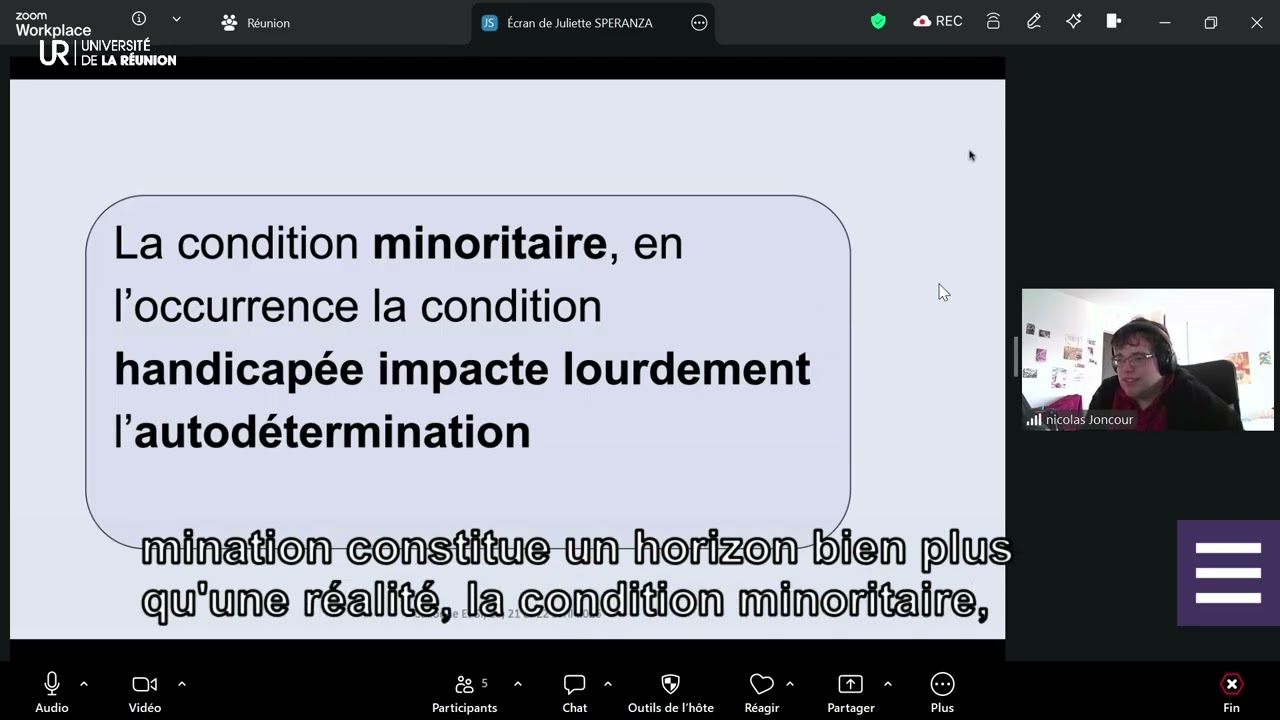
Colloque Et SI : intervention de Nicolas Joncour et Juliette Speranza
Keywords
Summary
166 words
Critical Evaluation
Value of the Information & Strength of the Argument
The presentation provides valuable insights into the barriers faced by disabled students in higher education, supported by personal testimony and references to international frameworks. The argumentation is coherent, moving from the general context of disability rights to specific challenges and proposed solutions. The use of personal experience adds authenticity and illustrates the theoretical points effectively. However, the argumentation could be strengthened by more empirical data or case studies beyond the personal narrative.
Scientific Rigor, Source Quality, Title Accuracy
The presentation references the CRPD and disability studies, which are credible sources. However, specific citations are not provided in the transcript, limiting the verifiability. The title accurately reflects the content. The presentation is well-structured and the speakers demonstrate expertise in the field, though the reliance on personal experience may introduce bias.
138 words
Title / Content Match
The title accurately reflects the content: a conference presentation by Nicolas Joncour and Juliette Speranza on empowerment of disabled students in academia.
Quality & Reliability
7/10
The presentation is based on personal experience and references to international conventions (CRPD) and academic fields (disability studies). It lacks detailed citations but is coherent and grounded in recognized frameworks.
Key Moments
Markers derived by PSI from the transcript: the creator did not define chapters.
- Introduction by Juliette Speranza, explaining the format and the use of AAC.
- Start of the presentation: 'The role of concerned individuals in academic empowerment'.
- Discussion of the CRPD and Article 24 on inclusive education.
- Nicolas Joncour shares his personal experience with dyspraxia and AAC.
- Definition of self-determination and its importance for disabled students.
- Critique of university norms and the concept of 'symbolic violence'.
- Introduction of 'minority knowledge' and the slogan 'Nothing about us without us'.
- Discussion of disability studies and their role in questioning hegemonic knowledge.
Cited Sources
- Convention relative aux droits des personnes handicapées (CIDPH) — Referenced as the basis for the right to inclusive education and reasonable accommodations.
- Disability Studies — Mentioned as an academic field that emerged in the 1970s to question hegemonic knowledge.
Concurring Sources
- Convention relative aux droits des personnes handicapées — Supports the argument for inclusive education and reasonable accommodations.
Contribution & Novelties
The presentation brings a personal and critical perspective on the inclusion of disabled students in academia, emphasizing the need to center the voices of concerned individuals. It highlights the concept of ‘minority knowledge’ and the importance of self-determination. The call for training all teachers and for more specialized support is a practical contribution.
Pour aller plus loin :
- Convention on the Rights of Persons with Disabilities — Official text of the CRPD, relevant for understanding the legal framework.
- Disability Studies — Overview of the academic field and its contributions.
- Universal Design for Learning — A framework for designing inclusive educational environments.
101 words
Radar Profile
The radar profile shows high scores in quality of information and global reliability, with moderate scores in quantity and technical level. This indicates a well-argued presentation with strong theoretical grounding, but with limited depth in terms of data and technical detail.