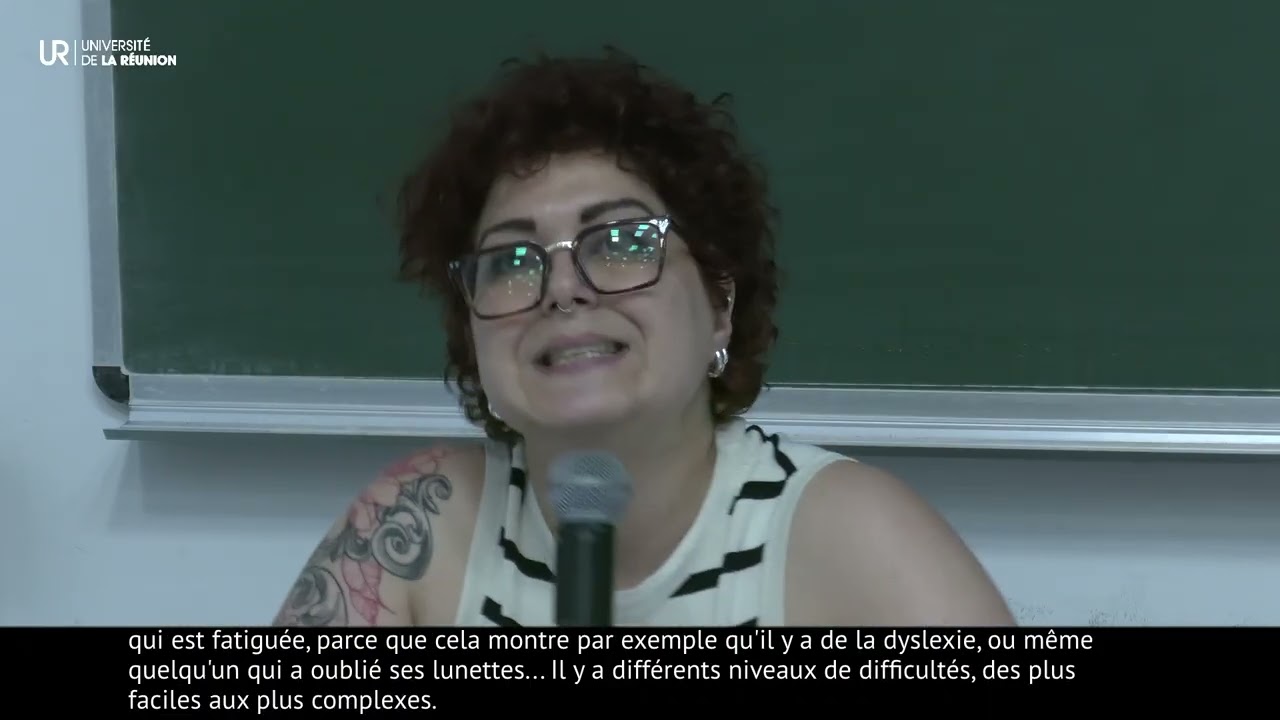
Colloque Et SI : intervention d'Antonella Ferrara
Keywords
Summary
141 words
Critical Evaluation
Value of the Information & Strength of the Argument
The presentation provides valuable insights into an innovative approach to teacher training. The argumentation is structured and grounded in a scientific methodology, including pre/post tests, psychophysiological measurements, and qualitative interviews. The speaker clearly explains the rationale for using VR, emphasizing the importance of pairing disability simulation with pedagogical solutions to avoid reinforcing stereotypes. Preliminary data support the effectiveness of the VR intervention, though the sample size is small. The discussion with the audience adds practical considerations, such as the challenge of engaging teachers in voluntary training and the potential of VR to attract participants.
Scientific Rigor, Source Quality, Title Accuracy
The speaker references the scientific literature for scenario design, but specific citations are not provided in the video. The project is funded by ANR, which adds credibility. The title accurately reflects the content. The presentation is a conference talk, so it is not peer-reviewed, but the methodology is described in sufficient detail. The speaker acknowledges limitations and the preliminary nature of the results. Overall, the scientific rigor is adequate for a conference presentation.
182 words
Title / Content Match
The title accurately reflects the content: a conference presentation by Antonella Ferrara on the use of virtual reality for inclusive education.
Quality & Reliability
7/10
The presentation is based on an ongoing ANR-funded research project (INCLUDE) and reports preliminary results from a scientific experiment. The methodology is described, but the sample size is small and results are preliminary. The speaker is an academic researcher, lending credibility, but the video is a conference talk, not a peer-reviewed publication.
Key Moments
Markers derived by PSI from the transcript: the creator did not define chapters.
- Introduction and project overview
- Context: stress and low self-esteem in students with learning disabilities
- Challenges in teacher training and lack of preparation
- Choice of virtual reality for immersive experience
- Description of VR scenarios: cognitive overload, dyslexia, dyspraxia, learned helplessness
- Importance of pairing simulation with pedagogical solutions
- Methodology: experimental design with three groups
- Preliminary results: empathy quotient and educational practices
- Stress and self-esteem changes across scenarios
- Qualitative feedback: immediate empathy and reflection
- Limitations and discussion with audience
Contribution & Novelties
The project contributes to the field by applying virtual reality to teacher training for inclusive education, specifically targeting university settings. The combination of VR simulation with pedagogical solutions is a novel approach. Preliminary results suggest positive impacts on empathy and stress perception.
Pour aller plus loin :
- Universal Design for Learning — Framework for inclusive teaching practices.
- Virtual reality in education — Overview of VR applications in education.
- Empathy — Psychological concept central to the training’s goal.
77 words
Radar Profile
The radar profile shows high scores in information quantity and quality, moderate technical level, and good reliability. This indicates a well-structured presentation with substantial content, though the technical depth is moderate and the reliability is based on preliminary data.