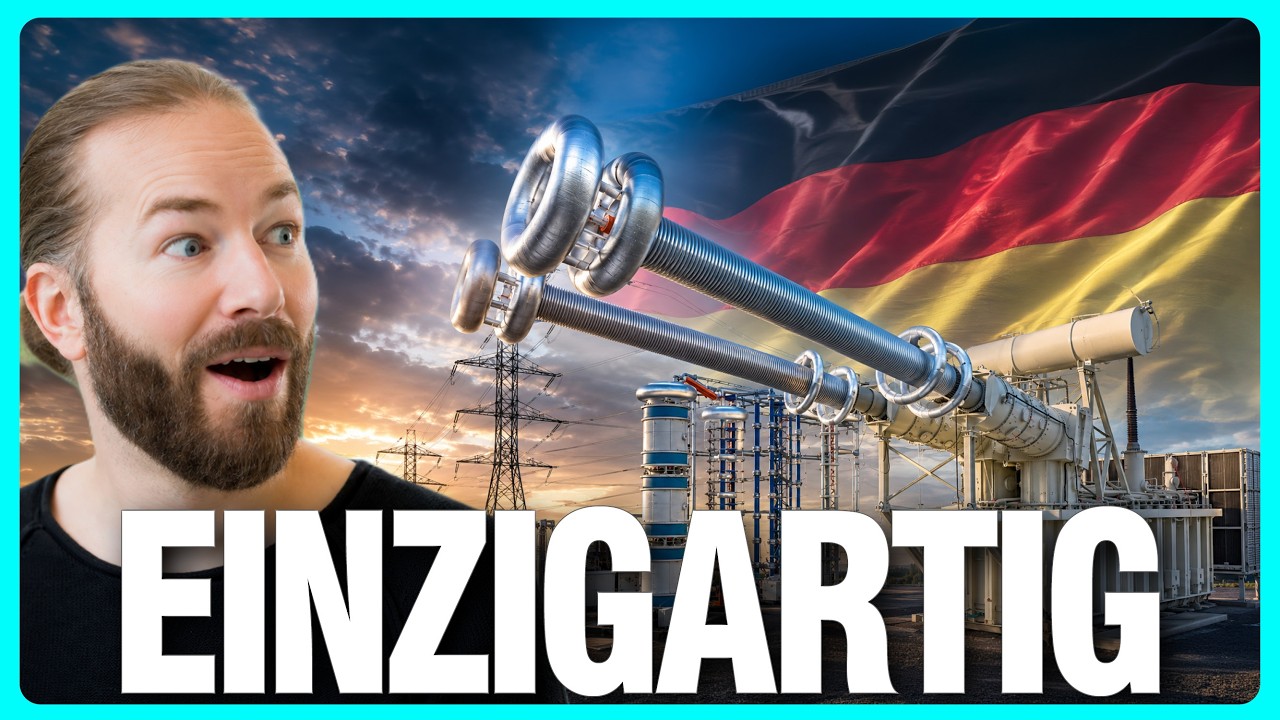
Unbekannter Weltrekord: Deutschlands geheime Stromnetz-Technik
Keywords
Summary
154 words
Critical Evaluation
Value of the Information & Strength of the Argument
The video provides substantial value by explaining the technical and economic rationale behind HVDC projects in Germany. The argumentation is solid, based on expert knowledge and references to the Netzentwicklungsplan. The guest clearly distinguishes between AC and DC transmission, explaining the physics of reactive power and the benefits of HVDC for cable systems. The comparison with China is well-balanced, acknowledging China’s scale but emphasizing Germany’s focus on controllability and grid stability. The discussion is nuanced and avoids oversimplification, making it valuable for understanding the complexities of grid expansion.
Scientific Rigor, Source Quality, Title Accuracy
The scientific rigor is high, with the guest providing detailed technical explanations and referencing the Netzentwicklungsplan for cost figures. However, the video does not cite specific academic sources or studies, relying instead on expert opinion and industry knowledge. The title is somewhat sensationalist but the content is accurate and informative. The description includes links to the sponsor and social media, but no direct references to external sources. Overall, the information is reliable and well-presented, though it could benefit from more explicit citations.
185 words
Title / Content Match
The title is somewhat sensationalist ('Unbekannter Weltrekord') but the content does discuss Germany's advanced HVDC technology, which is not widely known. The title is acceptable.
Quality & Reliability
8/10
The video features a domain expert (Dr. Max Görtz) discussing HVDC technology with technical depth and references to the German Netzentwicklungsplan. The content is well-structured and avoids sensationalism, but lacks direct citations to primary sources.
Key Moments
Markers derived by PSI from the transcript: the creator did not define chapters.
- Introduction to the topic and guest Dr. Max Görtz.
- Discussion on China's HVDC projects and their scale.
- Explanation of AC vs DC transmission and the role of reactive power.
- Economic threshold for HVDC: 30-50 km for cables, 500 km for overhead lines.
- Cost breakdown: 7.6 million €/km for cables, 600 million € per converter station.
- Overview of German projects: SüdLink, SüdOstLink, Ultranet.
- Comparison with China and Germany's role as a pioneer in controllable HVDC.
- Discussion on redispatch reduction and grid stability benefits.
Cited Sources
- MS Elektro - Trafostationen — Sponsor link mentioned in the description.
- Geladen Podcast LinkedIn — Social media link in the description.
Concurring Sources
- Netzentwicklungsplan Strom — The official German grid development plan, referenced for cost figures.
Contribution & Novelties
The video provides an expert perspective on Germany’s HVDC projects, highlighting their advanced controllability and grid services, which are often overlooked in public discourse. It offers a balanced comparison with China, emphasizing different system needs. The discussion of costs and technical details adds depth.
Pour aller plus loin :
- High-voltage direct current - Wikipedia — Provides a comprehensive overview of HVDC technology and history.
- SüdLink - Wikipedia — Details on the specific German HVDC project.
- Voltage-source converter - Wikipedia — Explains the converter technology used in modern HVDC systems.
89 words
Radar Profile
The radar profile shows high scores in information quantity, quality, and reliability, with a slightly lower technical level, indicating content that is informative and credible but accessible to a broader audience.
💬 Positive: The 30 comments analyzed are overwhelmingly positive, with viewers praising the informative and well-explained content, and expressing appreciation for the expert guest.