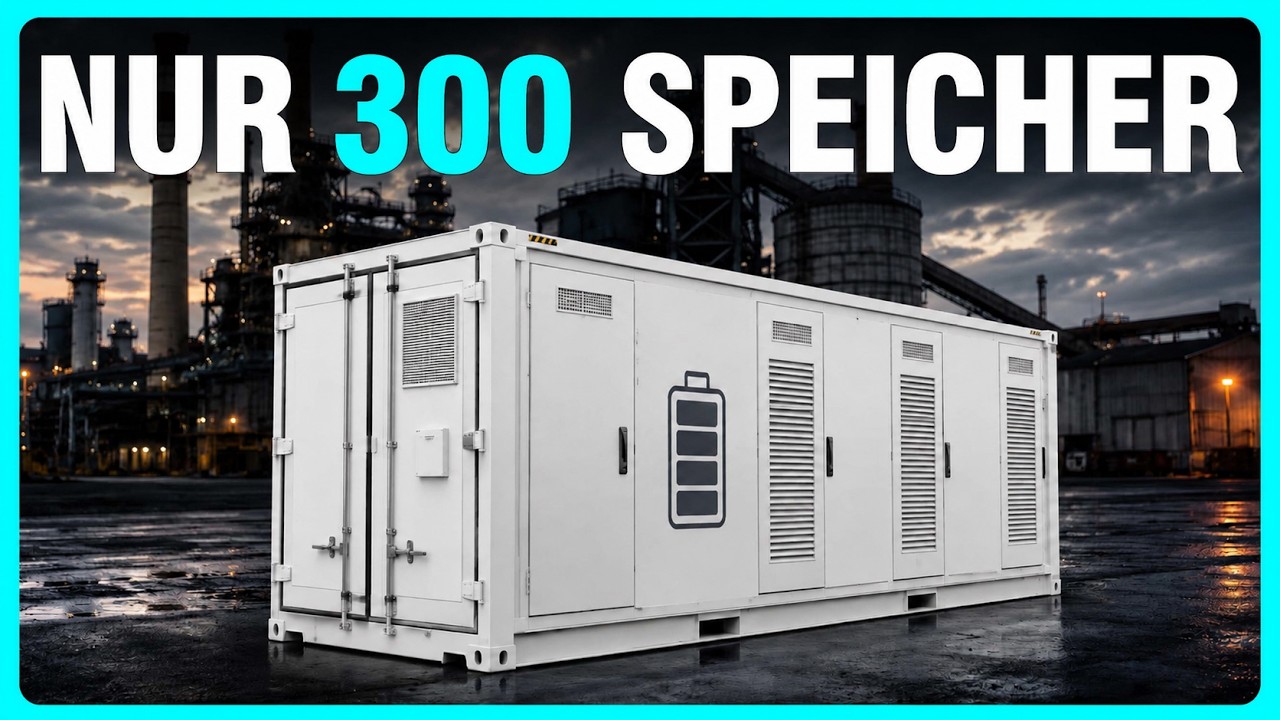
Industrie verschläft Batterie-Boom – trotz hohem Strompreis!
Keywords
Summary
184 words
Critical Evaluation
Value of the Information & Strength of the Argument
The value of the information is high, as it provides practical insights from industry experts on the economic and technical feasibility of commercial battery storage. The argumentation is solid, based on real-world examples, market data, and clear explanations of the underlying mechanisms. The hosts and guests critically examine the challenges and opportunities, avoiding hype and presenting a balanced view. They effectively argue that battery storage can be a key solution for German industry to reduce costs and support the energy transition, while also acknowledging the complexity and the need for careful planning.
Scientific Rigor, Source Quality, Title Accuracy
The scientific rigor is good, with the discussion grounded in current market data and practical experience. The guests reference specific figures, such as the 1.5 GWh of industrial storage and the potential of using automotive batteries. The sources cited are primarily the guests’ own company (Fenecon) and their practical experience, which is credible but not peer-reviewed. The title accurately reflects the content, and the episode maintains a scientific tone throughout. The podcast is produced for the Karlsruhe Institute of Technology (KIT), adding to its credibility.
192 words
Title / Content Match
The title accurately reflects the core topic: the slow adoption of battery storage in German industry despite high electricity prices. The content directly addresses this issue, making the title highly appropriate.
Quality & Reliability
8/10
The podcast features expert guests from Fenecon, a leading German battery storage company, discussing technical and economic aspects of commercial and industrial battery storage. The discussion is grounded in practical experience and current market data, but it is primarily an expert opinion rather than a peer-reviewed study. The hosts maintain a scientific approach, and the content is consistent with known trends in the energy sector.
Key Moments
Markers derived by PSI from the transcript: the creator did not define chapters.
- Introduction to the topic: Germany has only 1.5 GWh of industrial battery storage, which is negligible compared to home storage and large-scale batteries.
- Discussion on why industrial storage has been slow to adopt, including high costs and lack of awareness, but now the situation is changing.
- Explanation of the various use cases for industrial storage, including peak shaving, grid fee reduction, and arbitrage, making storage economically viable.
- Discussion on the use of automotive batteries for stationary storage, including new 'obsolete' batteries from car manufacturers, and the advantages of NMC chemistry.
- Outlook on the future of industrial storage in Germany, including the potential of sodium-ion batteries and the role of energy management systems.
Cited Sources
- Green Energy Tools — Mentioned as a sponsor providing planning software for commercial battery storage projects.
- Geladen Podcast LinkedIn — LinkedIn page of the podcast, mentioned for further engagement.
Concurring Sources
- Battery storage power station — General information on battery storage systems, consistent with the episode's discussion.
- Peak shaving — Concept of reducing peak demand, a key application for industrial storage.
Contribution & Novelties
The episode provides a unique perspective on the underutilized potential of industrial battery storage in Germany, offering concrete economic and technical insights from industry insiders. It highlights the emerging trend of using automotive batteries for stationary storage, which is a novel approach that could significantly boost the market. The discussion also touches on the importance of energy management systems and the evolving regulatory landscape, providing a forward-looking view.
Pour aller plus loin :
- Battery storage power station — Provides background on large-scale battery storage systems and their applications.
- Peak shaving — Explains the concept of reducing peak demand, a key use case discussed in the episode.
- Sodium-ion battery — Overview of sodium-ion technology, which the guests mention as a promising future chemistry.
122 words
Radar Profile
The radar profile shows high scores in quantity of information and technical level, indicating a content-rich and technically detailed episode. The quality and reliability scores are also high, reflecting the expert guests and scientific approach. The overall balance suggests a well-rounded and informative discussion.
💬 Positif. Sur les 30 commentaires analysés, la grande majorité exprime un soutien enthousiaste et une appréciation pour la qualité du contenu, avec des éloges pour les invités et l'optimisme quant à l'avenir de la transition énergétique.