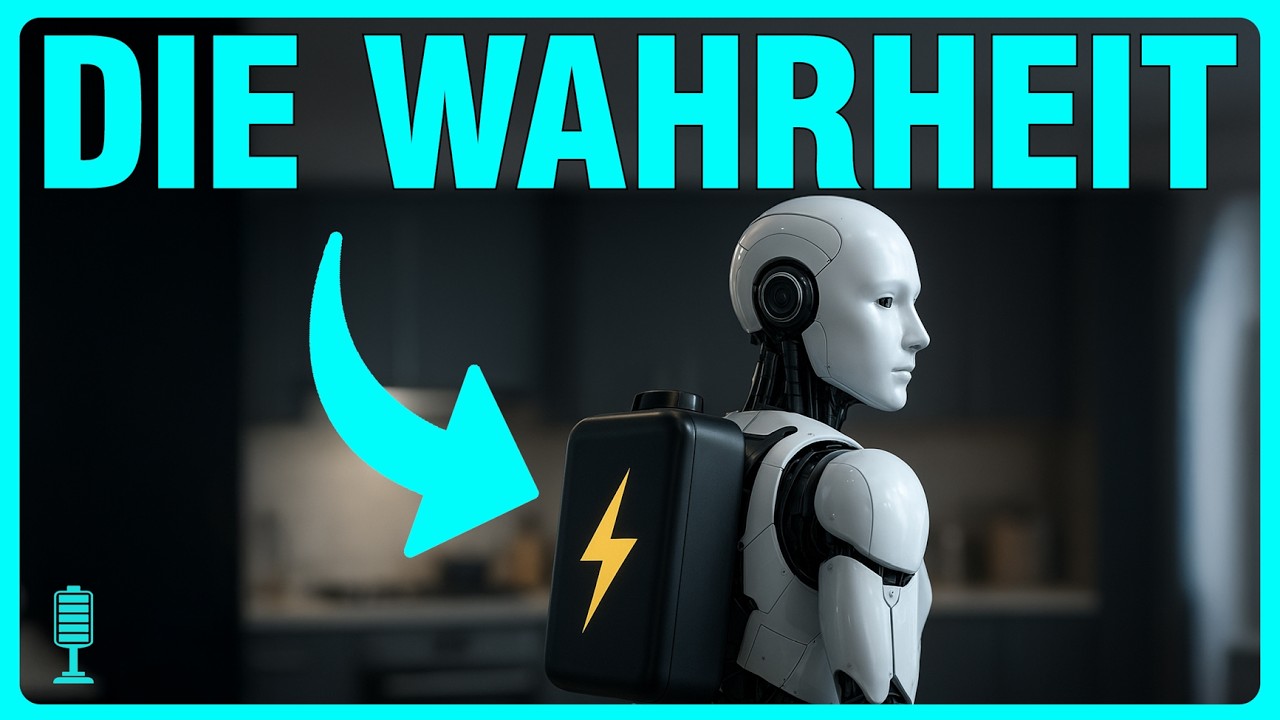
Akku: Das größte Problem der Roboter? Prof. Alexander König & Prof. Jürgen Janek | Geladen Podcast
Keywords
Summary
182 words
Critical Evaluation
Value of the Information & Strength of the Argument
The podcast provides valuable insights into the intersection of robotics and battery technology, a topic that is often overlooked. The guests offer expert opinions grounded in their respective fields, and the discussion is well-structured, covering definitions, current state, challenges, and future prospects. The argumentation is solid, with both experts acknowledging uncertainties and avoiding overhyped claims. They provide concrete examples, such as the energy consumption of a bee versus current AI models, and discuss practical considerations like battery placement and energy management. The value lies in the expert perspectives and the identification of key research gaps, though the discussion remains qualitative and lacks specific data or case studies.
Scientific Rigor, Source Quality, Title Accuracy
The scientific rigor is high, given the credentials of the guests and the podcast’s affiliation with KIT. The discussion is technically accurate and avoids sensationalism. However, the podcast does not cite specific sources or studies during the conversation, and the description only includes links to merchandise and a sponsor, not to academic references. The title accurately reflects the content, focusing on the battery problem in robots. The podcast maintains a balanced and critical tone, acknowledging the limitations of current technology and the need for further research.
208 words
Title / Content Match
The title accurately reflects the core topic: the role of batteries in humanoid robots, with a focus on challenges and perspectives from experts in robotics and battery research.
Quality & Reliability
8/10
The podcast features two established professors in robotics and battery research, providing expert opinions grounded in their respective fields. The discussion is well-structured and technically informed, though it remains largely qualitative and lacks specific data or citations. The hosts and guests demonstrate a balanced and critical perspective, acknowledging uncertainties and future challenges.
Key Moments
Markers derived by PSI from the transcript: the creator did not define chapters.
- Introduction of guests and definition of humanoid robots.
- Discussion on potential applications of humanoid robots in care and household.
- Current capabilities of humanoid robots: locomotion vs. manipulation.
- Energy consumption of AI models and comparison to a bee's power usage.
- Battery requirements for robots: energy density, safety, and cycle life.
- Discussion on battery placement and design considerations.
- Potential improvements: energy-saving modes, specialized chips, and battery swapping.
- Future market projections and the need for interdisciplinary research.
Cited Sources
- Geladen Podcast WhatsApp — Mentioned as a way for listeners to send voice messages.
- Emma Matratze Sale — Sponsorship segment for Emma mattresses.
Concurring Sources
- Boston Dynamics — Mentioned as a leading company in humanoid robotics.
- Unitree Robotics — Mentioned as a manufacturer of humanoid robots.
Contribution & Novelties
This podcast provides a unique interdisciplinary perspective on the battery challenges specific to humanoid robots, a topic that is rarely discussed in depth. It brings together experts from robotics and battery research to explore the energy requirements, current limitations, and potential solutions. The discussion highlights that while batteries are not currently the primary bottleneck, they will become critical as robots become more autonomous and capable. The podcast also emphasizes the need for energy-efficient AI and specialized hardware, offering a forward-looking view on the evolution of both fields.
Pour aller plus loin :
- Humanoid robot — Overview of humanoid robots, their history, and applications.
- Lithium-ion battery — Fundamental technology behind most robot batteries.
- Energy density — Key metric for battery performance.
- Edge AI — Concept relevant to on-board processing for robots.
- NVIDIA Isaac — Platform for robot AI development, mentioned indirectly via GPU simulation.
143 words
Radar Profile
The radar profile shows a balanced performance across all dimensions, with slightly higher scores in quality and reliability, reflecting the expert-driven discussion. The podcast excels in providing credible information and technical depth, while the quantity of information is moderate due to the conversational format.
💬 Très positif. Sur les 30 commentaires analysés, les auditeurs expriment un fort enthousiasme pour le sujet et les invités, saluant la qualité des échanges et la pertinence des questions, avec quelques critiques mineures sur le manque de données concrètes.