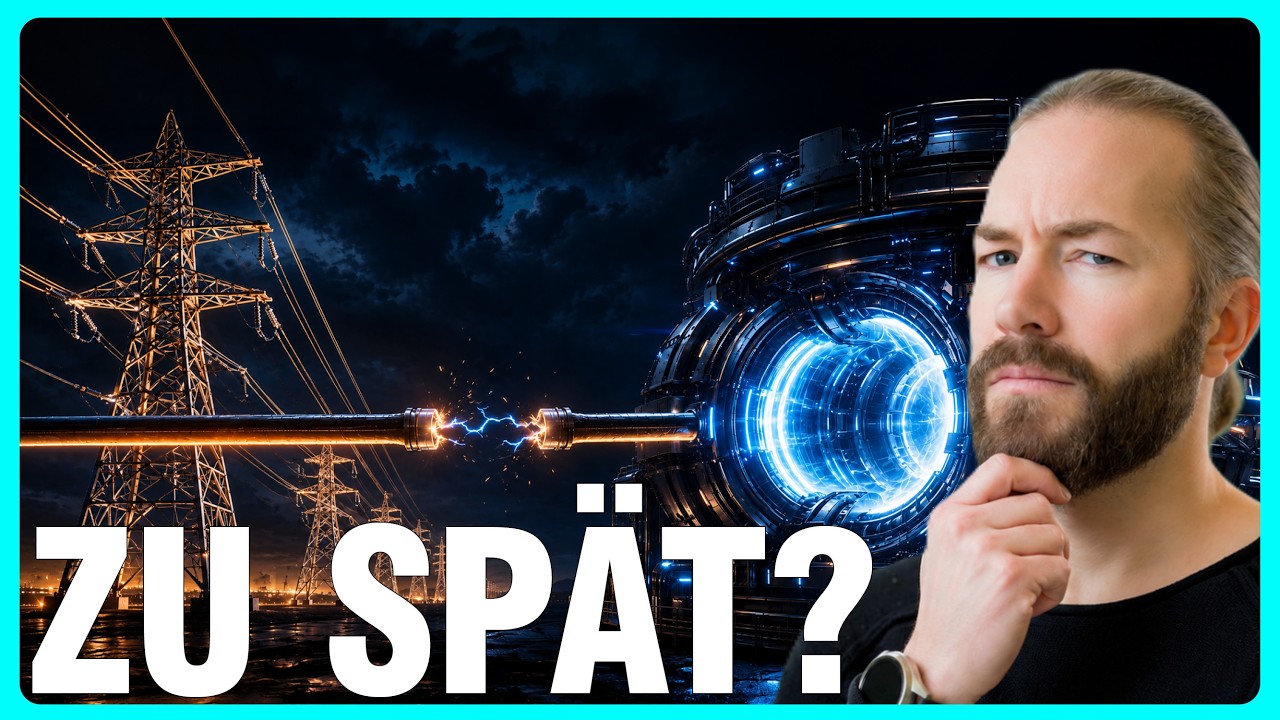
Kernfusion: Der Durchbruch kommt – der Strom noch lange nicht!
Keywords
Summary
161 words
Critical Evaluation
Value of the Information & Strength of the Argument
The video provides valuable insights from a leading expert in fusion materials research. Kirchlechner offers a balanced perspective, debunking overoptimistic claims while acknowledging genuine progress. He clearly explains complex concepts such as plasma confinement, tritium breeding, and the difference between scientific and engineering breakthroughs. The argumentation is solid, grounded in his expertise and the current state of fusion research. He avoids speculation and provides concrete timelines and challenges, making the information highly useful for understanding the realistic prospects of fusion energy.
Scientific Rigor, Source Quality, Title Accuracy
The scientific rigor is high: the guest is a professor at KIT, and the discussion is consistent with the broader scientific consensus on fusion. The podcast is produced for KIT, adding credibility. The title accurately reflects the content, emphasizing the gap between scientific breakthroughs and commercial electricity generation. The description provides links to the podcast’s social media and a sponsor, but no direct scientific sources are cited in the video itself. The discussion is well-structured and avoids misinformation.
174 words
Title / Content Match
The title accurately reflects the content: the scientific breakthrough is acknowledged, but the economic and practical implementation is still far off.
Quality & Reliability
8/10
The video features a professor from KIT with expertise in fusion materials, providing a balanced and realistic assessment of fusion's timeline and challenges. Claims are consistent with mainstream scientific consensus, and the discussion avoids sensationalism. However, the format is an interview/podcast, not a peer-reviewed study, and some statements are qualitative.
Key Moments
Markers derived by PSI from the transcript: the creator did not define chapters.
- Introduction of the topic and guest, Professor Christoph Kirchlechner.
- Discussion on the political hype around fusion and its impact on the Energiewende.
- Explanation of how fusion works and how electricity is generated.
- Comparison between nuclear fission and fusion, emphasizing intrinsic safety.
- Discussion on radioactive waste and recycling of reactor materials.
- Challenges: plasma confinement, materials, and tritium breeding.
- Timeline for demonstration plants and commercial reactors.
- Role of fusion in industry and its relationship with renewables.
- Conclusion: fusion will not replace solar, wind, and batteries.
Cited Sources
- MS Elektro - Trafostationen — Sponsor link mentioned in the description and during the podcast.
- Geladen Podcast LinkedIn — Social media link provided in the description.
Concurring Sources
- ITER — International fusion project expected to demonstrate Q>10, consistent with the video's timeline.
- Max Planck Institute for Plasma Physics — Research on plasma confinement, supporting the technical challenges discussed.
Contribution & Novelties
The video offers an expert perspective on the realistic timeline and challenges of nuclear fusion, emphasizing that scientific breakthroughs do not immediately translate to commercial power plants. It clarifies the distinction between scientific, technological, and societal hurdles, and provides a nuanced view on fusion’s role in the energy transition.
Pour aller plus loin :
- ITER — The international fusion research project mentioned as a key step towards demonstrating fusion’s viability.
- Max Planck Institute for Plasma Physics — Leading research institute in plasma physics, referenced as the ‘Vatican of fusion’.
- Tritium breeding — Concept of breeding tritium from lithium, crucial for fusion fuel supply.
103 words
Radar Profile
The radar profile shows high scores in information quantity, quality, and reliability, with a slightly lower technical level, indicating that the content is accessible yet scientifically sound. The overall high scores reflect the expert's credibility and balanced presentation.
💬 Sur les 0 commentaires analysés, aucune tendance n'est disponible.