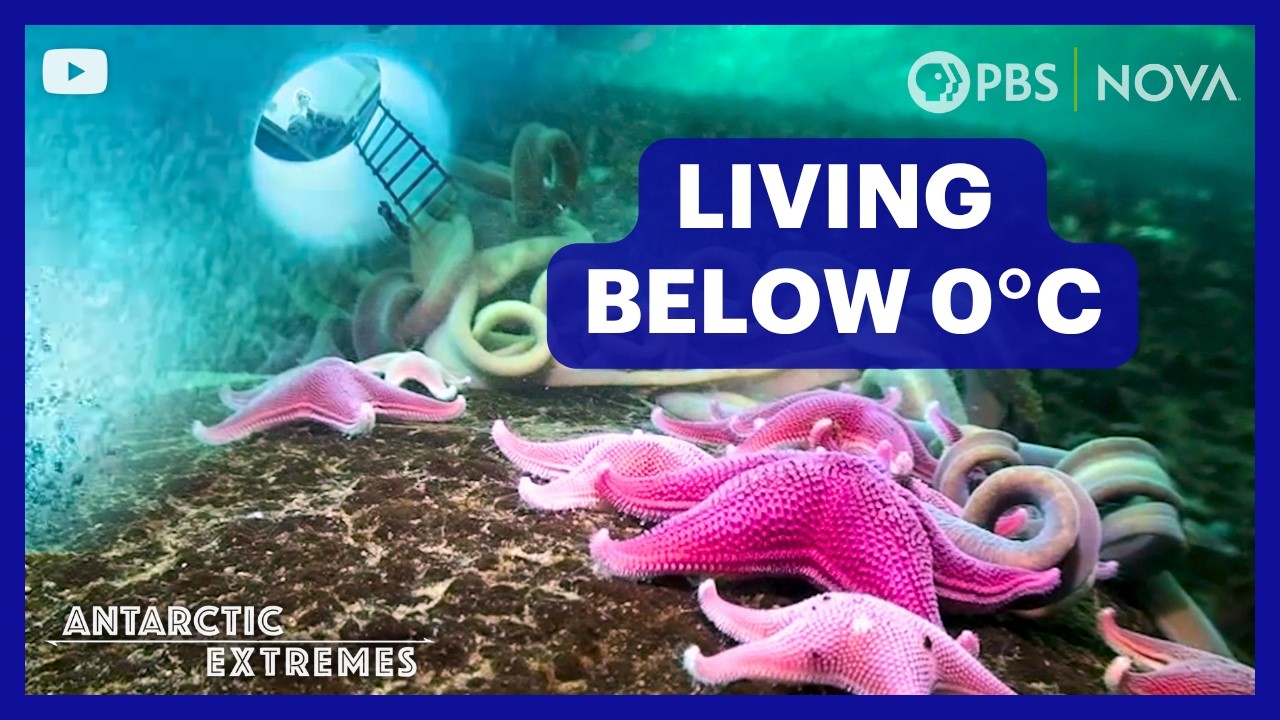
Antarctica’s Strange Underwater World | NOVA | PBS
Keywords
Summary
165 words
Critical Evaluation
The video is a well-crafted piece of science communication that effectively explains complex biological concepts to a general audience. It combines stunning underwater footage with clear explanations from experts, making the science accessible without oversimplifying. The demonstration of supercooling and the role of antifreeze proteins is particularly well done, using simple experiments and microscope imagery to illustrate the mechanisms. The interviews with scientists like Paul Cziko and Art DeVries add credibility and a personal touch, highlighting the history of discovery in this field. The video also touches on the broader ecological significance of these fish, connecting the dots between molecular adaptations and ecosystem dynamics. However, as a short documentary, it necessarily skims over some details, such as the diversity of antifreeze proteins and the evolutionary history of notothenioids. The production quality is high, and the information is accurate, but viewers seeking in-depth scientific detail would need to consult primary literature. The title accurately reflects the content, and the video delivers on its promise to showcase the strange underwater world of Antarctica. Overall, it is an excellent educational resource that balances entertainment and information.
183 words
Title / Content Match
The title accurately reflects the content, which explores the unique marine life under Antarctic ice and the adaptations that allow fish to survive in freezing waters.
Quality & Reliability
8/10
The video is produced by NOVA PBS, a reputable science documentary series. It features interviews with experts (Paul Cziko, Art DeVries) and demonstrates scientific concepts with experiments and microscope footage. The information is accurate and well-presented, though it is a popular science piece rather than a peer-reviewed source.
Key Moments
Markers derived by PSI from the transcript: the creator did not define chapters.
- Introduction to the Antarctic underwater world and the divers who explore it.
- Caitlin visits the McMurdo Aquarium and sees an Antarctic toothfish.
- Paul Cziko demonstrates supercooling with a test tube and snow.
- Explanation of how ice crystals in fish bodies can seed freezing.
- Fishing expedition to catch notothenioid fish for study.
- Art DeVries explains the discovery of antifreeze proteins.
- Microscope footage showing antifreeze proteins binding to ice crystals.
Cited Sources
- NOVA Newsletter — Sign up for NOVA's newsletter for more science content.
Concurring Sources
- NOVA PBS — The video is part of NOVA's science documentary series, known for accurate science communication.
Contribution & Novelties
The video provides a clear and engaging explanation of how Antarctic fish survive in freezing waters, focusing on the role of antifreeze proteins. It effectively uses demonstrations and expert interviews to convey the science. The original contribution lies in its accessible presentation of supercooling and antifreeze protein mechanisms, making these concepts understandable to a broad audience.
Pour aller plus loin :
- Antifreeze protein - Wikipedia — Overview of antifreeze proteins and their mechanisms.
- Notothenioidei - Wikipedia — Information on the fish group that dominates Antarctic waters.
- Supercooling - Wikipedia — Explanation of the supercooling phenomenon demonstrated in the video.
99 words
Radar Profile
The radar profile shows high scores in information quantity and quality, with a moderate technical level. This indicates a well-balanced educational video that is both informative and accessible, with a strong emphasis on accurate scientific content.
💬 Sur les 0 commentaires analysés, aucune tendance n'est disponible.