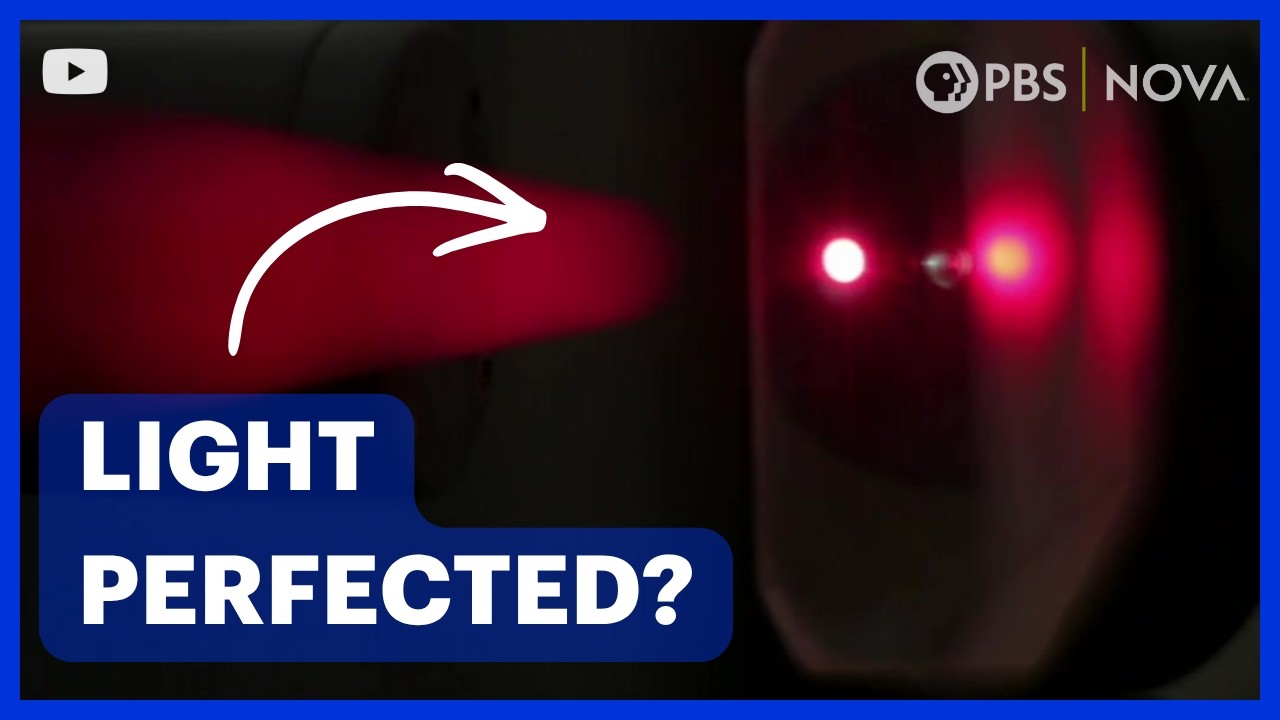
The Quantum Secret Behind the Most Precise Tool on Earth | NOVA | PBS
Keywords
Summary
148 words
Critical Evaluation
The video excels in presenting complex quantum physics concepts in an accessible and engaging manner. The use of expert commentary from Rana Adhikari adds credibility, and the explanations of stimulated emission and interferometry are clear and accurate. The historical context, from Einstein’s predictions to LIGO’s first detection, is well-covered and highlights the significance of the achievement. The visual aids, including animations and real footage, effectively illustrate the principles discussed. However, the video simplifies some aspects, such as the technical challenges of LIGO and the nature of quantum entanglement, which may leave some viewers with an incomplete understanding. The sources cited are limited to the NOVA episode and a newsletter, lacking direct references to scientific papers or further reading. The title accurately reflects the content, and the video successfully conveys the importance of lasers in modern physics. Overall, it is a high-quality educational piece that balances scientific rigor with accessibility, though it could benefit from more detailed citations and a deeper exploration of the technical aspects.
165 words
Title / Content Match
The title accurately reflects the content, which explores the quantum principles behind lasers and their application in LIGO.
Quality & Reliability
8/10
High-quality production by NOVA PBS, featuring expert interviews with experimental physicist Rana Adhikari. The content is scientifically accurate and well-explained, with no apparent misinformation. However, as a popular science video, it simplifies complex topics and lacks detailed citations.
Key Moments
Markers derived by PSI from the transcript: the creator did not define chapters.
- Introduction to lasers in everyday life and Rana Adhikari's passion for them.
- Explanation of how a light bulb produces chaotic light versus laser's coherent light.
- Description of stimulated emission and the quantum mechanical amplification process.
- Introduction to LIGO and the concept of measuring ripples in spacetime.
- Explanation of laser interferometry and how LIGO detects gravitational waves.
- Discussion of the first gravitational wave detection in 2015 and its significance.
- Introduction to quantum entanglement and its role in quantum physics.
- Conclusion on the importance of lasers and future possibilities.
Cited Sources
- NOVA: Decoding the Universe: Quantum — Full episode referenced in the video description.
- NOVA Newsletter — Sign-up for NOVA's newsletter for more science content.
Concurring Sources
- LIGO Scientific Collaboration — Official collaboration website confirming LIGO's detections.
- Einstein's Theory of General Relativity — Background on the theory predicting gravitational waves.
Dissenting Sources
- No discordant sources found — No conflicting information was identified in the video.
Contribution & Novelties
The video provides a clear and engaging explanation of how lasers, based on quantum principles, are used in LIGO to detect gravitational waves. It bridges the gap between quantum mechanics and astrophysics, making complex concepts accessible. The inclusion of expert insights and real-world applications enhances its educational value.
Pour aller plus loin :
- Laser Interferometer Gravitational-Wave Observatory (LIGO) — Official LIGO website with detailed information.
- Gravitational wave — Wikipedia article on gravitational waves.
- Stimulated emission — Wikipedia article on the principle behind lasers.
- Quantum entanglement — Wikipedia article on quantum entanglement.
91 words
Radar Profile
The radar profile shows high scores in information quantity, quality, and reliability, with a slightly lower score in technical level, reflecting the video's accessible approach. This indicates a well-balanced educational resource that is both informative and trustworthy.
💬 Positif : Les commentaires sont majoritairement positifs, avec des éloges sur la qualité de l'épisode et des questions scientifiques pertinentes. Sur les 30 commentaires analysés, la plupart expriment de l'appréciation et de l'intérêt pour le contenu.