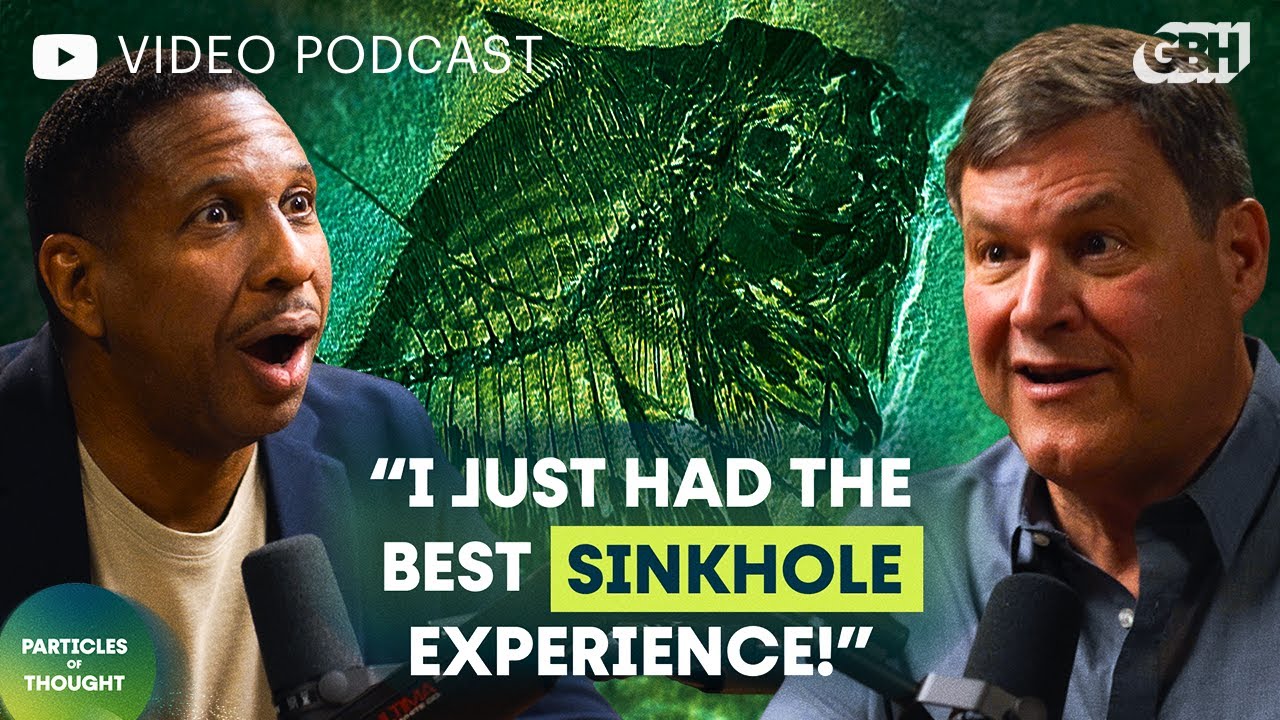
Interview: Fossil Hunting, Sinkholes, and Paleobotany with Kirk Johnson | Particles of Thought
Keywords
Summary
206 words
Critical Evaluation
The interview provides a rich and engaging overview of paleobotany and deep-time science, leveraging Dr. Kirk Johnson’s extensive expertise. The information is scientifically accurate and presented in an accessible manner without oversimplifying complex concepts. Johnson’s explanations of fossil formation, the D-world/E-world framework, and the significance of the Bennu samples are particularly valuable, offering clear insights into geological processes. The argumentation is solid, grounded in established research and personal field experience, such as the Snowmass excavation. The sources cited are primarily Johnson’s own work and NOVA documentaries, which are reputable, though the episode lacks direct references to specific scientific papers. The title accurately reflects the content, covering fossil hunting, sinkholes, and paleobotany. The discussion of sinkholes is somewhat brief but informative. Overall, the content is highly reliable and valuable for both general audiences and those with some scientific background. The only minor weakness is the absence of explicit citations to peer-reviewed literature, but this is typical for an interview format. The public comments (not provided) would likely reflect appreciation for Johnson’s storytelling and expertise.
173 words
Title / Content Match
The title accurately reflects the content, which is an interview covering fossil hunting, sinkholes, and paleobotany.
Quality & Reliability
9/10
High reliability due to the expertise of Dr. Kirk Johnson, a renowned paleobotanist and director of the Smithsonian NMNH, and the reputable NOVA PBS platform. The content is based on established scientific knowledge and personal research experience.
Chapters
Cited Sources
- Apple Podcasts - Particles of Thought — Podcast platform for the episode
- Apple Podcasts - Particles of Thought (Review) — Podcast page for ratings and reviews
- NOVA Official Site — NOVA's official website for related content
Concurring Sources
- NOVA: Polar Extremes — Documentary hosted by Kirk Johnson on climate change and polar regions
- NOVA: Making North America — Documentary hosted by Kirk Johnson on the geological history of North America
Contribution & Novelties
The interview offers a unique perspective by combining paleobotany, deep-time geology, and recent space exploration findings, making complex scientific concepts accessible. It provides insights into fossil formation processes and the significance of the Bennu asteroid samples for understanding Earth’s early history.
Pour aller plus loin :
- Paleobotany - Wikipedia — Overview of the field.
- OSIRIS-REx - NASA — Mission details and Bennu sample findings.
- Deep time - Wikipedia — Concept of geological time.
- Smithsonian National Museum of Natural History — Institution where Johnson works.
84 words
Radar Profile
The radar profile shows high scores across all dimensions, indicating a well-rounded and reliable scientific content. The strengths are particularly in information quantity and reliability, reflecting the depth of expertise and the quality of the discussion.