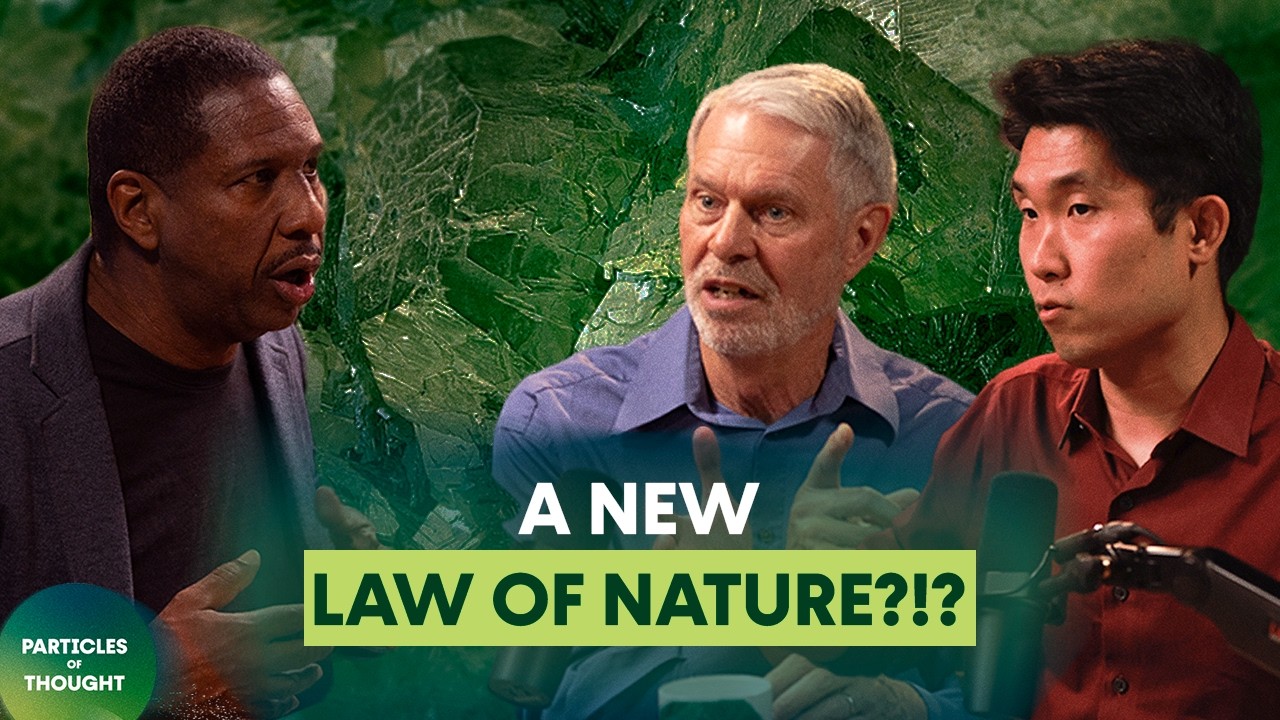
Interview: A Missing Law of Nature with Bob Hazen and Mike Wong | Particles of Thought
Keywords
Summary
119 words
Critical Evaluation
The interview presents a compelling and thought-provoking proposal for a new law of nature. The guests, Robert Hazen and Mike Wong, are established scientists with credible backgrounds, which lends authority to their claims. They clearly articulate the three conditions for the law: many interacting components, mechanisms for generating configurations, and selection for function. The discussion is well-structured, moving from the definition of laws to the specifics of their proposal and potential tests. However, the video is an interview rather than a formal scientific presentation, so the evidence is presented in a conversational manner without rigorous mathematical detail. The hosts do not challenge the proposal with deep skepticism, and the lack of counterarguments or alternative viewpoints weakens the critical analysis. The sources cited are primarily the guests’ own book and podcast, which may introduce bias. The adéquation between title and content is good, as the interview indeed focuses on the proposed law. Overall, the video is informative and accessible, but it would benefit from a more balanced examination of the scientific validity of the law.
174 words
Title / Content Match
The title accurately reflects the content, which is an interview about a proposed new law of nature.
Quality & Reliability
7/10
The discussion is based on a peer-reviewed proposal by established scientists, but the video is an interview and does not provide full evidence or independent verification.
Chapters
Cited Sources
- Time's Second Arrow: Evolution, Order, and a New Law of Nature — Book by the guests outlining the proposed law.
- Particles of Thought podcast — The podcast platform for this interview.
- NOVA PBS — NOVA PBS official site for related content.
Concurring Sources
- Second law of thermodynamics — The proposed law is presented as a complement to the second law.
- Darwinian evolution — Selection for function is a key component of the proposed law.
Dissenting Sources
- Critique of the law of increasing functional information — No specific discordant sources were mentioned in the video.
External References
Contribution & Novelties
The interview introduces a novel proposal for a law of increasing functional information, which could unify phenomena across physics, biology, and even social sciences. It offers a new perspective on the arrow of time and the emergence of complexity.
Pour aller plus loin :
- Second law of thermodynamics — Foundational concept discussed in the interview.
- Darwinian evolution — The concept of selection is central to the proposed law.
- Complexity science — The study of complex systems relates to the law’s scope.
81 words
Radar Profile
The radar profile shows high scores in quantity of information and technical level, indicating a dense and detailed discussion. Quality and reliability are also strong, but slightly lower, reflecting the interview format and lack of independent verification.