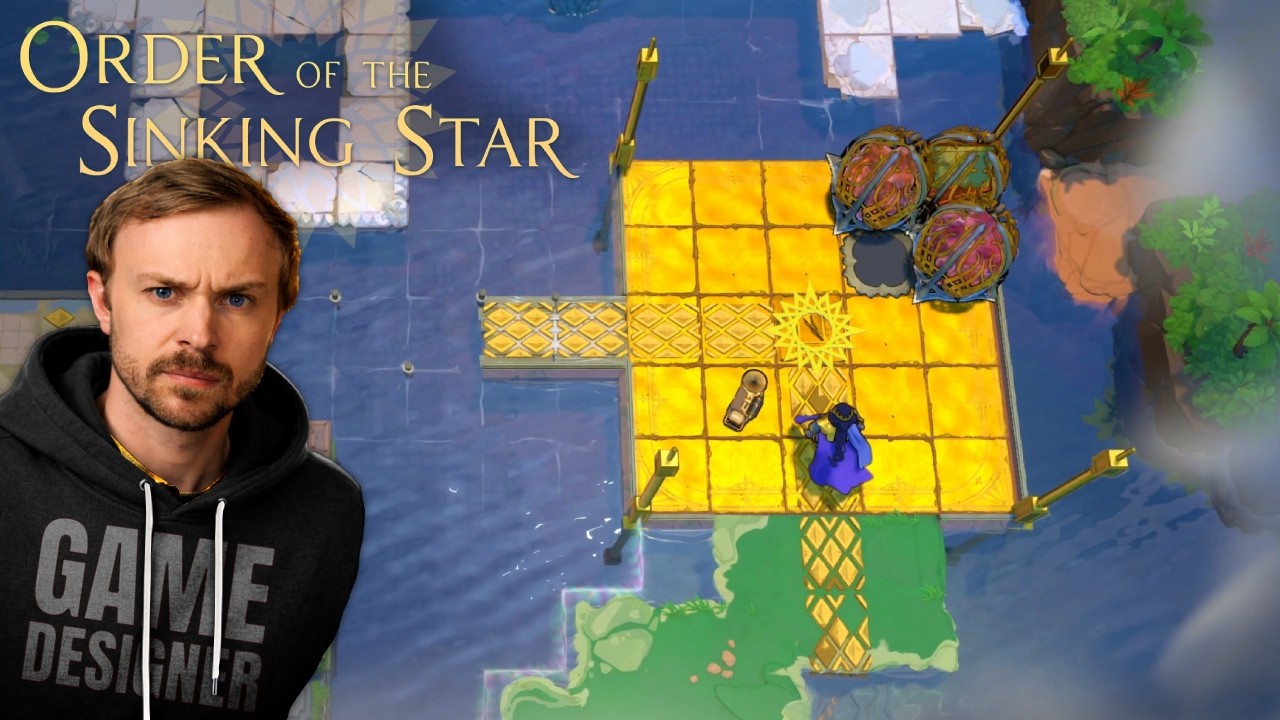
When Worlds Collide | Order of the Sinking Star Design Study #06
Keywords
Summary
211 words
Critical Evaluation
Value of the Information & Strength of the Argument
The video offers substantial value for those interested in game design and puzzle analysis. Noël’s approach is methodical: he formulates hypotheses, tests them, and revises his understanding based on observations. For instance, he initially assumes that mirror projection distance is based on the distance to the first mirror, then verifies this by counting steps and testing with multiple mirrors. He also demonstrates an awareness of common puzzle design tropes, such as the Sokoban-like deadlock, and explains why certain configurations are impossible. The argumentation is solid, as he clearly articulates his reasoning and often considers alternative solutions. However, the analysis is inherently subjective, and some interpretations (e.g., the symbolism of the lotus) are speculative, which he acknowledges. The value lies in the process of critical thinking and the insights into game mechanics, rather than in providing definitive answers.
Scientific Rigor, Source Quality, Title Accuracy
The video demonstrates a high level of rigor in its analysis, with Noël consistently testing his hypotheses and explaining his logic. However, it lacks external sources or citations; the only reference is a link to the full playlist of the Design Study series. The title ‘When Worlds Collide’ is appropriate, as it directly relates to the episode’s focus on the convergence of mechanics from different regions. The content matches the title, and the analysis is thorough and well-structured. No comments were provided for analysis.
236 words
Title / Content Match
The title 'When Worlds Collide' aptly captures the central theme of the episode, where the player encounters a level combining mechanics from two different regions, and the analysis focuses on this convergence.
Quality & Reliability
7/10
The video is a thoughtful, systematic analysis of game design by a self-identified game designer and programmer. It demonstrates deep engagement with the game's mechanics and narrative, and the reasoning is transparent and logical. However, it is based on subjective interpretation and lacks external verification or citations, which limits its scientific rigor.
Chapters
Cited Sources
- Order of the Sinking Star Design Study Playlist — The complete series of design study episodes, providing context and continuity for this analysis.
Contribution & Novelties
This episode contributes to the understanding of ‘Order of the Sinking Star’ by offering a detailed, player-centric analysis of its puzzle mechanics, particularly the mirror reflection system. Noël’s discovery that projection distance is based on the initial distance to the first mirror, regardless of intermediate mirrors, is a notable insight. He also provides a thoughtful interpretation of the game’s narrative and world structure, proposing an ‘onion-like’ layered design. The analysis is valuable for game designers and enthusiasts, as it illustrates how to approach puzzle solving systematically.
Pour aller plus loin :
- Sokoban — The classic puzzle game that shares mechanics with the game’s pushing and positioning challenges.
- Game design patterns — A framework for understanding recurring solutions in game design, relevant to the analysis of puzzle mechanics.
- Jonathan Blow — The game designer known for ‘The Witness’ and ‘Braid’, whose design philosophy is often discussed in the context of ‘Order of the Sinking Star’.
154 words
Radar Profile
The radar profile shows high scores in quantity of information and technical level, reflecting the detailed and systematic analysis. Quality of information is also strong, but reliability is slightly lower due to the lack of external sources and the subjective nature of the commentary.