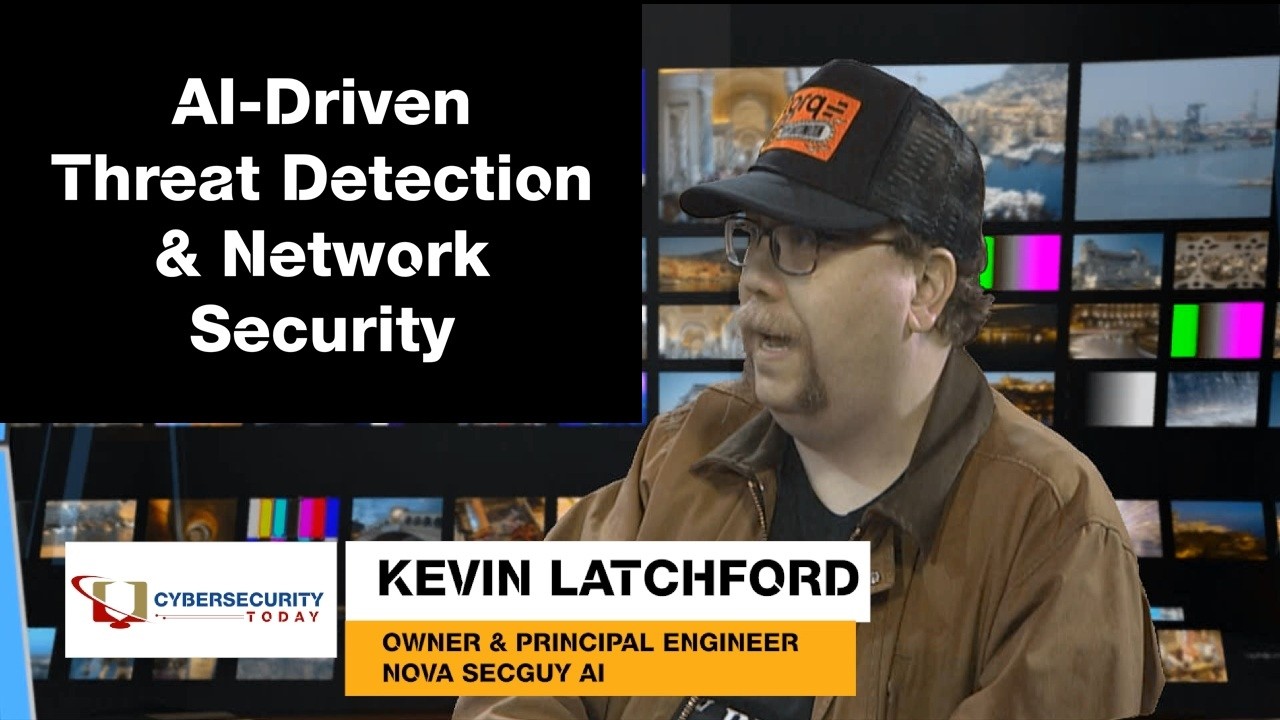
Cybersecurity Today TV - Ep 73 - AI-Driven Threat Detection & Network Security
Keywords
Summary
212 words
Critical Evaluation
Value of the Information & Strength of the Argument
The video provides valuable insights into the practical applications of AI in cybersecurity, particularly for small to medium-sized enterprises. Kevin Latchford offers a balanced perspective, discussing both the benefits and risks of AI in threat detection. He argues convincingly that AI can act as a force multiplier, especially in log analysis and automated penetration testing, but he also stresses the importance of human oversight and verification. The argumentation is coherent and grounded in his professional experience, though it lacks detailed technical depth and empirical evidence. The discussion on AI red teaming and the concept of MCP is particularly informative, offering a clear explanation of how AI can be used offensively. Overall, the value lies in its practical, real-world perspective, but it does not delve into advanced technical specifics or provide rigorous scientific backing.
Scientific Rigor, Source Quality, Title Accuracy
The scientific rigor is moderate. The guest, Kevin Latchford, is presented as an expert with nearly a decade of experience, which lends credibility, but the discussion is largely anecdotal and lacks citations to specific studies or frameworks. The sources mentioned are general tools and concepts (e.g., Giskard, Prompt Foo, Kali Linux, MCP) without detailed references. The title accurately reflects the content, which is a high-level overview of AI in cybersecurity. The adéquation between title and content is good, as the episode focuses on AI-driven threat detection and network security. However, the lack of concrete data or case studies limits the scientific rigor. The news segment provides current events but without in-depth analysis. Overall, the content is informative but not deeply scientific.
269 words
Title / Content Match
The title accurately reflects the content, which focuses on AI-driven threat detection and network security.
Quality & Reliability
6/10
The video is an interview with a practitioner sharing practical insights and opinions, but lacks rigorous scientific depth, detailed technical explanations, or verifiable data. The information is generally accurate and aligns with industry knowledge, but the reliability is moderate due to the informal nature and absence of citations.
Key Moments
Markers derived by PSI from the transcript: the creator did not define chapters.
- Introduction to the show and overview of the episode's structure.
- Cyber Bytes segment: news about a fintech breach, Princeton lawsuit, and French police database hack.
- Introduction of guest Kevin Latchford and start of the interview.
- Discussion on AI basics and its role in cybersecurity.
- Explanation of AI red teaming and the importance of testing AI systems.
- Discussion on jailbreaking AI and the risks of model poisoning.
- Benefits of AI in log ingestion and threat detection.
- Use of AI in automated penetration testing and MCP.
- AI's role in compliance and auditing, including CMMC.
- Skills needed for future professionals and final thoughts on AI's impact.
Cited Sources
- Giskard — Mentioned as a tool for AI red teaming and testing.
- Prompt Foo — Mentioned as a tool for AI red teaming and testing.
- Kali Linux — Mentioned as a platform for penetration testing with AI adapters.
- Model Context Protocol (MCP) — Explained as an adapter for LLMs to interact with systems.
Concurring Sources
- NIST AI Risk Management Framework — Provides guidelines for managing AI risks, aligning with the video's emphasis on AI security.
- OWASP Top 10 for Large Language Model Applications — Lists common vulnerabilities in LLM applications, supporting the discussion on AI red teaming.
Dissenting Sources
- AI is deterministic? — The guest claims AI is probabilistic, but some argue that with certain configurations, AI can be made more deterministic. This is a nuanced point.
Contribution & Novelties
The video provides a practical perspective on integrating AI into cybersecurity operations, emphasizing the need for AI red teaming and the use of tools like MCP for automated penetration testing. It highlights the dual role of AI as both a defensive and offensive tool, and discusses the importance of human oversight. The discussion on AI’s probabilistic nature and its implications for auditing is a valuable insight.
Pour aller plus loin :
- NIST AI Risk Management Framework — Relevant for understanding AI governance and risk management.
- OWASP Top 10 for Large Language Model Applications — Provides a list of common vulnerabilities in LLM-based systems.
- MITRE ATLAS — A knowledge base of adversary tactics and techniques for AI systems.
- CMMC (Cybersecurity Maturity Model Certification) — Relevant for understanding compliance requirements in defense supply chains.
132 words
Radar Profile
The radar profile shows moderate scores across all dimensions, indicating a balanced but not deeply technical presentation. The video offers practical insights but lacks rigorous scientific depth, making it suitable for a general audience interested in AI in cybersecurity.
💬 No comments were provided for analysis.