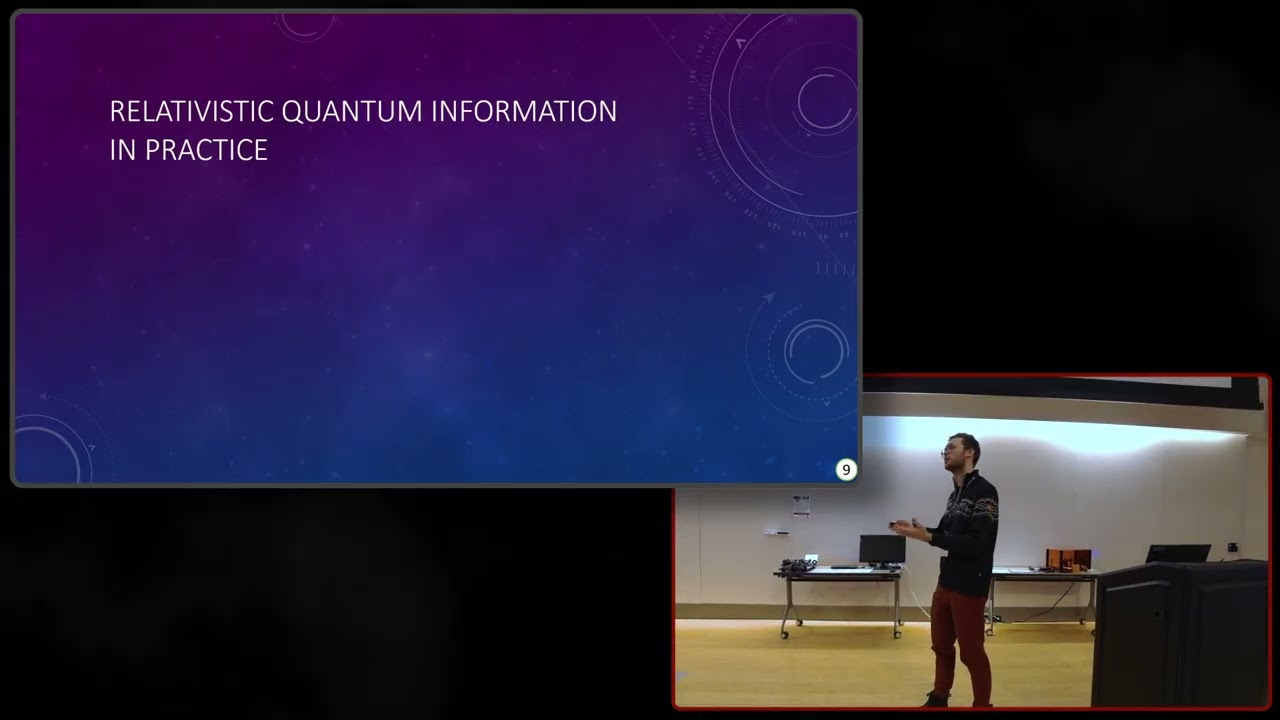
Quantum Probes of Spacetime: A Brief Introduction to Relativistic Quantum Information
Keywords
Summary
181 words
Critical Evaluation
Value of the Information & Strength of the Argument
The talk provides a clear and accessible overview of relativistic quantum information, highlighting its potential to probe quantum gravity. The argumentation is logical, starting with the fundamental problem and then presenting concrete research directions. The speaker effectively uses analogies and examples to explain complex concepts, making the value of the information high for a general scientific audience. The case studies illustrate the practical applications of quantum information tools in relativistic settings, strengthening the argument for their importance.
Scientific Rigor, Source Quality, Title Accuracy
The talk is scientifically rigorous, referencing key works such as Hawking’s original paper on radiation and the proposal for gravity-induced entanglement by Bose et al. The speaker is affiliated with a reputable institution (IQC), adding credibility. The title accurately reflects the content, which is a brief introduction to RQI. No comments were provided for analysis.
147 words
Title / Content Match
The title accurately reflects the content, which introduces how quantum probes can be used to study spacetime within the framework of relativistic quantum information.
Quality & Reliability
8/10
The talk is given by a researcher at the Institute for Quantum Computing, presenting established concepts and recent research in relativistic quantum information. The content is accurate and well-structured, though it is a high-level overview without detailed derivations.
Key Moments
Markers derived by PSI from the transcript: the creator did not define chapters.
- Introduction and punchline: qubits can be used to learn about quantum gravity.
- Historical context: Einstein's relativity and quantum mechanics as pillars of modern physics.
- Introduction to Hawking radiation and its significance.
- Explanation of using qubits as particle detectors to probe quantum fields.
- General pipeline for RQI problems: spacetime, quantum field, quantum probe.
- Case study 1: Entanglement degradation near black holes or under acceleration.
- Case study 2: Entanglement harvesting from quantum fields.
- Case study 3: Gravity-induced entanglement proposal.
- Conclusion and promotion of International Year of Quantum.
Cited Sources
- Hawking radiation paper — Mentioned as the original paper by Hawking on black hole radiation.
- Quantum Computation and Quantum Information — Referenced as a standard textbook on quantum information.
Concurring Sources
- Unruh effect — Mentioned indirectly through the analogy between acceleration and gravity.
Contribution & Novelties
The talk provides a concise and accessible introduction to relativistic quantum information, synthesizing key concepts and recent research. It highlights the potential of using quantum information tools to probe quantum gravity, which is an emerging field.
Pour aller plus loin :
- Unruh effect — Related to the acceleration analog of Hawking radiation.
- Quantum entanglement — Central concept in the discussed protocols.
- General relativity — Framework for spacetime description.
68 words
Radar Profile
The radar profile shows high scores in quality and reliability, moderate in quantity and technical level, indicating a well-presented but introductory talk.