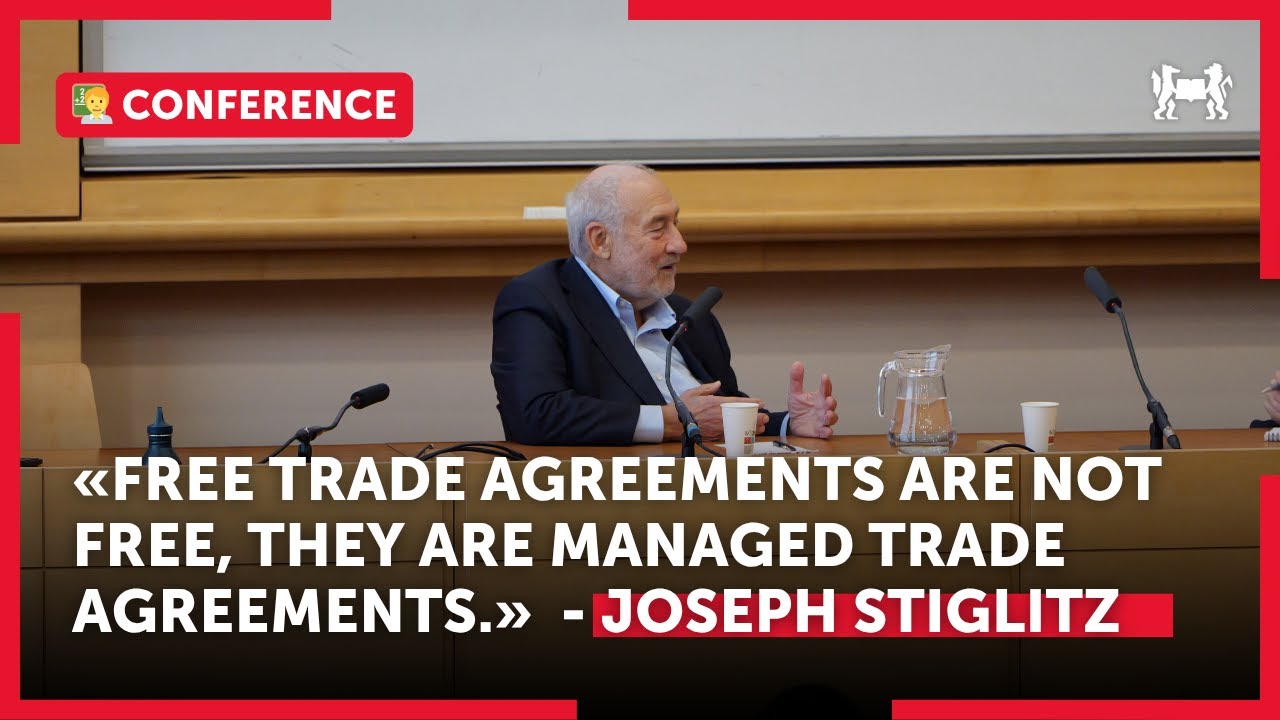
Fireside chat with Joseph Stiglitz - What economics for a good society
Keywords
Summary
171 words
Critical Evaluation
Value of the Information & Strength of the Argument
The value of the information is high, as Stiglitz provides expert insights into the economic and political dynamics of multilateralism. His arguments are well-structured and grounded in economic theory, such as the macroeconomic identity linking trade deficits to savings-investment gaps. He also offers a nuanced historical perspective, noting the bipartisan nature of US dissatisfaction with multilateral institutions. The argumentation is solid, with clear causal reasoning and concrete examples, such as the WTO appellate body and the carbon border adjustment mechanism. However, some claims are presented without detailed evidence, and the discussion is more conversational than rigorously cited.
106 words
Title / Content Match
The title accurately reflects the content: a fireside chat with Joseph Stiglitz discussing economic issues for a good society.
Quality & Reliability
8/10
Discussion by a Nobel laureate economist and a professor of economics, grounded in economic theory and historical context. The arguments are coherent and well-supported, though the format is an informal debate without formal citations.
Key Moments
Markers derived by PSI from the transcript: the creator did not define chapters.
- Introduction of Joseph Stiglitz and his background.
- Discussion on US dissatisfaction with multilateralism and historical context.
- Analysis of Trump's trade deficit misconceptions and macroeconomic explanation.
- Discussion on Europe's capitulation and defense dependence.
- Proposal for a new multilateralism based on self-enforcing clubs.
- Discussion on carbon border adjustment and incentives for cooperation.
Cited Sources
- Sciences Po App - App Store — Link to Sciences Po app in the video description.
- Sciences Po LinkedIn — Link to Sciences Po LinkedIn page in the video description.
- Sciences Po Snapchat — Link to Sciences Po Snapchat in the video description.
Concurring Sources
- World Trade Organization — Institutional context for trade rules and disputes.
Contribution & Novelties
The video provides a unique perspective from a Nobel laureate on the current crisis of multilateralism, offering both historical context and forward-looking proposals. Stiglitz’s emphasis on self-enforcing agreements and ‘clubs of the willing’ as a pragmatic path forward is a valuable contribution to the debate.
Pour aller plus loin :
- Multilateralism — Overview of the concept and its evolution.
- Thucydides Trap — The concept referenced by Stiglitz regarding US-China relations.
- Carbon Border Adjustment Mechanism — The policy discussed as an incentive for cooperation.
83 words
Radar Profile
The radar profile shows high scores in quantity and quality of information, reflecting the depth of the discussion. The technical level is moderate, making it accessible to a broad audience. The overall reliability is high due to the speaker's expertise.