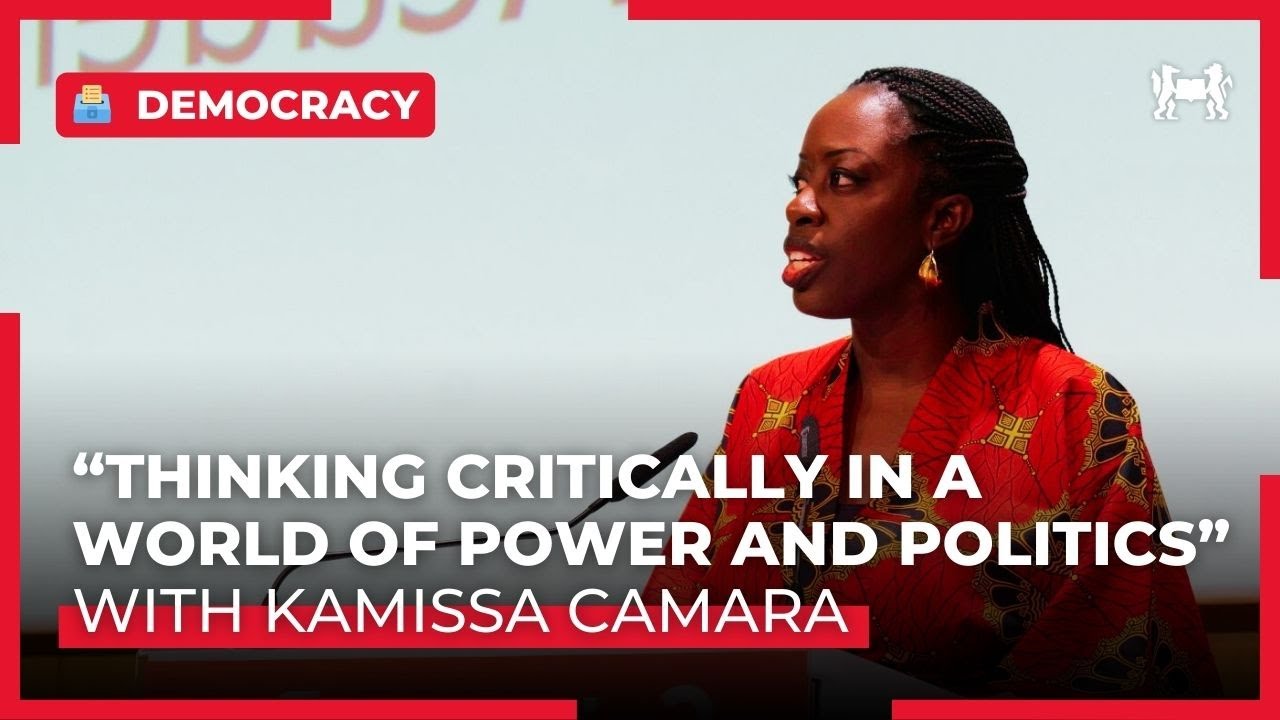
Kamissa Camara - Inaugural lecture of Reims campus
Keywords
Summary
180 words
Critical Evaluation
Value of the Information & Strength of the Argument
The lecture offers valuable insights into power from a practitioner’s perspective, blending personal experience with theoretical frameworks. Camara’s argumentation is coherent and persuasive, as she moves from personal narrative to broader political analysis. She effectively uses examples from her career to illustrate abstract concepts, such as the importance of reading the room and maintaining principles in negotiations. However, the argumentation is largely anecdotal and lacks systematic empirical support, which may limit its generalizability. The discussion of postcolonial thinkers is insightful but brief, and the advice given, while practical, is not novel.
Scientific Rigor, Source Quality, Title Accuracy
Camara demonstrates intellectual rigor by referencing key scholars in political science and postcolonial theory, such as Huntington, Nye, Mbembe, Fanon, and Bhabha. She accurately represents their core ideas, though she does not provide citations beyond the authors’ names. The title accurately reflects the content, as it is an inaugural lecture. The lecture is well-structured and the speaker’s credibility is high given her background. However, the lack of explicit sources and the subjective nature of some claims slightly reduce the overall rigor.
187 words
Title / Content Match
The title accurately reflects the content, as it is an inaugural lecture by Kamissa Camara at the Reims campus.
Quality & Reliability
8/10
The lecture is based on the speaker's extensive experience as a former foreign minister and academic researcher, providing credible insights into power dynamics. However, it is primarily an opinion piece with limited empirical evidence, and the sources cited are well-known but not systematically verified.
Chapters
- Opening & welcome
- The “student bubble”: time to think, read, reflect
- A meditation on power
- 9/11 as intellectual turning point
- Huntington’s “Clash of Civilizations”
- Nye and soft power
- Changing lenses: top-down vs. ground-up views
- Postcolonial thought (Mbembe, etc.)
- Fanon: power, dignity, sovereignty
- Bhabha: hybridity & the “in-between”
- Identities as prism (focus vs. blind spots)
- Women & power: readings and role models
- Practices of power: method, ethics, discipline
- UN Security Council—rite of passage
- Negotiating without trading away principles
- The weight of power & mental discipline
- Unquestioned power
- Research on coups: militarism & certainty
- Thinking as political practice
- Seven pieces of advice (network, reliability, generosity, purpose, curiosity, identities, legacy)
- Q&A
Cited Sources
- Sciences Po LinkedIn — Official LinkedIn page of Sciences Po, mentioned in the video description.
- Sciences Po Snapchat — Official Snapchat account of Sciences Po, mentioned in the video description.
- Sciences Po App on Apple App Store — Link to the Sciences Po app on the Apple App Store, mentioned in the video description.
Concurring Sources
- Sciences Po official website — The video description links to Sciences Po's official website, which provides information about the institution.
Contribution & Novelties
The lecture provides a unique perspective on power by combining personal experience as a female African diplomat with academic insights. It bridges Western and postcolonial theories, offering a nuanced view that is often missing in traditional political science education. The emphasis on ‘unquestioned power’ as a danger is a compelling concept that resonates with contemporary political issues.
Pour aller plus loin :
- Samuel Huntington - Clash of Civilizations — The book that sparked Camara’s initial understanding of power.
- Joseph Nye - Soft Power — Concept of soft power that Camara discusses.
- Frantz Fanon - The Wretched of the Earth — Key postcolonial text referenced.
- Homi K. Bhabha - The Location of Culture — Bhabha’s work on hybridity and cultural power.
- Achille Mbembe - Necropolitics — Mbembe’s concept of power over life and death, relevant to postcolonial thought.
137 words
Radar Profile
The radar profile shows high scores in quality and reliability, reflecting the speaker's expertise and credible sources, but lower scores in quantity and technical level, indicating a focus on qualitative insights rather than dense factual content.
💬 No comments were provided for analysis.