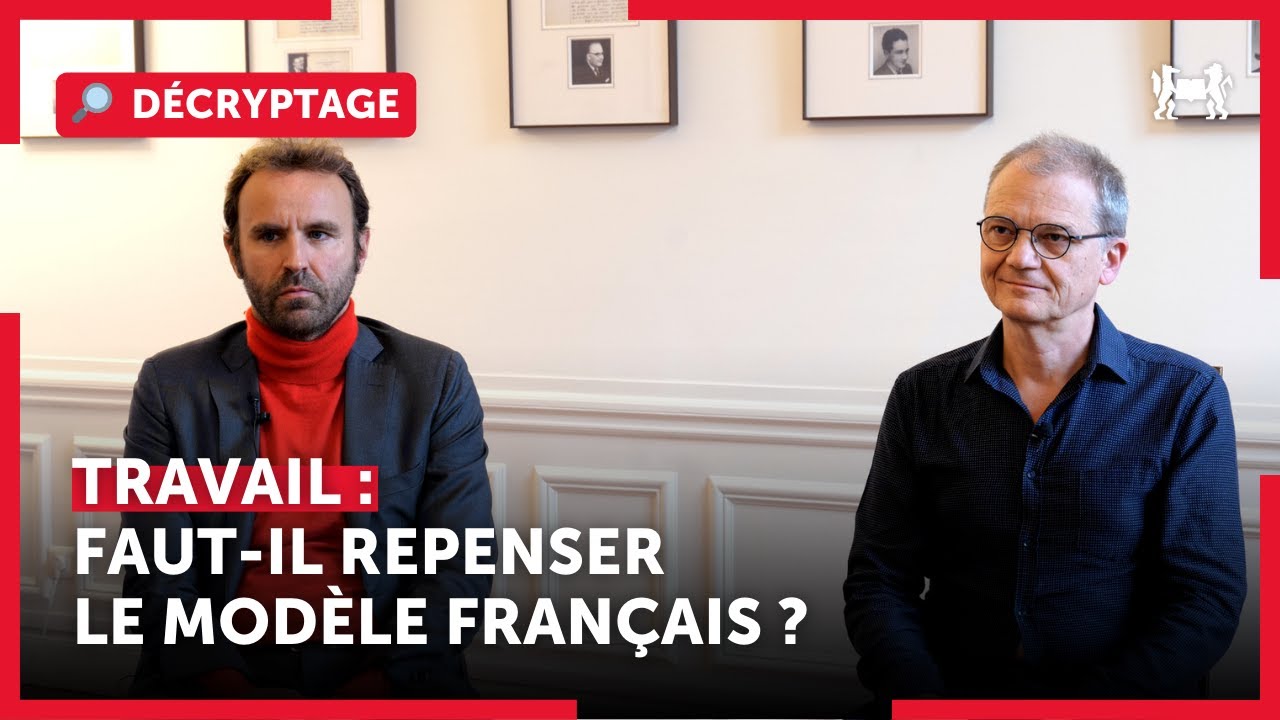
Travail : faut-il repenser le modèle français ?
Keywords
Summary
145 words
Critical Evaluation
Value of the Information & Strength of the Argument
The video provides valuable insights into the French work crisis, supported by empirical data and expert analysis. The argumentation is solid, with both speakers presenting coherent and complementary perspectives. They use concrete examples, such as the Orpea scandal, to illustrate their points. The debate is well-structured and addresses both long-term and short-term solutions, making it a rich source of information.
Scientific Rigor, Source Quality, Title Accuracy
The scientific rigor is high, as both speakers are recognized experts and rely on academic research and official statistics. The sources are not explicitly cited in the video, but the arguments are consistent with existing literature. The title accurately reflects the content, which is a debate on the French work model. The video is produced by Sciences Po, a reputable institution, adding to its credibility.
140 words
Title / Content Match
The title accurately reflects the content, which is a debate on the French work model and its potential reform.
Quality & Reliability
8/10
The video features two recognized experts in the field (a CNRS research director and a former chief of staff to the Minister of Labour), and the discussion is grounded in empirical data and academic research. However, it is a debate format with some normative proposals, and the sources are not systematically cited on screen.
Key Moments
Markers derived by PSI from the transcript: the creator did not define chapters.
- Introduction of the topic and the two experts.
- Discussion on the importance of work in French identity and the disappointment of workers.
- Analysis of the deterioration of working conditions and the increase in psychosocial risks.
- Critique of the low-cost model and proposal for a quality-based differentiation.
- Discussion on the need for reindustrialization and investment in skills.
- Proposal to reduce employee contributions and reallocate public spending.
- Debate on the trade-off between retirement and education spending.
- Conclusion and call for a new model of work.
Cited Sources
- Sciences Po LinkedIn — Official page of Sciences Po, the institution producing the video.
- Sciences Po Podcast — Podcast channel of Sciences Po, possibly related to the discussion.
- Sciences Po Snapchat — Social media channel of Sciences Po.
- Sciences Po App Store — Official app of Sciences Po on the App Store.
Concurring Sources
- OECD Skills Outlook — OECD reports on skills and competencies, supporting the discussion on PIAAC.
- Sciences Po CEE — Research center of Bruno Palier, providing academic background.
Dissenting Sources
- Alternative economic perspectives — Some economists may argue that reducing labor costs is necessary for competitiveness, contrary to the video's critique.
Contribution & Novelties
The video offers a nuanced and expert analysis of the French work crisis, combining sociological and policy perspectives. It proposes a concrete reorientation towards quality and social investment, with specific proposals for financing. The debate highlights the need to rethink the financing of social protection and the trade-offs between different public expenditures.
Pour aller plus loin :
- Investissement social — Concept central to the proposals of Bruno Palier.
- PIAAC — OECD survey on adult skills, mentioned by Antoine Foucher.
- Orpea scandal — Example used to illustrate the low-cost model in elderly care.
92 words
Radar Profile
The radar profile shows high scores in information quantity, quality, and reliability, with a moderate technical level. This indicates a well-informed and credible debate, accessible to a general audience but with some technical depth.