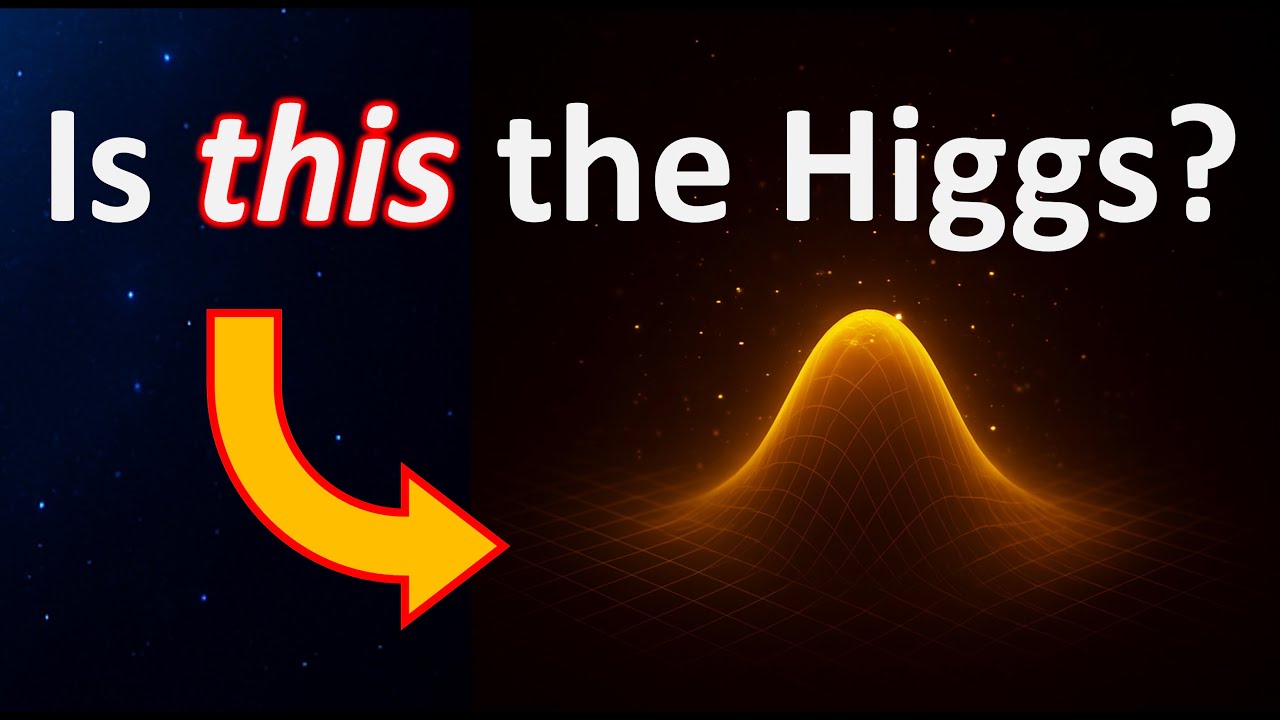
What the Higgs Boson Actually Is (No Analogies)
Keywords
Summary
134 words
Critical Evaluation
The video excels in providing a clear, mathematically grounded explanation of the Higgs mechanism, avoiding the oversimplifications common in popular science. It builds the concept from first principles, starting with wave equations and potentials, and systematically derives the mass of field quanta. The use of the Mexican hat potential is well-explained, and the connection between the curvature of the potential and particle mass is made explicit. The presentation is rigorous and accurate, consistent with standard quantum field theory textbooks. The sources cited are reputable, including textbooks by Srednicki, Lancaster & Blundell, and Zee, as well as a peer-reviewed article by Maldacena. The video also addresses common misconceptions, such as the ‘God particle’ nickname, and clarifies that the Higgs boson is not the source of mass but a ripple in the Higgs field. The mathematical level is appropriate for an audience with some background in calculus and physics, but it may be challenging for beginners. The adéquation between title and content is perfect: the video indeed explains the Higgs boson without analogies. The only minor criticism is that the video could have provided more context on the experimental evidence for the Higgs boson, but this is not a significant flaw. Overall, this is an excellent educational resource for those seeking a deeper understanding of the Higgs mechanism.
216 words
Title / Content Match
The title accurately reflects the content: the video explains the Higgs boson without relying on analogies, focusing on the mathematical and conceptual foundations.
Quality & Reliability
9/10
The video provides a rigorous, step-by-step derivation of the Higgs mechanism using wave equations and potentials, grounded in standard quantum field theory. It cites reputable textbooks and peer-reviewed articles, and the presentation is mathematically consistent. The content is accurate and well-structured, with no apparent errors or misleading claims.
Key Moments
Markers derived by PSI from the transcript: the creator did not define chapters.
- Introduction to the Higgs boson discovery and the goal of the video.
- Overview of quantum fields and particles as ripples.
- Explanation of wave equations and dispersion relations for massless and massive particles.
- Introduction of the potential function and its role in determining mass.
- Derivation of the mass formula from the curvature of the potential.
- Transition to the Higgs field and its nonzero vacuum expectation value.
- Explanation of how particles acquire mass through interaction with the Higgs field.
- Discussion of the Higgs boson as a ripple in the Higgs field.
- Conclusion summarizing the importance of the Higgs field for the universe.
Cited Sources
- Maldacena, J. (2016). The Symmetry and Simplicity of the Laws of Physics and the Higgs Boson. European Journal of Physics, 37(1), 015802. — Referenced in the video description as a source for the Higgs mechanism.
- Srednicki, M. (2007). Quantum Field Theory. Cambridge University Press. — Textbook cited in the description as a reference for quantum field theory.
- Lancaster, T. & Blundell, S. (2014). Quantum Field Theory for the Gifted Amateur. Oxford University Press. — Textbook cited in the description as a reference for quantum field theory.
- Zee, A. (2010). Quantum Field Theory in a Nutshell (2nd ed.). Princeton University Press. — Textbook cited in the description as a reference for quantum field theory.
- Ryder, L. H. (1996). Quantum Field Theory (2nd ed.). Cambridge University Press. — Textbook cited in the description as a reference for quantum field theory.
- Organtini, G. (2011). An Introduction to the Higgs Mechanism Based on Classical Physics Secondary School Curriculum. Sapienza Università di Roma & INFN–Sez. di Roma. — Paper cited in the description as a reference for the Higgs mechanism.
- Organtini, G. (2012). Unveiling the Higgs Mechanism to Students. Sapienza Università di Roma & INFN–Sez. di Roma. — Paper cited in the description as a reference for the Higgs mechanism.
- Strassler, M. Of Particular Significance (Blog Post) — Blog post cited in the description as a popular-level account.
- Strassler, M. (2024). Waves in an Impossible Sea: How Everyday Life Emerges from the Cosmic Ocean. — Book cited in the description as a popular-level account.
Concurring Sources
- Maldacena, J. (2016). The Symmetry and Simplicity of the Laws of Physics and the Higgs Boson. European Journal of Physics, 37(1), 015802. — Peer-reviewed article that supports the explanation of the Higgs mechanism.
Contribution & Novelties
The video provides a clear, mathematical explanation of the Higgs mechanism without relying on analogies, which is rare in popular science. It systematically derives the mass of field quanta from the curvature of the potential, making the concept accessible to those with basic calculus. The presentation is rigorous and grounded in standard quantum field theory, offering a deeper understanding than typical pop-science explanations.
Pour aller plus loin :
- Quantum field theory — Provides background on the framework used in the video.
- Higgs mechanism — Detailed article on the mechanism explained in the video.
- Standard Model — Context for the role of the Higgs field in particle physics.
- Mexican hat potential — Visualizes the potential function discussed in the video.
119 words
Radar Profile
The radar profile shows high scores in quantity and quality of information, with a slightly lower but still strong score in technical level. The overall fiabilité is high, indicating a reliable and informative video.
💬 Très positif. Sur les 30 commentaires analysés, la grande majorité exprime une forte appréciation, saluant la clarté et la rigueur de l'explication, bien que certains mentionnent une difficulté pour les débutants.